
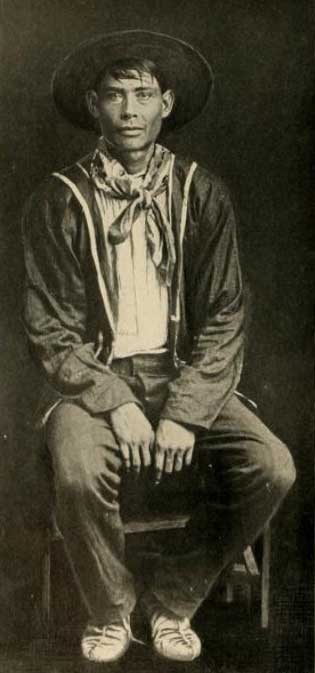
Yuchi Indians (‘situated yonder,’ probably given by some Indians of the tribe in answer to the inquiry “Who are you?” or ” Whence come you?”). A tribe coextensive with the Uchean family. Recent investigations point strongly to the conclusion that the Westo referred to by early Carolina explorers and settlers, and from whom Savannah river was originally named, were the Yuchi. It is uncertain whether the Stono, whose name is sometimes coupled with the Westo, were related to them, or whether the two tribes have been confused on account of a similarity in designation. The early writers also state that the Westo were driven out of their country in 1681 by the Savannah (Shawnee), but this must mean only a part of them. Another name applied to at least the northernmost Yuchi was Hogologee. These different names have caused much confusion, and standard maps of the 18th century have Westos, Hogologees, and Yuchi (or Uchee) noted independently. It is probable, however, that all of these were Yuchi, representing, instead of separate tribes, a number of successive migrations of Yuchi from Savannah river to the Chattahoochee – the Westo being, those driven out by the Shawnee, the Hogologee those who emigrated with the Apalachicola after the Yamasee war, and the Yuchi those who changed their place of abode between 1729 and 1750, just before and after the settlement of Georgia. Various attempts have been made to find a Yuchi derivation for words and names recorded by ancient chroniclers, but with the possible exception of Yupaha, the name of a country heard of by De Soto but not certainly reached, there is no good evidence in support of them.
The name of Cofitachique (Cofitachequi), which has generally been considered a Yuchi town, appears to be Muskhogean, and, if the identification of the Westo with the Yuchi is correct, there is good reason for believing that the people of Cofitachique were something else. Although there is known to have been one settlement of the Yuchi on Tennessee river, the rest of them apparently occupied one continuous area and seem to have constituted a homogeneous people. This area embraced the entire mid-course of Savannah river, and probably included most of the Ogeechee, which was sometimes known as Hughchee (i. e. Yuchi) River. In 1739 a Yuchi town, Mount Pleasant, existed on Savannah river 25 miles above Ebenezer, hence in Screven County, Georgia, probably near the mouth of Brier creek. Tracts on the west side of that river extending as far south as Ebenezer creek, Effingham County, and others above and below Augusta were claimed by the Yuchi as late as 1740. Hawkins in 1799 1 stated that Yuchi were formerly settled in small villages at Ponpon, Saltketchers (these two, however, were Yamasee centers), Silver Bluff, and Ogeechee, and were continually at war with the Cherokee, Catawba, and Creeks.
This gives them a wide range on both sides of Savannah river. Filson 2 said that the “Uchees occupy four different places of residence, at the head of St. John’s, the fork of St. Mary’s, the head of Cannouchee (Cannochee), and the head of St. Tilles [Satilla].” The principal Yuchi town among the Lower Creeks had in Hawkins’ time (1799) sent out three colonies eastward: Intatchkalgi, Padshilaika, and Tokogalgi (their Creek names). Another Yuchi town is mentioned by Morse (1822) near Miccosukee, Leon County, north Florida. Some of the Yuchi settled with the Savannah Indians on Tallapoosa river. Hawkins estimated the “gun-men” in Yuchi and these branch villages at 250. Bartram 3 points out their relations to the Creeks as follows: “They are in confederacy with the Creeks, but do not mix with them; and on account of their numbers and strength are of importance enough to excite and draw upon them the jealousy of the whole Muscogulge confederacy, and are usually at variance, yet are wise enough to unite against a common enemy to support the interest and glory of the general Creek confederacy.” Their town is described as the largest, most compact, and best situated Indian town he ever saw. Their population is stated by him to be from 1,000 to 1,500, and in this estimate he includes 500 warriors. The Creeks claimed to have subjugated the Yuchi and regarded them as slaves (salafki), probably only the western or Chattahoochee part, not those who lived among the Seminole and the Yamasee. In recent times this point was mooted even in the Creek legislature, and some members thought the Yuchi should receive no annuities, since they were slaves. The Yuchi were much attached to the ways and customs of their forefathers, and in 1813 they took sides with the Upper Creeks against the Government. Their towns were destroyed in consequence of this by the friendly Creeks. Hawkins 4 claims a better standard of morality for them than for many of the Creek towns, saying “these people are more civil and orderly than their neighbors, and their women are more chaste and the men better hunters. The men take part in the labors of the women, and are more constant in their attachment to their women than is usual among red people.” In 1836 they removed with the Creeks to the present Oklahoma, where fewer than 500 now reside in the north west part of the Creek Nation. Part live among the Shawnee on the west, the so-called Shawano Yuchi. Here they had a separate town body, with representatives in the Creek assembly. until the dissolution of the Creek Nation as such in 1906.
They exhibit a tendency toward conservatism and pride. Their loosely-marked settlements were named as follows:
- Arkansaw River
- Big Pond Town
- Blackjack Town
- Deep Fork Creek
- Duck Creek Town
- Intatchkalgi
- Mount Pleasant
- Ogeechee
- Padshilaika
- Polecat Creek
- Red Fork
- Silver Bluff
- Snake Creek
- Spring Garden Town
- Tokogalgi
Yuchi Indians Culture
In material culture the Yuchi are typical of the, agricultural hunting tribes of the south east Atlantic and Gulf coast area, living formerly in permanent villages surrounded by cultivated fields and always situated conveniently near some stream where fish abounded. Their houses were grouped about a square plot of ground, which was held as sacred, where religious ceremonies and social gatherings took place. The ordinary houses were of the common coast type, covered with bark or mats, but there was, besides, another more complex and permanent sort with sides plastered with clay. They were good potters, manufacturing various forms by the coiling process, nearly all, however, similar in shape to gourds, from which it is possible the forms were derived. Incised decorations occur only on or near the rim. Decorated effigy pipes of clay are still made, resembling closely some of those found in mounds in Georgia and the Carolinas. Basketry was made of cane and hickory splints, and the art was quite highly developed. Considerable wooden ware was also used. The original style of clothing has been supplanted for several generations by calico and trade goods made into shirts, outside hunting jackets, leggings, turban-like headgear, sashes, neckbands, garters, shoulder straps, and pouches, which are possibly survivals of older forms. Sashes, neckbands, leg-bands, hair pendants, pouches, and shoulder, bands are decorated with geometrical designs in bead embroidery representing animals and natural objects. Some of these designs are said to be worn in imitation of mythic characters and seem to be in a sense symbolical. An influence may have been exerted on Yuchi art by the prairie tribes since the removal to the west. Bows and arrows, clubs, and spears were their chief weapons. The blowgun was much in use in hunting. Dogs, too, were used in the chase, and hunting formulas were believed to affect the movements of the quarry. Fishing was commonly carried on by poisoning the stream with a species of tephrosia.
Each town has a sacred public square, or shrine, where social and religious meetings are held, on the four edges of which stand four ceremonial lodges covered with boughs. In these lodges the different clan groups have assigned places during public occasions. The square ground symbolizes the rainbow, where, in the sky-world, Sun, the mythical culture-hero, underwent the ceremonial ordeals which he handed down to the first Yuchi.
The chief power above that is recognized as the source of life and mystery is the Sun. There seems, as well, to be some unworshiped but acknowledged supernatural source of power from which mechanical magic flows. But the Sun, in his plural concept as chief of the skyworld, the author of the life, the ceremonies, and culture of the people, is by far the most important figure in their religious life. The various animals of the sky-world are important in myth, but in practice the Yuchi do not recognize in them anything more to be feared than in the numerous spirits which dominate other natural objects in their surroundings. Vegetation spirits are closely concerned in their daily and ceremonial life, as is shown in the annual new-fire and harvest ceremony. Besides these, totemic ancestral spirits play a rather important part.
Public religious worship is performed by the whole, town in a complex annual ceremony connected with the corn harvest, the different rites of which occupy three days and the intervening nights. The square ground is the scene of action. Ceremonial making of new fire, clan dances mimicking totemic ancestors, dances propitiating evilly-inclined spirits and thanking various beneficent ones as well as inducing them to continue their benefits, scarification of the males for sacrifice and purification, taking an emetic as a purifier, the partaking of the first green corn of the season, and the performance of a characteristic ball game with two sticks, are the main elements of the annual ceremony. Young men are admitted to the ranks of manhood at this time. This important event is carried on in distinct emulation of the Sun to insure a continuance of tribal existence. The sentiment of obedience to the Sun is peculiarly prominent with the Yuchi.
Disease is accredited to the presence of a harmful spirit which has been placed in the system by some offended animal spirit or malevolent conjurer. Herbs, which have names corresponding in some way to the name of the animal causing the trouble, are brewed in a pot and administered internally. By this means of sympathetic healing and by the use of song formulas the disease spirit is driven out by the shaman.
During her catamenial periods, and at childbirth also, the woman secludes herself from her family and house. She lives alone in a temporary hut under a taboo of certain foods. At the birth of the child its navel cord is ceremonially disposed of, and the father is henceforth prohibited from association with his friends, besides having restrictions for a month against the use of certain foods, manual labor, and hunting. The children’s cradle is the hammock. On the fourth day after its birth the child is named after a maternal granduncle or grandaunt. Unmarried girls are marked off from others with red paint. The marriage rite is a very simple one, the couple being of different clans, of course, merely agreeing to unite and for a while usually reside in the woman’s home. The dead were formerly buried underneath the floor of the house with a supply of food and clothes. Nowadays, however, burial is made in a cemetery, with rites similar to those of former times, and a small log hut is raised over the spot. Here a fire is kept burning for four days, during which time the spirit is on its journey eastward to the land of the dead up above where the Sun is. There are four souls, but only one passes on to the future life, having as a finale to pass an obstacle at the entrance to the sky. If this point is passed in safety the journey is over, otherwise it returns to earth a menace to the happiness of the living.
In Yuchi mythology there is a sharp contrast between culture hero and trickster. In the more sacred cosmological myths considerable unity is found, but the trickster tales are loose and often fragmentary. Creations are ascribed mostly to the assembled pre-earthly animals. Earth is brought up from a watery waste by crawfish. The Sun seen is to be connected in some way with the culture hero. He created time Yuchi, having caused their forebears to spring from a drop of menstrual blood in the sky world, whence they were transferred to this earth. He is likewise the author of the human class and clan system and the religious rites, but he does not appear prominently as a transformer. He is furthermore the giver of all that is materially good and beneficial in their lives. The trickster, on the other hand, is named Rabbit. He effects a few transformations in the course of his mischief-making career, without any particular motive. Other myths are held by the various clans, and repeated generally in praise of their totem. Many myth elements from Negro sources may have been embodied by these Indians in their animal tales, probably through contact with the Creek negroes. Other types of widely distributed myths are the race between two animal rivals, the imitation of the host, the magic flight, stealing of fire, tarman story, the legend about an emigration of part of the tribe, the origin of death resulting from someone’s mistake, and the explanation of various peculiarities possessed by the present-day animals. See Westo, Yupaha.
For Further Study
The following articles and manuscripts will shed additional light on the Yuchi as both an ethnological study, and as a people.
- Ethnology of the Yuchi Indians
in 1904 and 1905 Frank G. Speck received first hand accounts from the Yuchi Indians in Oklahoma concerning their culture, customs, history and religious practices. After performing due diligence and comparing what he was told with previously published and unpublished material on the Yuchi Indians he published his Ethnology of the Yuchi Indians. If researching the Yuchi Indians, then this is the premiere source of material for you. - Ceremonial Songs of the Creek and Yuchi Indians

- Hawkins, Sketch, 61, 1848[↩]
- Filson, Discovery of Kentucky, 1793[↩]
- Bartram, Travels, 387, 1792[↩]
- Hawkins, Sketch, 62, 1799[↩]
