
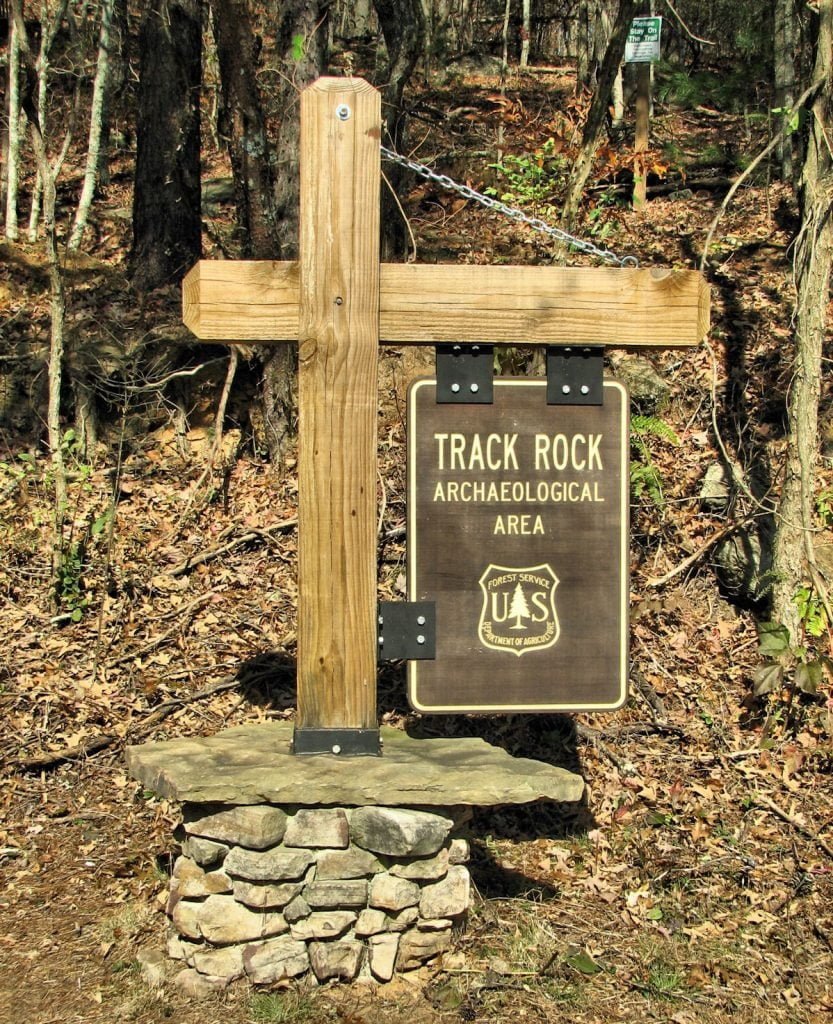
June 21, 2011, Yupaha – It was a magnificent Summer Solstice in the Georgia Mountains. There was barely a cloud in the sky. After hoeing my little garden next to the former egg hatchery in which I was “camped out,” I decided to celebrate the arrival of summer by taking the three canine musketeers for a hike near the source of the Nantahala River in North Carolina. It was in a 3,600 feet high gap along US 64 between Murphy and Franklin. It had been the dogs’ favorite camp site a year earlier when we were living in a tent.
The little chicken hatchery was only about a mile from Track Rock Gap Road. The most direct route to the Nantahala River’s source passed through Track Rock Gap, where the famous petroglyphs are located. On the way back from the excursion, the whim suddenly hit me of taking another look at the petroglyphs. Even though I now lived only about five minutes from the petroglyphs, I had not seen them in about five years. The petroglyphs had deteriorated further in those five years. There was not much to look at.
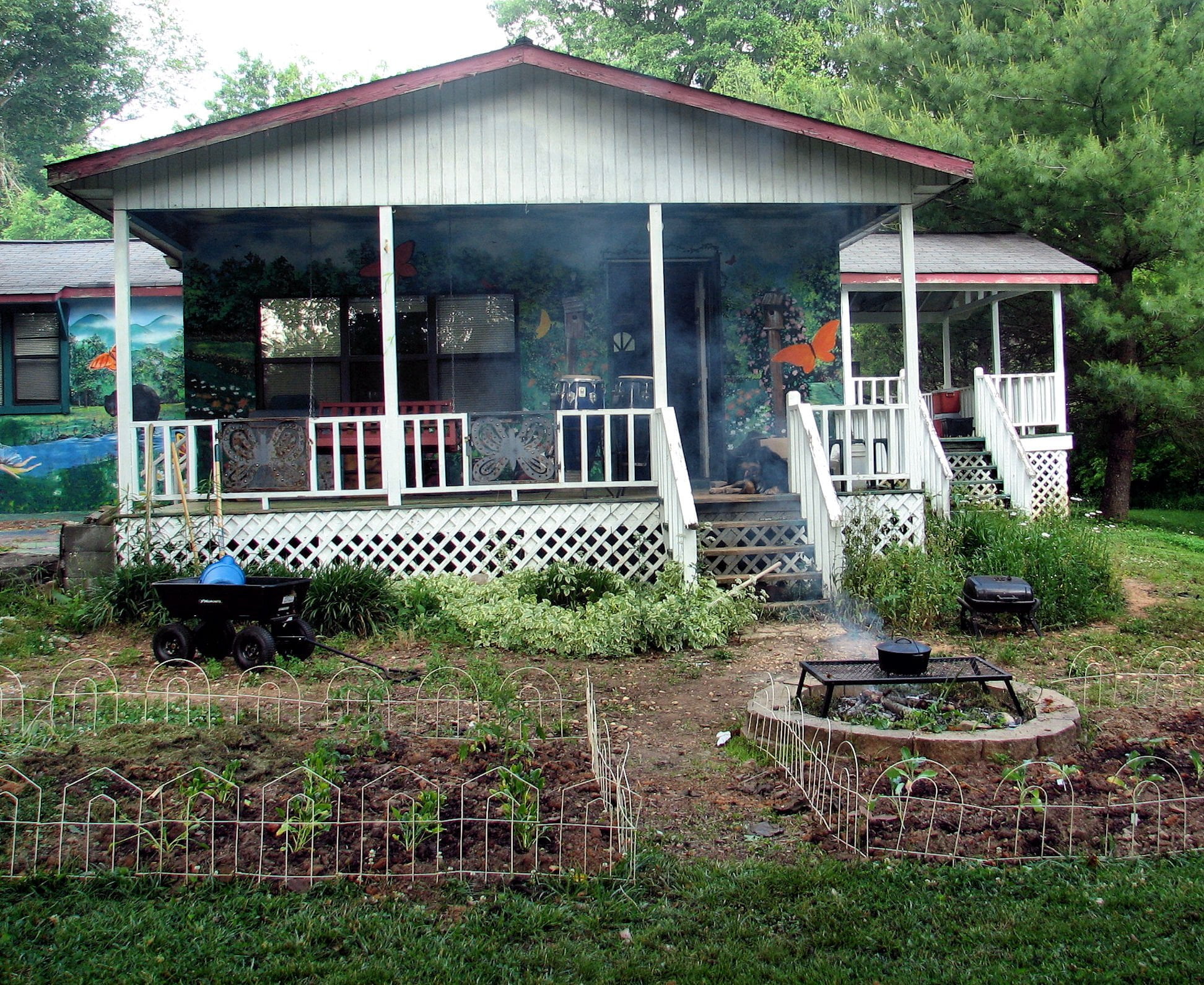
In pantomime language that only a trainer of herd dogs would understand, my canine companions told me that they were thirsty and also wanted to relieve themselves. I noticed what appeared to be a ravine across the road from the U.S. Forest Service parking lot at Track Rock Gap. In the Georgia Mountains, ravines almost always mean a spring or brook is nearby.
We had to walk about a 100 yards southward to reach a power line right of way, which could give access to Track Rock Gap Branch. A “branch” is a “brook” in the Southern English dialect. Within the mowed grass of the right of way, I immediately noticed the footprint of a long fieldstone wall. All that was left was its foundation. Apparently the Blue Ridge Electric Membership Cooperative had removed the upper levels of the wall, when clearing the right of way. The rock work was very old. Closer to the ravine was the footprint of a shorter wall. The area around Track Rock Gap Branch had been altered at some time in the past. It appeared to have been dammed long ago. Also, the sides of the presumed retention pond had been straightened. Immediately beyond the stream, I found some extremely old fieldstone retaining walls. They were curved and formed terraces on the slope… What have I found I asked myself? Come take a look and read about the Trail to Yupaha.
The Trail to Yupaha – Table of Contents

Track Rock Archaeological Site Georgia Cultural Periods
From the ealiest Paleo-Indian period the writer steps the reader through the various cultural periods as they influenced Georgia’s indigenous Peoples… Archaic, Woodland, Southeast Cermemonial, Etowah, and Lamar Culture periods are covered as well as through the early European contact periods. A firm understanding of the different cultural periods in Georgia’s Native American history is important in identifying when the Track Rock Gap area was populated.- The “Discovery” of Track Rock Gap
In June of 2011, very few people outside some of the staff at the U.S. Forest Service Office in Gainesville, GA even knew that there was a large complex of stone structures on the east side of Track Rock Gap. Even though the staff has had an archaeological report about this extremely important site for over a decade, it had allowed vines and scrub vegetation to continue growing in the stone ruins. No university archaeological program was invited to study the Track Rock terrace complex any further. Apparently, most Georgia archaeologists were unaware that such an unusual complex was located in their state until December of 2011. No sign at the boundary of this archaeological zone was installed until spring of 2012. - Archaeological Evidence
While on the lookout for possible 17th century Spanish Sephardic gold mining village sites, the writer found enigmatic field stone walls across the road from the Track Rock Petroglyphs. He asked around Union County, where he lived, for any information about artifacts found near the walls. Soon a gentleman living near Track Rock Gap emailed him an archaeological report prepared after a survey of Track Rock Gap in 2000 and 2001 by Johannes Loubser. - Facts and Myths About Track Rock Gap
The second part of the Loubser report discussed some Cherokee legends about the Track Rock Gap petroglyphs and terraces that claim a Cherokee origin. However, he left out an important Cherokee legend that remembers the Track Rock terraces as the ruins of a “Creek” town. This section analyzes Cherokee traditions about this archaeological zone. - Yupaha, AKA Great Copal
This section examines a legend from the Kashita branch of the Creek Confederacy, which seems to refer to the Track Rock site. French and Spanish colonial archives that relate to the Track Rock area will also be discussed. - A Summer Fellowship
One never knows when some seemingly insignificant experience will one day in the future have great significance. The writer finds himself in such a circumstance when provided a fellowship by Georgia Tech to spend a summer studying the indigenous architecture and town planning of Mesoamerica. During this fellowship he met Dr. Roman Piña-Chan of the Museo Nacional de Antropologia, and the questions pondered by the good Doctor has left a stalwart impression on the writer’s mind. Why were there cultural similarities between the Mayan and Creek cultures? - Archaeological site 9UN367
Archaeological site 9UN367, the Track Rock Terrace Complex, is unlike any documented Mississippian Period community in the United States. In fact, there is a high probability that the term “Mississippian” will go out of vogue after Track Rock is thoroughly studied. The first step in understanding the site was a geo-spatial analysis of the terraces in the context of indigenous communities that were developing at the same time the terraces were being constructed and cultivated. - Track Rock Gap Archaeological Zone
Throughout all of the summer and early fall, dense vegetation, merciless blackberry vines and poison ivy made it impossible to see much of archaeological site 9UN367. In fact, the writer could not even find the Vent Trail, which was supposed to give access to the heart of the archaeological zone. The U.S. Forest Service had not erected a sign, which denoted where the Vent Trail branched off from the Arkaquah Trail. By the beginning of the fourth week in November of 2011, several hard freezes and a torrential rain storm had eliminated most of the undergrowth on the sides of Track Rock Gap. It was finally possible to visit all sections of the site. The writer climbed the full height of the known archaeological zone on Thanksgiving Day, November 24, 2011… what he found is controverting the traditional archaeological view of the Georgia Mountains and the Native Americans who lived there. - An Overview of Mesoamerican History
A series of television documentaries timed to coincide with the recycling of the Maya Long Count calendar have given the general public an impression that southern Mesoamerica became a uninhabited desert after around 900 AD. That was not the case. Many large cities in the southern half of Maya country were abandoned. Apparently, most of the elite were either killed or deported. Construction of sophisticated ceremonial architecture ceased. Many areas of the Highlands that were devastated by volcanic eruptions were temporary abandoned. It was NOT, however, the end of the Mesoamerican world. - Linguistic Evidence of a Maya – Creek Connection
The languages of both Itsate and Muskogee are in part “borrowed” languages. Meaning they’ve derived part of their language from parts of other languages. But most surprisingly, is the elements of Mesoamerican languages prevalent in the prefix and suffix of the Itsate language. The writer has provided an overview of some prefix and suffix “borrowing” as well as place names which contain Mesoamerican influence.

