
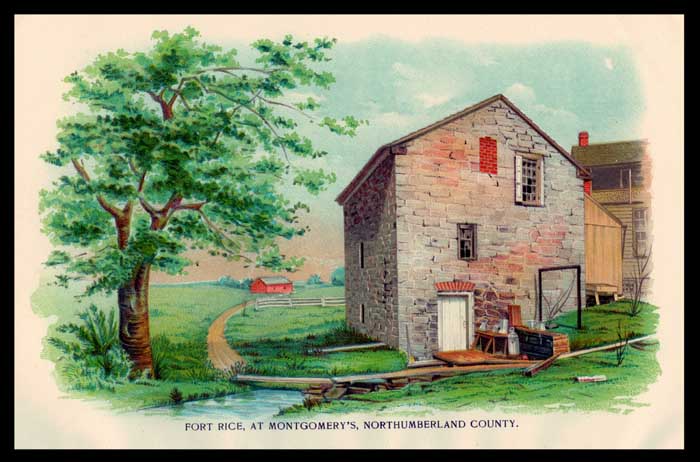
Fort Rice, at Montgomery’s, sometimes written of by one name by the military and other authorities and at another by the other until it was supposed to indicate two separate forts. It is located in Lewis Township, Northumberland County. Pennsylvania.
In 1769 William Patterson patented seven hundred acres of land on which Fort Rice was situated. On account of its handsome appearance and the fertility of its soil he named it Paradise. Meginness is correct in saying “For rural beauty, fertility of soil and charming surroundings, with healthfulness, it is not excelled by any district in the United States, and the name Paradise was worthily bestowed.” The country is gently rolling and under a high state of cultivation. Neat farm mansions with capacious barns are seen in all directions, and what adds to the beauty of the scene are the open groves of oak and other hard wood, free from underbrush, and a regularity almost equal to being planted by the hand of man, among which scores of gray squirrels may be seen sporting in the woods without fear of the pot hunters or poachers. Mr. Patterson exchanged this Paradise farm with John Montgomery, of Paxtang, in 1771, for his farm in that settlement. The descendants of John Montgomery still reside on these lands. The Montgomery family became widely known for their ability and integrity. At the time of the capture of Fort Freeland, July 28, 1779, John Montgomery living here, heard the firing; mounting two of his young sons on horses he sent them to the top of a hill to “learn the cause of the tiring. On arriving at the brow of the hill overlooking the creek they discovered the fort on fire and a fight raging in the timber some distance below. They returned and reported what they had seen; he loaded up his family in a wagon, with what provision and clothing they could carry and hurriedly drove across the country to the cabin of William Davis. After informing him what was going on he gathered up his family and proceeded to Fort Augusta.” – (Meginness.)
The Indians burned Mr. Montgomery’s house; he took his family to Paxtang, where they remained to the close of the war. The Indians burned the house and everything; in consequence of the fall of Fort Freeland it became necessary to fill its place by another. McClung’s place, which, I understand, was between Freeland and the Montgomery farm, was first selected, but it was decided to be impracticable, when, finally the Montgomery farm was selected, and here Captain Rice, of Col. Weltner’s German Regiment, erected it in the fall and winter of 1771) and 80. It was built around and enclosed the fine spring at the burned residence of John Montgomery, and remains today a lasting tribute to the excellent of the work of Capt. Rice’s Pennsylvania Germans. First, building a stockade for security they completed it, building it out of surface limestone. They occupied and defended it ably. The only attack made on the fort itself we have any record of occurred in the beginning of September 1780. A letter from Col. Samuel Hunter, at Sunbury, Sept. 21, 1780, found in Vol. viii, p. 567, Pennsylvania. Archives, saying: “We were alarmed by a large party of the enemy making their appearance in our county on the 6th inst. They came first to a small fort that Col. Weltner’s troops had erected on the headwaters of the Chilisquake, called Fort Rice, about thirteen miles from Sunbury (17), when the German Regiment marched off the enemy attacked the fort about sundown and fired very smartly. The garrison returned the fire with spirit, which made there withdraw a little off, and in the night they began to set fire to a number of houses and stacks of grain which they consumed. In the meantime our militia had collected to the number of one hundred men under the command of Col. John Kelly, who marched to the relief of the Garrison, and arrived there next day. The people in the Garrison acquainted Col. Kelly that there must be two hundred and fifty or three Hundred of the enemy, which he did not think prudent to engage without being reinforced. The confusion this put the inhabitants in, it was not easy to collect a party equal to fight the savages. I immediately sent off an express to Col. Purdy on Juneate whom I heard was marching to the Frontiers of Cumberland County with the militia, he came as quick as possible to our assistance with one Hundred and ten of the militia and about Eighty Volunteers, which was no small reinforcement to us. Genl. Potter just coming home from camp at this critical time came up to Sunbury and took command of the party that went in quest of the enemy, But previous to his marching, discharge the Volunteers as he concluded by the information he had received from spies we had out that the enemy did not exceed one hundred and fifty and that they had withdrawn from the inhabitants to some remote place. General Potter, However, marched on to Muncy Hills, but was a little baffled by the information of their route and did not come on their track till the l3th and followed on about 50 miles up Fishing Creek, the road the enemy took, but finding they had got too far ahead returned here the 17th inst. The enemy got but one scalp and one prisoner (The Colonel did not know of their having committed the Sugarloaf Massacre when he wrote). We all concluded the enemy had gone off, but on the 18th there was a small party made their appearance on the West Branch about fourteen miles above this place, they killed one man and wounded another, and killed their horses they had in the plow, which plainly shows they have’ scattered into small parties to harass the inhabitants, which I am afraid will prevent the people from getting crops put in the ground this fall. When the German Regiment marched off from here I give orders for the Frontiers Companies to embody and keep one-fourth of the men constantly reconnoitering. After garrisoning Fort Jenkins, Fort Rice, and Fort Schwartz with twenty men in each of them, this was the only method I could think of encouraging the people as we were left to our own exertions. Only about thirty of Capt. McCoys company of Volunteers from Cumberland County, until the 10th Inst, that two companies of militia came here from the same county in the whole about eighty men. When I received the intelligence of a large party of savages and Tories coming against Fort Rice, I give orders to evacuate Fort Jenkins as I did not look upon it to be tenable, which is since burned by the enemy, and would have shared the same had the men staid there on act of the buildings that were adjoining it, &c.”
As to the numbers attacking Fort Rice, Genl. Potter (Vol. viii, p. 563), says: “Since I wrote the above I am informed by Capt. Robeson that a large body of the enemy crossed the Moncey Hills near one Evses and went up the Moncey Creek so that it is leekly (likely) that the number that was down amounted to 300 men – they carried off a large number of Cattle and Horses.”
John Montgomery returned with his family on the return of peace. Finding the buildings of his farm destroyed and a good strong stone house supplying its place; he at once occupied the fort, which, with additions, made him a comfortable home for years. Capt. Rice leaving the country, Montgomery remained and it soon became known as Montgomery’s fort. The old actors in the bloody drama enacted in this region having passed away, Fort Rice was forgotten except as found in the old records, which placed it thirteen miles from Sunbury and on the head waters of the Chillisquaque – both erroneous. Fort Rice was lost as to site to the present generation. After considerable research I became satisfied Fort Rice and Montgomery must mean the same place.
Hon. John Blair Linn, of Bellefonte, at this time sent me a newspaper cutting, recording an examination of the subject by J. F. Wolfinger, of Milton, in about 1885 (since dead). I have found his statement correct in the main and here present it: “Our ancestors and first settlers on the West and North branches of the Susquehanna River had two great runaway times from the Indians. The first took place in 1778 and the second one in 1779. * * * John F. Montgomery must certainly have known how and why this stone building was built over his spring, but as he died in November 1792, and left no writings with any person to show that the German Battalion had built it and had a fort and barracks standing close by his spring (falling into the error that there was a Fort Rice and a Fort Montgomery close together, he mistook the defenses erected to protect the soldiers and their arms and commissary while building Fort Rice for the Fort Montgomery which Rice is). The knowledge of these facts was entirely unknown to the coming generations of people in this beautiful region of country called Paradise, and, hence, a great many different stories very naturally arose as to when the old stone building in question was built and by whom it was built and why it had small port holes in its walls and the like. July 13, 1885. On this day I visited this old Fort Montgomery or Rice ground, accompanied by my old friend, the Hon. David B. Montgomery, a grandson of the above John F. Montgomery, and who, I mean David B. M. has for many years resided about a hundred and fifty yards south of the spot. Spring House Buildings – A Grand relic. This building is 26×23 feet outside measurement and is two stories (and an Attic of 4 feet) high, being 22 feet high from the ground up to its square on the west side and on a part of its northern end, it is now used as, and forms in its lower story a splendid spring house for keeping milk, cream, batter, meats and the like in a very nice and cool condition and it afforded me a good deal of pleasure to have a drink from its clear, cool and refreshing waters.
“The walls of the fort are two feet chick and are composed of rather small dull colored limestone, as no quarries were open at that early day to get stones of a large size and of a clear strong blue color. But its walls are still solid and in a very good condition, considering their age and the hasty manner in which Capt. Rice’s German soldiers made them. The door to the spring was and still is in the south end of the building and it had when built in 1770 a wooden stairway that extended from the ground on its eastern side up to the second story, where there was another door for the purpose of storing away there for safe keeping such things as Capt. Rice and his men needed for their use and comfort. But this stairway is gone long ago and the doorway on the second story was also changed long ago into a window, but on the east side it had and still has two windows with twelve panes of glass in each window and all the windows were of the old-fashioned sort, 7½x8½ inches in size, but one or two of these smaller sized windows have been walled shut with bricks. The northern end of the second story (third story or attic) still has two small port holes made there, no doubt, to enable soldiers standing there to stick their guns through the holes and fire at any Indians that might come there with an evil design, but it is probable that every other side of the building had smaller port holes for this same purpose, but they are all gone now excepting the two just noticed. Mr. Henry Raup, who lives in a fine two-story brick house on the east side of the spring house, called my attention to the fact that a smooth-faced stone in the central part of the southern end wall and about eighty feet above the ground, contained on its face the letters W. R. that were so thinly cut into the stone as to make them after so long a time now have but a faint appearance. As W. and R. are the initials of Capt. William Rice, I now found the evidence strong enough to satisfy me that Fort Rice, Montgomery, you can call it now by either of those names just as you please, actually stood here and nowhere else, on the west side of the road that runs in front of Raup’s house up north to and beyond Turbotville. Some time after John F. Montgomery had returned from his runaway from the Indians, he built a stone addition to the northern end of the above described spring house (fort) building, an addition large enough to make a tine eating room for his family and work hands, and then to make things handy for the women he cut a hole through the wall of the fort and put a door there to go into the spring house for milk, butter, &c. This additional room was torn away long ago and the above doorway was walled up again but a portion of the plastering of this room still sticks to the northern wall of the old fort. Capt. Rice’s old building aforesaid thus forms a grand and very interesting relic of our olden time building that every man in the county should be proud of and feel a great pleasure in visiting.” I visited the place in 1894 with James I. Higbee, of Watsontown, and Mr. Yarrington, of the same place and secured a picture of probably the best-preserved fort of its date in the State. I found it two stories and an attic of four feet or more at the square of the building, could recognize the old portholes in the walls of the second story. The old-fashioned chimney was in the northern end, the spring covered about half the space inside the walls of the lower story. We hung “Old Glory” out of one of the old portholes, I suppose the first time since the close of the Revolution. Capt. Rice’s name was Frederick William Rice.
