
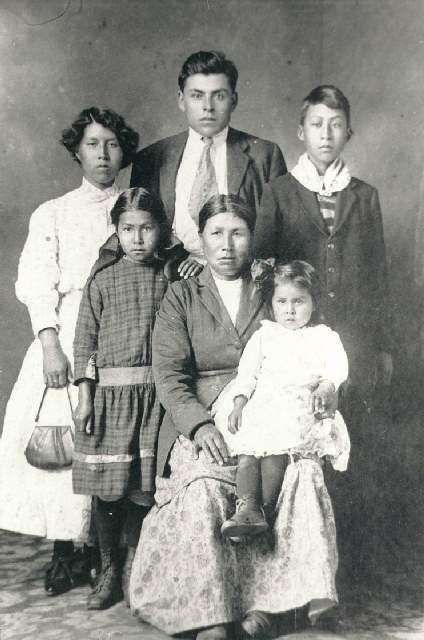
Okanagon Indians, Okanagon Tribe, Okinagan Tribe, Okinagan Indians. From the native term Okanā’qēn, Okaāqē’nix, or Okinā’qēn. The name is derived from some place on the Okanogan River, near Okanogan Falls at the mouth of the Similkameen, where is said to have been the headquarters of a large band of the tribe and is even given as the place of origin of the entire tribe. Also called:
- Akênuq’łā’lām or KōkEnu’k’kē, by Kutenai (Chamberlain, 1892).
- Isonkuafli, own name, meaning “our people.”
- Känk.’utlā’atlam, Kutenai name, meaning “flatheads” (Boas, 1911).
- KEnāke’n, by Tobacco Plains Band of Klickitat.
- OtcEnake’, OtcEna.gai’n, or UtcEnā’.gai’n, by the Salish and their allies.
- Soo-wān’-a-mooh, Shuswap name.
- .SoqEnāqai’mEx, Columbia name.
- Tcutzwā’ut, Tcitxûā’ut, Tsawa’nEmux, or OkEnā.gai’n, Ntlakyapamuk names.
- WEtc.nāqei’n, Skitswish name.
Okanagon Connections
The Okanagon belonged to the interior division of the Salishan stock, but their closest relatives were the Sanpoil, Colville, and Senijextee.
Okanagon Location
On Okanagan River above the mouth of the Similkameen to the Canadian border and in British Columbia along the shores of Okanagan Lake and in the surrounding country; in later times they have displaced an Athapascan tribe and part of the Ntlakyapamuk from the Similkameen Valley.
Okanagon Indian Villages
The Similkameen Okanagon were divided into three bands, the Okanagon proper into four; with the villages belonging to each, they are as follows:
Upper Similkameen Band:
- Ntkaihelok (Ntkai’xelôx ), about 11 miles below Princeton, north side of Similkameen River.
- Snazaist (Snäzäi’st), on the north shore of Similkameen River, a little east of Twenty-mile Creek and the town of Hedley.
- Tcutcuwiha (Tcutcuwî’xa) or Tcutcawiha (Tcutcawī’xa), on the north side of Similkameen River, a little below the preceding.
Ashnola Band:
- Ashnola (Acnū’1ôx), on the south side of Similkameen River, near the mouth of Ashnola Creek.
- Nsrepus (Nsre’pus) or Skanek, .sa’nEx, a little below the Ashnola, but on the north side of Similkameen River.
Lower Similkameen Band:
- KekerEmyeaus (KekerEmyē’aus), across Similkameen River from Keremyeus.
- Keremyeus (KerEmye’us), on the north side of Similkameen River, near Keremeos.
- Nkura-elok (Nkuraē’lôx ), on the south side of Similkameen River and about 4 miles below KerEmyeaus.
- Ntleuktan (Ntleuxta’n), on the south side of Similkameen River, opposite Skemkain.
- Skemkain (Skemquai’n), a short distance below Nkuraelok.
- Smelalok (Smela’lox);), on the south side of Similkameen River, about 10 miles below Nsrepus.
To the villages listed above must be added the following old Similkameen village sites in Washington:
- Hepulok (Xe’pulôx).
- Konkonetp (Ko’nkonetp), near the mouth of Similkameen River.
- Kwahalos (Kwaxalo’s), a little back from Similkameen River, below Hepulok.
- Naslitok (Nā.sli’tok), just across the International Boundary in Washington.
- Skwa’nnt, below Kwahalos.
- Tsakeiskenemuk (Tsakei’sxEnEmux), on a creek along the trail between
- Keremeous and Penticton.
- Tseltsalō’s, below Kwahalos.
Douglas Lake Band:
- Kathlemik (Kā.’łEmix), near Guichons, at the mouth of the Upper Nicola River, where it falls into Nicola Lake.
- Komkonatko (Komkona’tko) or Komkenatk (KomkEna’tkk), at Fish Lake on the headwaters of the Upper Nicola River.
- Kwiltcana (Kwiltca’na) at the mouth of Quilchene Creek.
- Spahamen (Spā’xamEn) or Spahamen (Spā’xEmEn), at Douglas Lake.
Komaplix or Head of the Lake Band:
- Nkamapeleks (Nkama’pElEks) or Nkomapeleks (Nkoma’pElEks), near the head of Okanagan Lake, about 8 miles north of Vernon.
- Nkekemapeleks (Nkekema’pE1Eks), at the head of Long Lake, a little over a mile from Vernon.
- Nkokosten (Nxok.o’stEn), a place near Kelowna, and also a general name for the district around there and Mission.
- Skelaunna (SkElō’un.na), at Kelowna, near the present-town.
- Sntlemukten (SntlEmuxte’n), (Black Town), a little north of the head of Okanagan Lake.
- Stekatelkeneut (Stekatelxenē’ut), a little above Mission(?) on Long Lake opposite Tselotsus.
- Tseketku (Tse’kEtku), at a small lake a little north of Black Town.
- Tselotsus (TsElo’tsus), at the narrows of Long Lake.
- Tskelhokem (TsxElho’qem), near the lower end of Long Lake about 19 miles south of Vernon.
Penticton Band:
- Penticton (Pentī’ktEn), Penticton, near the foot of Okanagan Lake.
- Stekatkothlkneut (StEkatkołxne’ut) or Stekatethlkeneut (StEkatEłxEne’ut), on the opposite side of Long Lake from Mission.
Nkamip Band:
- Nkamip (Nkamī’p), on the east side of the upper end of Osoyoos Lake. Sci’yus, near Haynes or the old customhouse just north of the American line.
- Skohenetk (Sxoxenē’tkuu), at the lower end of Dog Lake.
To the villages listed above must be added the following names of old village sites on Okanagan River south of the Canadian line:
- Milkemahituk (MilkEmaxi-tuk) or Milkemihituk (MilkEmixī’tuk), a general name for the district around the mouth of Similkameen River and of the river itself.
- Okinaken (Ōkinā’qēn), an old name for Sathlilk.
- Sathlilk (Sałi’lxu), near the mouth of Similkameen River.
- SmElkammin (Smelkammī’n), thought to be the old name of a place at the mouth of Similkameen River.
Okanagon Tribal History
The history of the Okanagon differed little from that of the Ntlakyapamuk and other neighboring tribes except that they were affected by the fact that a part of them were on the south side of the International Boundary. During the last two centuries, however, there has been a steady movement of the tribe northward, where they have displaced the Shuswap, who once hunted down to the head of Okanagan Lake and in the hinterland on the east side of it down to the latitude of Penticton. They have also displaced the Stuwik(?) and the Ntlakyapamuk in the Similkameen Valley.
Okanagon Indian Population
Mooney (1928) estimated that there were about 2,200 Okanagon in 1780. Teit (1900) gives the population as between 2,500 and 3,000. In 1905, according to the Canadian and United States Departments of Indian Affairs, there were 1,516 Indians belonging to this tribe, including 824 in Canada and 1 92 in the United States. In 1906 the numbers were given as 824 and 527, respectively.
Connections in which the Okanagon Indians have become noted
The name of the Okanagon in the form Okanogan has been given to a county, a town in that county, a precinct, and a river in the State of Washington, and in the form Okanagan to a lake and a town in British Columbia.

