
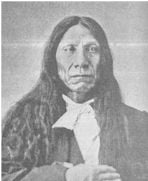
Red Cloud (Makhpiya-luta, `scarlet Cloud,’ frequently known among his people as Makhpia-sha, ‘Red Cloud’). A principal chief of the Oglala Teton Sioux of Pine Ridge reservation, the largest band of the Sioux nation, and probably the most famous and powerful chief in the history of the tribe. The origin of the name is disputed, but is said by ex-agent McGillycuddy 1 to refer to the way in which his scarlet-blanketed warriors formerly covered the hillsides like a red cloud. If this be true, the name was bestowed after he had obtained recognition as a leader.
Red Cloud was born at the forks of Platte River, Nebraska, in 1822, and died at Pine Ridge, South Dakota, Dec. 10, 1909. He was a member of the Snake family, the most distinguished and forceful of his tribe, and rose to prominence by his own force of character, having no claim to hereditary chiefship, which in the Oglala band rested with the family represented by They-fear-even-his-horse (“Youngman-afraid-of-his-horses”), the latter being more conservative and more friendly toward civilization.
Red Cloud’s father died of drunkenness brought about by the introduction of liquor into the tribe without stint, commencing about 1821. When in 1865 the Government undertook to build a road from Ft. Laramie, Wyoming, on the North Platte, by way of Powder River to the gold regions of Montana, Red Cloud headed the opposition for his tribe, on the ground that the influx of travel along the trial would destroy the best remaining buffalo ground of the Indians. The first small detachment of troops sent out to begin construction work were intercepted by Red Cloud with a large party of Oglala Sioux and Cheyenne, and held practically as prisoners for more than two weeks, but finally were allowed to proceed when it seemed to the chief that they might be massacred by his young men. In the fall of the same year commissioners were sent to treat with the Oglala for permission to build the road, but Red Cloud forbade the negotiations and refused to attend the council.
On June 30, 1866, another council for the same purpose was called at Ft Laramie, Red Cloud this time attending and repeating his refusal to endanger the hunting grounds of his people. While he was speaking, a strong force of troops under Gen. Carrington arrived, and on being told, in reply to a question, that they had come to build forts and open the road to Montana, he seized his rifle and with a final defiant message left the council with his entire following. Carrington then set out on his mission, which included the rebuilding and garrisoning of Fort Reno, on powder River, and the establishment of Fort Phil Kearny and Fort C. F. Smith, the last named being on Bighorn River, in Montana.
Another protest to Carrington himself proving ineffectual, Red Cloud surrounded the troops and working force at Fort Kearny with perhaps 2,000 warriors and harassed them so constantly that not even a load of hay could be brought in from the prairie except under the protection of a strong guard, while it was made impossible to venture out after the game that was abundant all around. On Dec. 21, 1866, an entire detachment of 81 men under Capt. Fetterman was cut off and every man killed. On Aug. 1, 1867, another severe engagement occurred near the post. In all this time not a single wagon had been able to pass over the road, and in 1868 another commission was appointed to come to terms with Red Cloud, who demanded as an ultimatum the abandonment of the three posts and of all further attempts to open the Montana road.
A treaty was finally made on this basis, defining the limits of the Sioux country as claimed by the Sioux, Red Cloud refusing to sign or even to be present until the garrisons had actually been withdrawn, thus winning a complete victory for the position which he had taken from the beginning. He finally affixed his signature at Ft Laramie, Nov. 6, 1868. From that date he seems to have kept his promise to live at peace with the whites, although constantly resisting the innovations of civilization.
He took no active part in the Sioux war of 1876, although he is accused of having secretly aided and encouraged the hostiles. Being convinced of the hopelessness of attempting to hold the Black Hills after the discovery of gold in that region, he joined in the agreement of cession in 1876. In the outbreak of 1890-91 also he remained quiet, being then an old man and partially blind, and was even said to have been threatened by the hostiles on account of his loyal attitude toward the Government.
As a warrior Red Cloud stood first among his people, having counted 80 coups (q. v.) or separate deeds of bravery in battle. As a general and statesman he ranked equally high, having been long prominent in treaties and councils, and several times a delegate to Washington, his attitude having been always that of a patriot from the Indian standpoint. Unlike Indians generally, he had but one wife, with whom he lived from early manhood. Personally he is described by one well acquainted with him as a most courtly chief and a natural born gentleman with a bow as graceful as that of a Chesterfield. For some years before his death he was blind and decrepit, and lived in a house built for him by the Government. His immediate band is known as Iteshicha (q. v.)

- McGillycuddy, inf’n,1906[↩]