
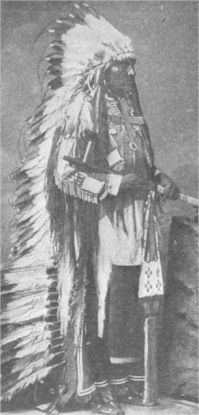
Oglala Indians, Oglala Tribe (‘to scatter one’s own’). The principal division of the Teton Sioux. Their early history is involved in complete obscurity; their modern history recounts incessant contests with other tribes and depredations on the whites. The first recorded notice of them is that of Lewis and Clark, who in 1806 found them living above the Brule Sioux on Missouri river, between Cheyenne and Bad rivers, in the present South Dakota, numbering 150 or 200 men. In 1825 they inhabited both banks of Bad river from the Missouri to the Black Hills, and were then friendly with the whites and at peace with the Cheyenne, but enemies to all other tribes except those of their own nation. They were then estimated at 1,500 persons, of whom 300 were warriors.
Their general rendezvous was at the mouth of Bad river, where there was a trading establishment for their accommodation. In 1850 they roamed the plains between the north and south forks of Platte river and west of the Black Hills. In 1862 they occupied the country extending north east from Ft Laramie, at the mouth of Laramie river on North Platte river, including the Black Hills and the sources of Bad river and reaching to the fork of the Cheyenne, and ranged as far west as the head of Grand river. De Smet 1 says: “The worst among the hostile bands are the Blackfeet, the Ogallalas, the Unkpapas, and Santees.” The Oglala participated in the massacre of Lieut. Grattan and his men at Ft Laramie in 1854. From 1865 they and other restless bands of western Sioux were the terror of the frontier, constantly attacking emigrant trains on the plains and boats on the river, fighting soldiers, and harassing the forts and stations during several years, under the leadership of Sitting Bull and Crazy Horse. The invasion of the Black Hills by gold seekers led to the war of 1876, in which Custer and his command were destroyed.
For several months previous thereto stragglers from other tribes had been flocking to Sitting Bull’s standard, so that according to the best estimates there were at the battle of Little Bighorn 2,500 or 3,000 Indian warriors. The victor and his band were soon thereafter defeated by Gen. Miles and fled to Canada. Crazy Horse and more than 2,000 followers surrendered at Red Cloud and Spotted Tail agencies in the May following. These different parties were composed in part of Oglala, of whom the larger part probably surrendered with Crazy Horse.
The Oglala entered into a treaty of peace with the United States at the mouth of Teton (Bad) Rivers, South Dakota, July 5, 1825, and also a treaty signed at Ft.Sully, South Dakota, Oct. 28, 1865, prescribing relations with the United State and with other tribes. An important treaty with the Oglala and other tribes was made at Ft Laramie, Wyo., Apr. 29, 1868, in which they agreed to cease hostilities and which defined the limits of their tribal lands. An agreement, confirming the treaty of 1868, was concluded at Red Cloud agency, Neb., Sept. 26, 1876, which was signed on behalf of the Oglala by Red Cloud and other principal men of the tribe.
In 1906 the Oglala were officially reported to number 6,727, all at Pine Ridge agency, South Dakota.
Oglala Divisions and Bands
Lewis and Clark 2 mention only two divisions, the Sheo and the Okandandas. According to the Report of Indian Affairs for 1875 (p. 250), the Oglala were then divided into four bands, “usually called Ogallallas, Kiocsies [Kiyuksa], Onkapas [Oyukhpe], and Wazazies.” The Rev. John Robinson in a letter to Dorsey (1879) names the following divisions:
- Payabya
- Tapishlecha
- Kiyuksa
- Wazhazha
- Iteshicha
- Oyukhpe
- Waglukhe
These correspond with the seven bands of Red Cloud’s pictographs. According to Rev. W. J. Cleveland (1884) they consist of 20 bands, as follow:
- Iteshicha
- Payahya
- Oyukhpe
- Tapishlecha
- Peshla
- Chekhuhaton
- Wablenicha
- Peshlaptechela
- Tashnahecha
- Iwayusota
- Wakan
(a) Iglakatekhila
(b) Iteshicha - Iteshichaetanhan
- Kiyuksa
- Wacheonpa
- Wachape
- Tiyochesli
- Waglukhe
- Oglala
- Ieskachincha.
Unidentified bands are:
- Minisha
- Night Cloud,
- Old Skin Necklace,
- Red lodge, and the
- Shorthair band.
Consult Further:

