
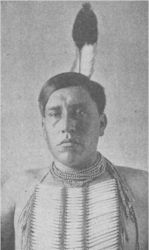
Missouri Indians (‘great muddy,’ referring to Missouri river). A tribe of the Chiwere group of the Siouan family. Their name for themselves is Niútachi. According to Gale the early form of the word Missouri is Algonquian, of the Illinois dialect. The most closely allied tribes are the Iowa and the Oto.
According to tradition, after having parted from the Winnebago at Green bay, the Iowa, Missouri, and Oto moved westward to Iowa river, where the Iowa stopped. The rest continued westward, reaching the Missouri at the mouth of Grand river. Here, on account of some dispute, the Oto withdrew and moved farther up Missouri river. Marquette’s autograph map of 1673, which is perhaps the earliest authentic notice of the tribe, locates the Semesssrit on Missouri river, apparently as far north as the Platte. Joutel (1687) appears to have been the first writer to use the name Missouri in this form. It is stated that Tonti met the tribe a day and half’s journey from the Village of the Tamaroa, which was on the Mississippi, 6 leagues below Illinois river. About the beginning of the 18th century the French found them on the left bank of the Missouri, near the mouth of Grand river, and built a fort on an island near them. They continued to dwell in this locality until about 1800.
According to Bourgmont 1 their village in 1723 was 30 leagues below Kansas river and 60 leagues below the principal Kansa village. About 1798 they were conquered and dispersed by the Sauk and Fox tribes and their allies. Five or six lodges joined the Osage, two or three took refuge with the Kansa, and some amalgamated with the Oto, but they soon recovered, as in 1805 Lewis and Clark found them in villages south of Platte river, having abandoned their settlements on Grand river some time previously on account of smallpox.
They were visited again by an epidemic in 1823. Although their number was estimated in 1702 at 200 families and in 1805 by Lewis and Clark at 300 souls, in 1829, when they were found with the Oto, they numbered only 80. Having been unfortunate in a war with the Osage, part of them joined the Iowa, and the others went to tho Oto previous to the migration of the latter to Big Platte river. In 1842 their Village stood on the bank of Platte river, Nebr. They accompanied the Oto when that tribe removed in 1882 to Indian Territory. There were only 40 individuals of the tribe remaining in 1885. They are now officially classed with the Oto, together numbering 368 in 1905 under the Oto school superintendent in Oklahoma.
Missouri Gentes
The gentes, as given by Dorsey 2 were:
- Tunanpin ( Black bear),
- Hotachi (Elk), and
- Cheghita (Eagle) or Wakanta (Thunder-bird).
Missouri Treaties
The Missouri joined in the following treaties with the United States:
- Peace treaty of June 24, 1817;
- Ft Atkinson, ,Ia., Sept. 26, 1825, regulating trade and relations with the United States;
- Prairie du Chien, Wis. July 15, 1830, ceding lands in Iowa Ad Missouri;
- Oto Village, Nebr., Sept. 21, 1833, ceding certain lands;
- Bellevue, upper Missouri r., Oct. 15, 1836, ceding certain lauds;
- Washington, Mar. 15, 1854, ceding lands, with certain reservation;
- Nebraska City, Nebr., Dec. 9, 1854, changing boundary of reservation.
Morgan 3 used the term Missouri Indians to include the Ponca, Omaha, Kansa, Quapaw, Iowa, Oto, and Missouri. These are the Southern tribes of Hale 4 , and the Dhegiha and Chiwere groups of J. O. Dorsey.
