
Big Jim
Big Jim. The popular name of a noted full-blood Shawnee leader, known among his people as Wapameepto, “Gives light as he walks”. His English name was originally Dick Jim, corrupted into Big Jim. He was born on the Sabine Reservation, Texas, in 1834, and in 1872 became chief of the Kispicotha band, commonly known as Big Jim’s band of Absentee Shawnee. Big Jim was of illustrious lineage, his grandfather being Tecumseh and his father one of the signers of the “Sam Houston treaty” between the Cherokee and affiliated tribes and the Republic of Texas, February 23, 1836. He was probably the most conservative member of his tribe. In the full aboriginal belief that the earth was his mother and that she must not be wounded by tilling of the soil, he refused until the last to receive the allotments of land that had been forced upon his band in Oklahoma, and used every means to overcome the encroachments of civilization. For the purpose of finding a place where his people would be free from molestation, he went to Mexico in 1900, and while there was stricken with smallpox in August, and died. He was succeeded by his only son, Tonomo, who is now (1905) about 30 years of age.
Chief Black Bob
Black Bob. The chief of a Shawnee band, originally a part of the Hathawekela division of the Shawnee. About the year 1826 they separated from their kindred, then living in eastern Missouri on land granted to them about 1793 by Baron Carondelet, near Cape Girardeau, then in Spanish territory, and removed to Kansas, where, by treaty with their chief, Black Bob, in 1854, they were given rights on the Shawnee reservation in that state. Under Black Bob’s leadership they refused to remove with the rest of the tribe to Indian Territory in 1808, but are now incorporated with them, either in the Cherokee Nation or with the Absentee Shawnee.
Chief Bluejacket
Bluejacket ( Weyapiersenicah). An influential Shawnee chief, born probably about the middle of the 18th century. He was noted chiefly as the principal leader of the Indian forces in the battle with Gen. Wayne of Aug. 20, 1794, at Presque Isle, Ohio. In the fight with Gen. Harmer in 1790 he was associated in command with Little Turtle, but in the battle with Wayne Bluejacket assumed chief control, as Little Turtle was opposed to further warring and urged the acceptance of the offers of peace, but was over ruled by Bluejacket. After the defeat of the Indians, Bluejacket was present at the conference at Greenville, Ohio, and signed the treaty of 1795 made with Wayne at that place. He also signed the treaty of Ft Industry, Ohio, July 4, 1805. It is probable that he died soon after this date, as there is no further notice of him. Later descendants of the same name continue to be influential leaders in the tribe in the west.
Chief Catahecassa
Catahecassa (Black Hoof, probably from ma‛ka-täwikashä W. J.). A principal chief of the Shawnee, born about 1740. He was one of the greatest captains of this warlike tribe throughout the period when they were dreaded as inveterate and merciless foes of the whites. He was present at Braddock s great defeat in 1755, and in the desperate battle with the Virginian militia under Gen. Andrew Lewis at Point Pleasant in 1774 he bore a prominent part. He was an active leader of the Shawnee in their resistance to the advance of the white settlements west of the Allegheny Mountains, and fought the troops of Harmar and St Clair. When the victory of Gen. Anthony Wayne broke the power of the Indian confederation and peace was signed on Aug. 3, 1795, Catahecassa’s fighting days came to an end, but not his career as an orator and counselor. When finally convinced of the hopelessness of struggling against the encroachment of the whites, he used his great influence to preserve peace. He was a persuasive and convincing speaker and was thoroughly versed in the traditions of the tribe as well as in the history of their relations with the whites, in which he had himself borne a conspicuous part. As head chief of the Shawnee he kept the majority of the tribe in restraint when British agents endeavored to stir them into rebellion against the American government and succeeded in seducing Tecumseh and some of the younger warriors. He died at Wapakoneta, Ohio, in 1831.
Chief Paxinos
Paxinos. A Minisink and subsequently a Shawnee chief of the 17th and 18th centuries. He appears first in history in 1680, when as sachem of the Minisink he sent 40 men to join the Mohawk in an expedition against the French, and 10 years later was sent by his tribe to confer with Gov. Dongan of New York in regard to engaging in the war against the same nation. About 1692 or 1694 a small body of Shawnee settled among the Munsee, of whom the Minisink formed a division, and possibly Paxinos may have been one of this party. He was married about 1717. As early at least as 1754 he is referred to as the “old chief” of the Shawnee 1, and is so designated in the New York Colonial Documents wherever referred to. Heckewelder 2, confirmed by Brinton, also says he was the chief of the Shawnee. He removed from Minisink to the Delaware country, but at what date is unknown, his next appearance being in connection with the difficulties which grew out of the removal of the Delawares to Wyoming, Pennsylvania. After the death, in 1749, of Shekellimus, the father of Logan, who had been a friend of the Moravian missionaries, the latter were fortunate in gaining the friendship of Paxinos. In 1754 he, with Tedyuskung, warned the people of Gnadenhuetten to remove to Wajomick (Wyoming), Pennsylvania; but for this their lives would have been in danger. The next year Paxinos renewed the warning and demanded an answer in the name of the Hurons. His wife, for whom he had great affection and to whom he had been married for 38 years, was converted and baptized with Paxinos’ consent. Soon after his last visit the Moravian settlement at Shamokin was attacked, and hearing of the danger to which the missionary Kiefer was exposed, Paxinos sent his two sons to conduct him to a place of safety. He was present with chiefs of other tribes at Ft Johnson, N. Y., Apr. 15-19, 1757, in conference with Sir William Johnson regarding lines of travel and trade 3, and also at the conference with Gov. Denny at Easton, Pennsylvania, in August of the same year 4. Paxinos removed with his family to Ohio in 1755 or 1758, where his tribesmen joined in the war against the English. It is probable that he died shortly after this time. He left two sons, Kolapeka and Teatapercaum, the latter a chief of some note in the war of 1764 5. His name is given in various forms, as Paxihos, Paxinosa, Paxnos, Paxnous, Paxowan, Paxsinos, etc.
Tenskwatawa – Shawnee Prophet
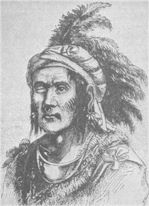
Tenskwatawa. The famous “Shawnee Prophet,” twin brother of Tecumseh prominent in Indian and American history immediately before the War of 1812. His original name was Lalawéthika, referring to a rattle or similar instrument. According to one account he was noted in his earlier years for stupidity and intoxication; but one day, while lighting his pipe in his cabin, he fell back apparently lifeless and remained in that condition until his friends had assembled for the funeral, when he revived from his trance, quieted their alarm, and announced that he had been conducted to the spirit world. In November 1805, when hardly more than 30 years of age, he called around him his tribesmen and their allies at their ancient capital of Wapakoneta, within the present limits of Ohio, and announced himself as the bearer of a new revelation from the Master of Life. “He declared that he had been taken up to the spirit world and had been permitted to lift the veil of the past and the future, had seen the misery of evil doers and learned the happiness that awaited those who followed the precepts of the Indian god.
He then began an earnest exhortation, denouncing the witchcraft practices and medicine juggleries of the tribe, and solemnly warning his hearers that none who had part in such things would ever taste of the future happiness. The firewater of the whites was poison and accursed; and those who continued its use would he tormented after death with all the pains of fire, while flames would continually issue from their mouths. This idea may have been derived from some white man’s teaching or from the Indian practice of torture by fire. The young must cherish and respect the aged and infirm. All property must be in common, according to the ancient law of their ancestors. Indian women must cease to intermarry with white men; the two races were distinct and must remain so. The white man’s dress, with his flint and steel, mast be discarded for the old time buckskin and the fire stick. More than this, every tool and every custom derived from the whites must be put away, and the Indians must return to the methods the Master of Life had taught them.
When they should do all this, he promised that they would again he taken into the divine favor, and find the happiness which their fathers had known before the coming of the whites. Finally, in proof of his divine mission, he announced that he had received power to cure all diseases and to arrest the hand of death in sickness or on the battlefield” 6. The movement was therefore a conservative reaction against the breakdown of old customs and modes of life due to white contact, but it had at first no military object, offensive or defensive.
Intense excitement followed the prophet’s announcement of his mission, and a crusade continued against all suspected of dealing in witchcraft. The prophet very cleverly turned the crusade against any who opposed his supernatural claims, but in this he sometimes overreached himself, and lost much of his prestige in consequence.
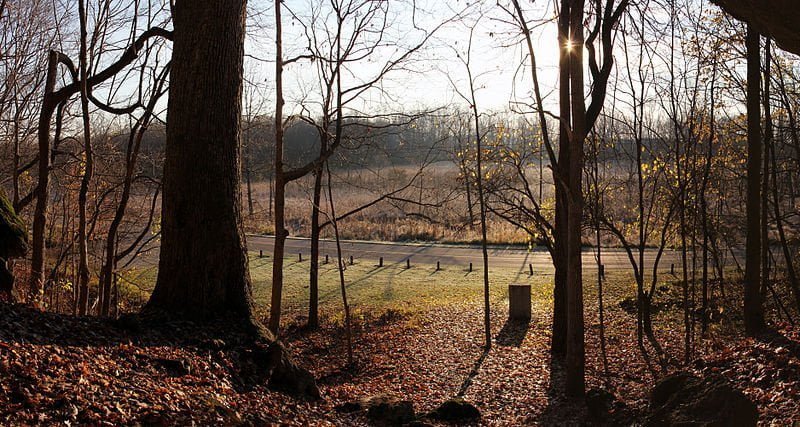
He now changed his name to Tenskwátawa, significant of the new mode of life which he had come to point out to his people, and fixed his headquarters at Greenville, Ohio, where representatives from the various scattered tribes of the northwest gathered about him to learn the new doctrines. To establish his sacred character and to dispel the doubts of the unbelievers he continued to dream dreams and announce wonderful revelations from time to time. A miracle which finally silenced all objections was the prediction of an eclipse of the sun which took place in the summer of 1806; this was followed by his enthusiastic acceptance as a true prophet and the messenger of the Master of Life. The enthusiasm now spread rapidly, and emissaries traveled from tribe to tribe as far as the Seminole and the Siksika, inculcating the new doctrines. Although this movement took much the same form everywhere, there were local variations in rituals and beliefs. Prominent among these latter was a notion that some great catastrophe would take place within four years, from which only the adherents of the new prophet would escape. In most places the excitement subsided almost as rapidly as it had begun, but not before it had given birth among the Northern tribes to the idea of a confederacy for driving back the white people, one which added many recruits to the British forces in the War of 1812.
Its influence among Southern tribes was manifested in the bloody Creek war of 1813. The prophet’s own influence, however, and the prestige of the new faith were destroyed by Harrison’s victory in the vicinity of the town of Tippecanoe, where he had collected 1,000 to 1,200 converts, Nov. 7, 1811. After the War of 1812 Tenskwatawa received a pension from the British government and resided in Canada until 1826, when he rejoined his tribe in Ohio and the following year moved to the west side of the Mississippi, near Cape Girardeau, Missouri. About 1828 he went with his band to Wyandotte County, Kansas, where he was interviewed in 1832 by George Catlin, who painted his portrait., and where he died, in Nov. 1837, within the limits of the present Argentine. His grave is unmarked and the spot unknown. Although his personal appearance was marred by blindness in one eye, Tenskwatawa possessed a magnetic and powerful personality, and the religious fervor he created among the Indian tribes, unless we except that during the recent “ghost dance” disturbance, has been equaled at no time since the beginning of white contact.
Consult further:
- Mooney in 14th Rep. B. A. E., 1896, and authorities therein cited.
Chief Tecumseh
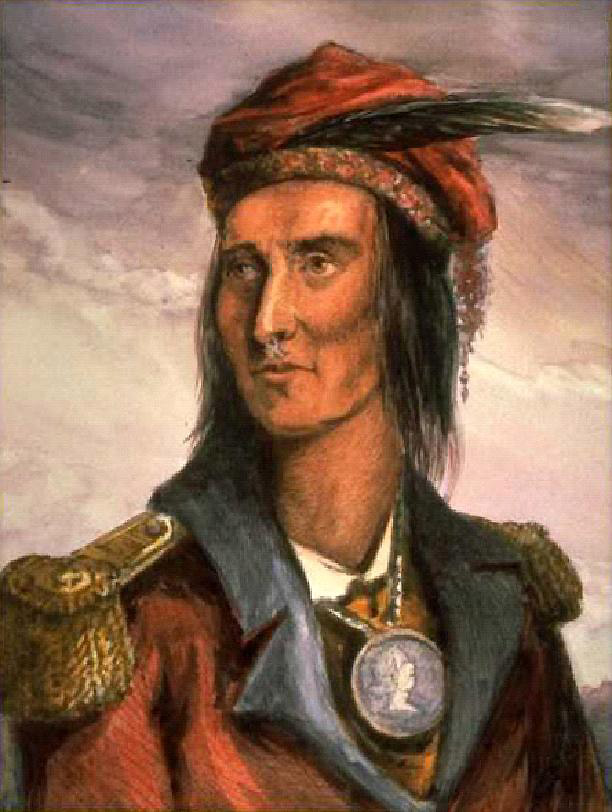
Tecumseh (properly Tikamthi or Tecumtha: ‘One who passes across intervening space from one point to another,’ i. e. springs (Jones); the name indicates that the owner belongs to the gens of the Great Medicine Panther, or Meteor, hence the interpretations ‘Crouching Panther’ and ‘ShootingStar’ ). A celebrated Shawnee chief, born in 1768 at the Shawnee village of Piqua on Mad river, about 6 in. southwest of the present Springfield, Ohio. It was destroyed by the Kentuckians in 1780. His father, who was also a chief, was killed at the battle of Point Pleasant in 1774 (see Cornstalk). His mother is said of the white man, and denied the right of the Government to make land purchases from any single tribe, on the ground that the territory, especially in the Ohio valley country, belonged to all the tribes in common. On the refusal of the Government to recognize this principle, he undertook the formation of a great confederacy of all the western and southern tribes for the purpose of holding the Ohio river as the permanent boundary between the two races. In pursuance of this object he or his agents visited every tribe from Florida to the head of the Missouri river. While Tecumseh was organizing the work in the south his plans were brought to disastrous overthrow by the premature battle of Tippecanoe under the direction of the Prophet, Nov. 7, 1811. On the breaking out of the War of 1812, Tecumseh at once led his forces to the support of the British, and was rewarded with a regular commission as brigadier general, having under his command some 2,000 warriors of the allied tribes. He fought at Frenchtown, The Raisin, Ft Meigs, and Ft Stephenson, and covered Proctor’s retreat after Perry’s decisive victory on Lake Erie, until, declining to retreat farther, he compelled Proctor to make a stand on Thames river, near the present Chatam, Ontario. In the bloody battle which ensued the allied British and Indians were completely defeated by Harrison, Tecumseh himself falling in the front of his warriors, Oct. 5, 1813, being then in his 45th year. With a presentiment of death he had discarded his general’s uniform before the battle and dressed himself in his Indian deerskin. He left one son, the father of Wapameepto, alias Big Jim. From all that is said of Tecumseh in contemporary record, there is no reason to doubt the verdict of Trumbull that he was the most extraordinary Indian character in United States history. There is no true portrait of him in existence, the one commonly given as such in Lossing’s War of 1812 (1875) and reproduced in Appleton’s Cyclopedia-of American Biography (1894), and Mooney’s Ghost Dance (1896), being a composite result based on a pencil sketch made about 1812, on which were mounted his cap, medal, and uniform.
Consult further:
- Appleton Cycl. Am. Biog., vi, 1894;
- Drake, Life of Tecumseh, 1841;
- Eggleston, Tecumseh and the Shawnee Prophet, 1878;
- Law, Colonial Hist. Vincennes, 1858;
- Lossing, War of 1812,1875;
- McKenney and Hall, Ind. Tribes, 1, 1854;
- Mooney, Ghost Dance Religion, in 14th Rep. B. A. E., pt. ii, 1896;
- Randall, Tecumseh, in Ohio Arch. and Hist. Quar., Oct. 1906;
- Trumbull, Indian Wars, 1851.
Chief Nererahhe
Nererahhe. A civil or peace chief of that part of the Shawnee living on the Scioto in Ohio present at the conference between Sir William Johnson the representative of the Six Nations, at Johnson’s Hall, N. Y., in Apr., 1774. He appears to have possessed considerable oratorical power, and at this conference made a strong appeal to the Miami representatives to follow Johnson‘s advice and remain friendly to the English. Ruttenher 7 mentions him as one of the two or three more prominent chief’s of the Shawnee at, that period. Sowanowane, who, Ruttenber thinks, was Cornstalk, was head or war chief of the Shawnee, and when a belt was given to Nererahhe in 1774, he sent it to Sowanowane.

Searching for anything on Cornstalk.
Seeking any information (links) on Shawnee chief Youngasaw who, during a murder raid (c. 1758-1764) captured, adopted, and trained my then 12-year-old 4th maternal grandfather. I might not be looking correctly, but I’ve nothing about him via the WWW.
I’m looking for any information on head chief old Kewana between the years 1740 and 1750 from the Shawnee tribe he had a daughter Mihaha Who married my relative Thomas Frederick son of Noah Frederick who is captured in 1728.
Hey Gary! Im sill looking for information myself. i have pictures of his kids. I am a descendent of Thomas Frederick myself.
i am a descendent of Thomas Frederick to.
Conservative US Republican party’s spin doctors at OAN and Fox News attempt to up hold the disgraced legacy of a drunk deer hunter known as Sam Houston! I am learning more about my ethnic native American Indian ancestors related to the Lenape Cheswold Moor Delmarva and now Shawnees through my family history in the Seminoe, Saponi, Cherok and Chickasaws communites. The Piquan Shawnee assistances with the Susquehannocks was successfully completed by Delawares leading the way to Penn’s Creek . In KY and TN Shawnees check ambitions of the Goose Creek men master class slave drivers of Anglo-American Indians. There’s not a lot of published history about the Shawnee fpcs. I do know that when living in Georgia among the five civilized tribes citizens the Shawnee created comfortable rich lifestyle for themselves ignored the low class Anglo-Americans toxic influence and customs.
I’m so proud that the Shawnee help make sure the US for the Red Indians is the home of the Real Bold Warriors and the Brave!
Looking for lost history on name change of my great great grandfather Thomas A Captain Sr
Name went from this below to Captain when Thomas helped get the white man out of the woods when lost
Nan-Ho-Gom-We with Ma-Tah-Wah-See
(census- Non-ho-gom-wee.) (census Ma Ta WA Sa)
B1827 d. 1855 d. 1879
(From Missouri they had son name Thomas A Captain SR)
Ma-ta-haw-e-seec (mother)ck (spelling from book)
Maw-tah-wah-see (Mother)ck(spelling in book)
Wau-A-Ha-Gu-Ma (Father of thomas Captain)(spelling from book)
Na-Na-He-Pu-Ma-Ka (thomas captain Indian name)(spelling from book
Hello. My name is Kristin Whiteye (White Eyes). I am looking for information on Chief White Eyes of the Moravians of Ohio. I’m unsure of the connection if any. My grandfathers family followed the Moravian Missionaries to our current home, Moravian of the Thames, Delaware First Nation, Ontario, Canada, near the Battle of the Thames, War of 1812.
I’m also looking for info on Chief Oshawana. His english name was John Nahdee, which I am told came from his Indian name; Nangie, Nan-gie or Nan-gi. He was a warrior who fought along side Tecumseh during the War of 1812. I am told he was Shawnee from Ohio and married a Potawatami women from Walpole Island First Nation, Ontario, Canada. As traditon he took his wifes name; Nangie?
Thank you and looking forward to your reply.
Kristin
Thanks for the help.
I have just learned my great grandfather was Blue Jacket. My grandmother Margaret Moore was kidnapped at 9 years of age and had a son, William W. Moore with Blue Jacket.
View in TreeCindy Rae McDaniel 1963 Family TreeFind person in tree SearchToolsEdit
Select a profile image for Weyapiersenwha Whirlpool Sepettekenathe Big Rabbit BlueJacket.
Weyapiersenwha Whirlpool Sepettekenathe Big Rabbit BlueJacket
1735–1809
6th great-grandfather
LifeStory Facts Gallery Hints7
Support CenterAncestry BlogSite MapGift MembershipsCareers
Other Sites:
© 1997-2018 AncestryCorporate InformationPrivacyTerms and Conditions
Tutorials
Print
Relationship to me
Weyapiersenwha Whirlpool Sepettekenathe Big Rabbit BlueJacket (1735 – 1809)
6th great-grandfather
William W. Moore (1775 – 1878)
Son of Weyapiersenwha Whirlpool Sepettekenathe Big Rabbit BlueJacket
Jabez Green Moore (1801 – 1878)
Son of William W. Moore
Frederick Garrett Moore (1824 – 1875)
Son of Jabez Green Moore
John Allen Moore (1869 – 1936)
Son of Frederick Garrett Moore
Charles Wesley ‘Wes’ Moore (1897 – 1959)
Son of John Allen Moore
BETTY LOU moore (1922 – 1998)
Daughter of Charles Wesley ‘Wes’ Moore
Charles WAYNE MCDANIEL (1943 – )
Son of BETTY LOU moore
Cindy Rae McDaniel
You are the daughter of Charles WAYNE MCDANIEL
are there any robinsons named as indians
I feel foolish for asking, as I have so little to go on. Are there any records of a Louisiana Green from Adams County, OH? Thank you.
5
I am interested in reasearching more about my Great Grandfather, John King, who was Chief of the Absentee Shawnee Tribe back around 1900. His wife was Fannie Mae he had one daughter, Etta King.
He attended Hampton Institute College in the late 1800s. My Great Grandmother Fannie Mae’s Indian name was Tecumsehkia (sp?), as she was a descendent of Chief Tecumseh.
I would like to get whatever you have. Thank you,
Mary Leath-Berry
Member of the Absentee Shawnee Tribe
John C. King
John Cherokee King
Absentee-Shawnee Indian Name~~They-quah-na-kea
Thawegila Clan (?Chief?)
Date of Birth .ca. 1858
Date of Death: 9/29/1900
1887 Land Allotment Act #187
Did not find Fannie Mae/Tecumsehkia
Did find a wife in 1892 Census who was married several times.
Wife: Susan (Fox) King
Also known as Mrs. Josiah Lewis pet Heirship Congressional Notes “Widow of Josiah Lewis”
1887 Land Allotment Act #43
ETTA King is listed as Anna King, Absentee-Shawnee Indian Name Kin-no-tah-com-se
Date of Birth .ca. 1878
Date of Death Unknown
1887 Land Allotment Act #22