
Blacksnake
Blacksnake (Thaonawyuthe, ‘needle or awl breaker’). A chief, about the close of the 18th century, of the Seneca Indians, who lived on their reservation along the Alleghany River in Cattaraugus County, New York. His residence was a mile above the village of Cold Spring. The date of his birth is not known, but is supposed to have been about 1760, as it is stated that in 1856 he had reached the age of 96 years. He was present on the English side at the battle of Oriskany, N. Y., in 1777, and it is said that he participated in the Wyoming massacre of 1778, but he fought on the American side in the battle of Ft George, New York, August 17, 1813. He died in 1859.
Farmer’s Brother
Farmer’s Brother. A Seneca chief, known among his people as Honanyawus, of vulgar meaning, born in 1716, or 1718, or 1732, according to varying authorities; died in 1814 1 . He is often mentioned in connection with Red Jacket, but does not appear to have come into prominence until about 1792. One of his most celebrated speeches was delivered before a council at Genesee River, New York, in 1798. He signed the treaties of Genesee, September 15, 1797, and Buffalo Creek, June 30, 1802. He espoused the cause of the United States in the war of 1812, and although 80 years of age engaged actively in the strife and was present in the action near Ft George, New York, August 17, 1813. He died soon after the battle of Lundy’s Lane and was buried with military honors by the fifth regiment of U. S. infantry. Farmer’s Brother was always an advocate of peace and more than once prevented his tribe from going on the warpath.
Cornstalk
Cornstalk. A celebrated Shawnee chief (born about 1720, died in 1777) who held authority over those of the tribe then settled on the Scioto, in Ohio. He was brought most prominently into notice by his leadership of the Indians in the battle of Point Pleasant, at the mouth of Great Kanawha river, West Virginia, October 10, 1774. Although defeated in a battle lasting throughout the day, his prowess and generalship on this occasion where his force, mostly Shawnee, numbering probably 1,000, was opposed to 1,100 Virginia volunteers won the praise of the whites. After this battle he entered into a treaty of peace with Lord Dunmore in Novomber, 1774, at Chillicothe, Ohio, although strenuously opposed by a part of his tribe, and faithfully kept it until 1777. In the latter year the Shawnee, being incited to renew hostilities, he went to Point Pleasant and notified the settlers that he might be forced into the war. The settlers detained him and his son as hostages, and they were soon after murdered by some infuriated soldiers in retaliation for the killing of a white settler by some roving Indians, thus arousing the vindictive spirit of the Shawnee, which was not broken until 1794. Cornstalk was not only a brave and energetic warrior, but a skilful general and an orator of considerable ability. A monument was erected to his memory in the courthouse yard at Point Pleasant in 1896.
Cornplanter
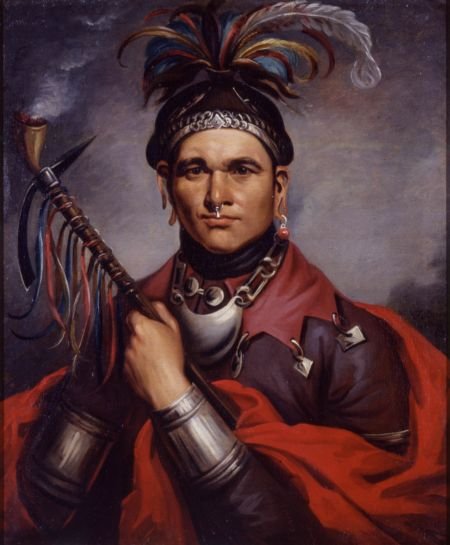
Cornplanter (Kaiioñtwa?’kon, ‘by what one plants’ Hewitt; variously written Garganwahgah, Koeentwahka, etc.). A Seneca chief known also as John O’Bail, supposed to have been born between 1732 and and 1740 at Conewaugus, on Genesee river, New York. Drake 2 says he was a warror at Braddock’s defeat in 1755, which is evidently a mistake, though he may have been present a a boy of 12 or 15 years. His father was a white trader named John O’Bail or O’Beel, said by some to have been an Englishman, although Harris 3 says he was a Dutchman, named Abeel, and Tuttenberer 4 also say he was a Dutch trader. His mother was a full-blood Seneca. All that is known of Cornplanter’s early days is contained in a letter to the governor of Pennsylvania, in which he says he played with Indian boys who remarked the difference between the color of his skin and theirs; his mother informed him that his father resided at Albany. He visited his father, who it appears, treated him kindly but gave him nothing to carry back; nor did he tell me,” he adds, “that the United States were about to rebel against the Government of England.” He states that he was married before this visit. He was one of the parties to the treaty of Ft Stanwix in 1784, when a large cession of land was made by the Italians; he also took part in the treaty of Ft Harmar in 1789, in which all extensive territory was conveyed to the United States (although his name is not among the signers); and he was a signer of the treaties of September 15, 1797, and July 30, 1802. These acts rendered him so unpopular with his tribe that for a time his life was in danger. In 1790 he, together with Halftown, visited Philadelphia to lay before Gen. Washington the grievances complained of by their people. In 1816 he resided just within the limits of Pennsylvania on his grant 7 miles below the junction of the Connewango with the Allegheny, on the banks of the latter. He then owned 1,300 acres, of which 640 formed a tract granted to him by Pennsylvania, Mar. 16, 1796, “for his many valuable services to the whites.” It is said that in his old age he declared that the “Great Spirit” told him not to have anything more to do with the whites, nor even to preserve any mementos or relics they had given him. Impressed with this idea, he burned the belt and broke the elegant sword that had been given him. A favorite son (Henry Obeal), who had been carefully educated, became a drunkard, thus adding to the troubles of Cornplanter’s last years. He received from the United States, for a time, a pension or grant of $250 per year. He was perhaps more than 90 years of age at the time of his death, Feb. 18, 1836. A monument erected to his memory on his reservation by the state of Pennsylvania in 1866 bears the inscription “aged about 100 years.”
Consult Further:
Half King
Half King (Scruniyatha, Seruniyattha, Tanacharison, Tannghrishon, etc.). A Seneca chief; born about 1700; died at the house of John Harris, at the site of Harrisburg, Pennyslvania, October 1, 1754. He appears to have first come into notice about 1748, at which time he lived at or in the vicinity of Logstown, Pennyslvania. According to some statements his residence was in this village, but according to others it was on Little Beaver Creek, about 15 miles distant. It was to Half King that most of the official visitors to the Indians of the Ohio region, including Weiser, Gist, Croghan, and Washington, applied for information, advice, and assistance, Logstown being their stopping place for this purpose. He accompanied Washington both on his journey of 1753 and on his expedition of 1754.
Half King claimed that he killed Jumonville, the French officer, during the skirmish at Great Meadows, Pennyslvania, May 28, 1754, in revenge of the French, who, he declared, had killed, boiled, and eaten his father; and it was he who had advised Ensign Ward, when summoned by Contracoeur, the French officer, to surrender Ft. Necessity, at the site of Pittsburg, Pennyslvania, to reply that his rank did not invest him with power to do so, thus obtaining delay. Half King was a prominent figure on the Indian side in the treaty with the Virginia commissioners in 1752, and for this and other services was decorated by Gov. Dinwiddie and given the honorary name “Dinwiddie,” which, it is said, he adopted with pride. On the advice of Croghan, he with other Indians removed to Aughquick (Oquaga) Creek, Pennyslvania, in 1754. Half King has been confused with the Huron Half King of Sandusky, Ohio, known also as Pomoacan, also with Schoroyady (Scarouady, etc.), the Oneida Half King, and with Monakatuatha (Monacatootha, etc.).
Consult further:
- Drake, Aborig. Races, 531, 1880;
- Rupp, Hist. West. Pa., 71, 1846;
- Dinwiddie Papers, i, 148, 1883;
- Col. Records Pa., v, 358, 1851.
Onondakai
Onondakai (‘Destroy Town’). A Seneca chief who signed the treaty of 1826. His name is also given as Gonondagie, and, more exactly, as Oshagonondagie.
He Destroys the Town,’ written “Straw Town” in the treaty of 1815, Oosaukaunendauki in 1797. He was one of those whose remains were re-interred at Buffalo in 1884. The name was a favorite one, but, as applied to George Washington and some French governors, has a slightly different form.
Red Jacket
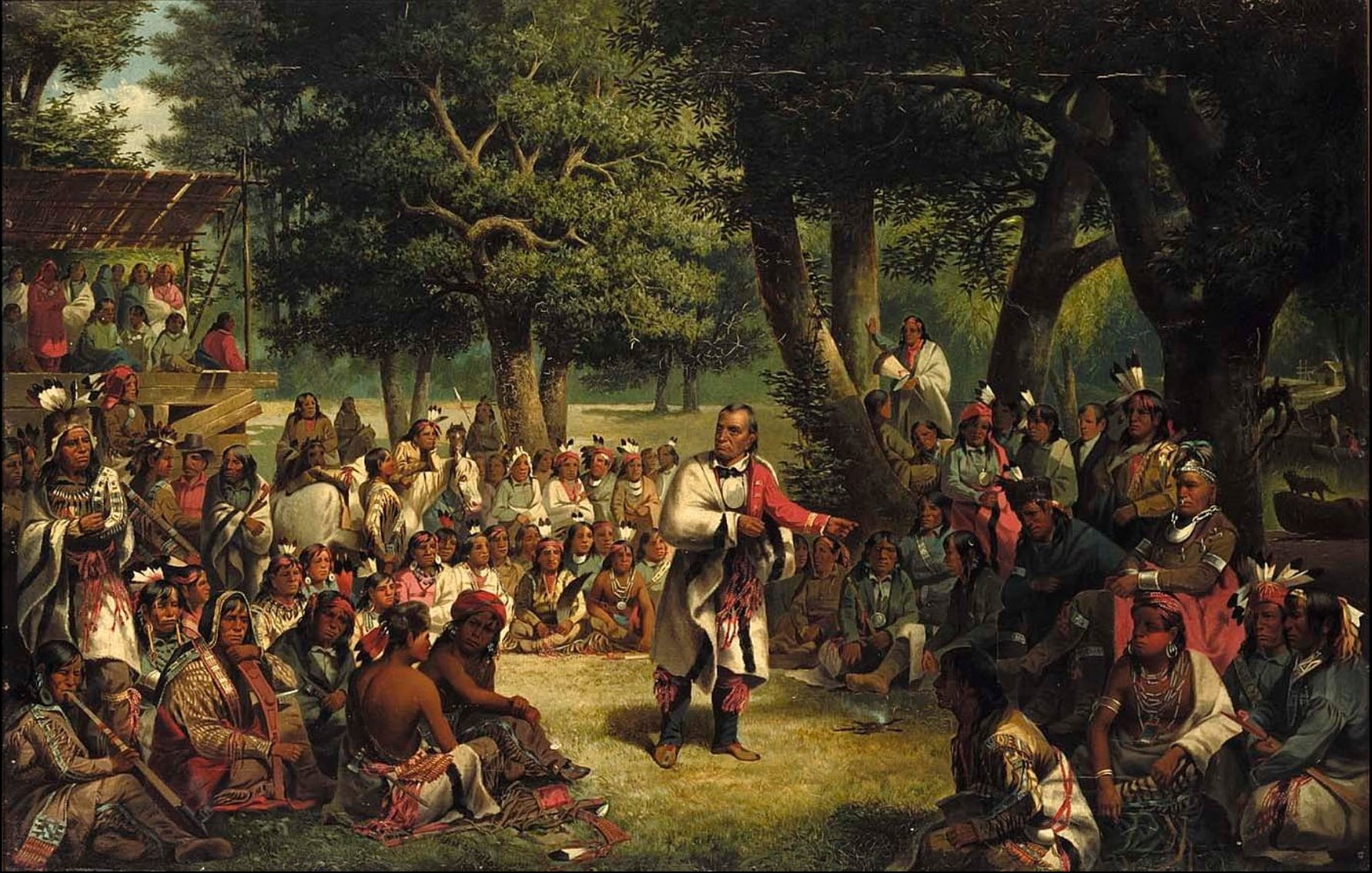
Red Jacket. A noted Seneca orator and chief of the “merit” class of the Wolf clan, born about 1756, probably at Canoga, in Seneca County, New York, where a monument commemorates his birth; died on the former “Buffalo reservation” of the Seneca, on lands now within the limits of Buffalo, New York, January 20, 1830. In civil life his Indian name was Otetiani, probably meaning ‘prepared’ or ‘ready’. On’ his elevation to a chief-ship, he received the name ‘Shagoie-‘wa-ttha’ (commonly spelled Sa-go-ye-wat-ha), signifying literally ‘be them causes to be awake,’ and, as a name, ‘he who causes them to be awake,’ a designation having no reference to his reputed ability as an effective speaker, although this seems to be the popular inference. Being a member of the Wolf clan of the Seneca, the Indian names received by Red Jacket belonged, according to custom, exclusively to this important clan. And, institutionally, clan names were in large measure designations descriptive of some distinctive feature, attitude, habit, or other phenomenon characteristic of the clan tutelary. So it being one of the marked habits of the wolf to disturb or awaken people at night by howling or by other weans, there naturally would be a personal name belonging to the Wolf clan which embodied this lupine trait and which in this case became the name of a tribal but not federal chiefship therein. This is also an official name among the Cayuga.
In the American Revolution, his tribe, the Seneca, having, reluctantly espouse the cause of Great Britain, Red Jacket, although strongly opposed to this course of his people, took the field with his fellow warriors. At once his ability and intelligence attracted the attention of British officers, one of whom gave him a brilliant red jacket, which, when worn out, was replaced by a second, and so on until this distinctive dress became a characteristic feature of its wearer, whence his popular name. Red Jacket was frequently employed in carrying dispatches, but he took no very active part in the actual fighting; indeed, he was even reproached with being a coward for certain conduct in the field by the great fighting chief, Cornplanter.
During the invasion of the Seneca country by Gen. Sullivan in 1779, Cornplanter sought to make a stand against the American forces on the shore of Canandaigua Lake, but on the approach of the American troops, a number of Indians, including Red Jacket, began to retreat. Seeing the ill effect of this movement, Cornplanter endeavored to rally the fugitives. Placing himself in front of Red Jacket, he sought to persuade him and his fellow refugees to turn back to fight, but his efforts were fruitless; in anger, the baffled chief, turning to Red Jacket’s young wife, exclaimed, “Leave that man; he is a coward! ”
Red Jacket was reputed to have had a most tenacious memory and a quick wit, and, being a ready and effective speaker, he possessed a remarkable gift for defensive debate; but, judging from his interpreted speeches and from his course in life, it is evident he was not a deep, broad-minded thinker, and so justly he could hardly be called a great orator. He was at all times an egotist, and his mind was of so narrow a cast that he failed to see that he and his people had reached a point where they had to strive to adjust themselves so far as practicable to the new conditions brought about by the coming of the white race. And so he likewise failed to read aright the lesson taught by the cataclysm that engulfed the institutions of the Iroquois of the League when the avenging army of Sullivan desolated their homes, their orchards, and their harvests in 1779. The meager measure of importance that finally attached to Red Jacket arose.
Consult further:
- Red Jacket, Seneca War Chief
- Red Jacket or SA-GO-YE-WAT-HA
- Biography of Red Jacket or Sa-Go-Ye-Wat-Ha
- How Red Jacket Got His Name

I found this in my family tree ” Seneca Indian-Maiden Kennedy was born in 1694 in Virginia, the daughter of Gah-hon-no-neh and Chief. She had one son with David Kennedy(Scottish Immigrant) in 1730. She died having lived for more than 100 years. She died on April 22, 1812, in Greencastle, Pennsylvania, at the age of 118.” Does anyone know more information?
Also “When David Kennedy(Immigrant) was born in 1705 in Antrim, Antrim, Northern Ireland, his father, John, was 49 and his mother, Janet, was 46. He had one son with Seneca Indian-Maiden Kennedy. He died on April 15, 1768, in Mercersburg, Pennsylvania, at the age of 63.”
I’m looking for information on my grandfathers, Chief Hiokatoo, Noah Twoguns other Twoguns descendants of Noah that are listed in Ancestry as chiefs. Thank you.
i am looking for the story on my grandfather hatchetnut i cannot seem to find anything on him i think he was cornplanters son