
Genealogy | Native American | DNA | About Us
Tell A Friend!


Genealogy Records

Genealogy
Biographies
Cemetery Records
Census Records
DNA
Family Tree Search
History Books Online
Military Records
Native American Records
Surnames
Vital Records
World Genealogy

Indian Genealogy

Proving Your Indian Heritage
Native American Rolls
Indian Tribal Histories
Indian Tribes by Location
Indian Books and Articles
Indian Genealogy Queries
Indian Census Records
Indian Cemetery Records

Indian Tribes

Abenaki Indians
Algonquian Indians
Apache Indians
Arapaho Indians
Blackfeet Indians
Caddo Indians
Cherokee Indians
Cheyenne Indians
Chickasaw Indians
Chinook Indians
Chippewa Indians
Choctaw Indians
Comanche Indians
Cree Indians
Creek Indians
Crow Indians
Dakota Indians
Delaware Indians
Fox Indians
Hopi Indians
Huron Indians
Illinois Indians
Iowa Indians
Iroquois Indians
Kansa Indians
Kickapoo Indians
Kiowa Indians
Menominee Indians
Miami Indians
Missouri Indians
Modoc Indians
Mohawk Indians
Mohegan Indians
Munsee Indians
Natchez Indians
Navajo Indians
Nex Percé Indians
Omaha Indians
Onondaga Indians
Osage Indians
Oto Indians
Ottawa Indians
Paiute Indians
Pawnee Indians
Pottawatomie Indians
Sauk Indians
Seminole Indians
Seneca Indians
Shawnee Indians
Siouan Indians
Sioux Indians
Stockbridge Indians
Tuscarora Indians
Winnebago Indians
Zuni Indians


Nez Perce Indian Chiefs and Leaders

Arthur, Mark. A full-blood Nez Perce, born in 1873. His mother being captured with Chief Joseph s band in 1877, Mark became a wanderer among strange tribes until about 1880, when he found his way back to the Nez Perce res., Idaho, where he entered the mission school of Miss McBeth and soon began to prepare for the ministry. When the Nez Perce captives sent to the Indian Territory were returned to their northern home, Mark found his mother among them and cared for her until her death . About 1900 he was ordained by the Walla Walla presbytery and became pastor, at Lapwai, Idaho, of the oldest Presbyterian church w. of the Rocky mts., in which charge he has met with excellent success. In 1905 he was elected delegate to represent both whites and Indians at the general assembly of the Presbyterian church. (A. C. F.)

Joseph

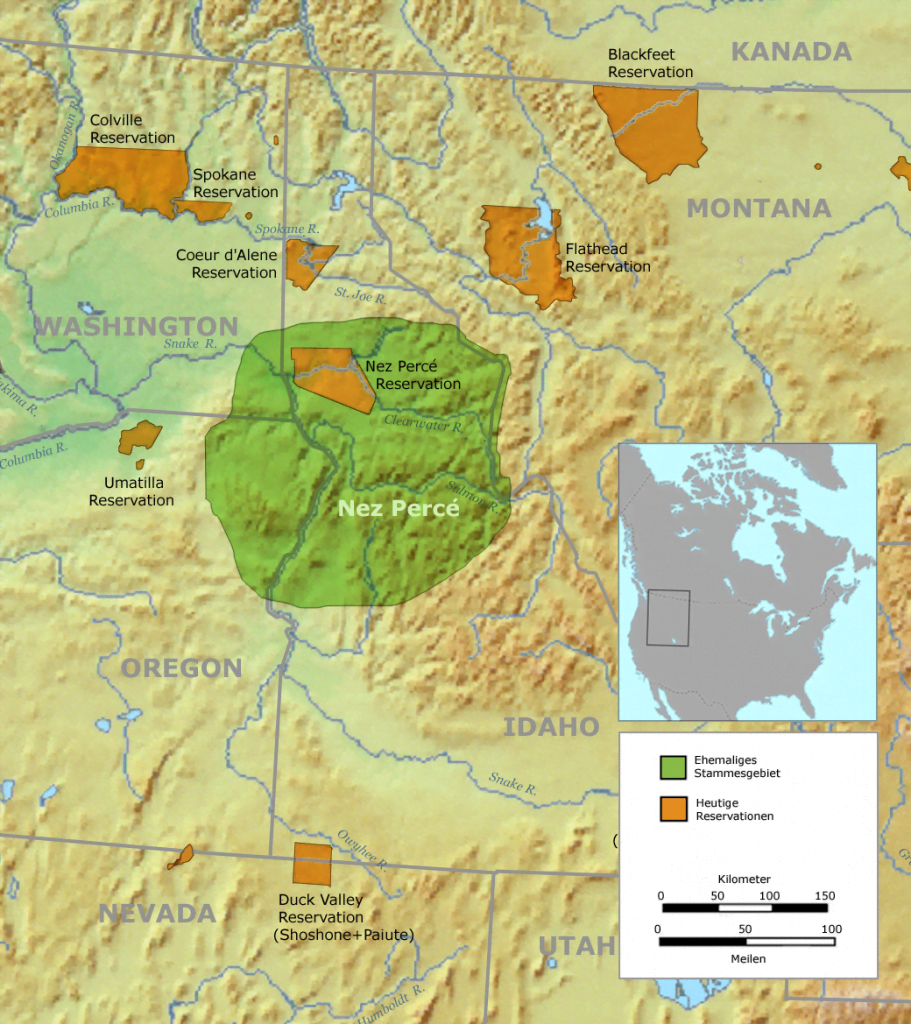
Joseph. The leader of the Nez Percé in the hostilities of 1877. His mother was a Nez Percé, his father a Cayuse, who re­ceived the name Joseph from his teacher, the missionary Spalding, who was with Dr. A. Whitman and who went to the Idaho country in the late thirties of the 19th century. Chief Joseph's native name was Hinmaton-yalatkit (Hinmaton, `thunder'; yalatkit, 'coming from the water up over the land.'-Miss McBeth), but both he and his brother

Ollicot were often called Joseph, as if it were a family name. Joseph was a man of fine presence and impressive features, and was one of the most remarkable Indians within the borders of the Union.
     The treaty of 1863, by which the whites obtained a right to the Wallowa valley, the ancient home of Joseph's band in N. E. Oregon, was not recognized by Joseph and the Indians sympathizing with him, who continued to dwell there in spite of collisions between the Indians and the whites, which became more and more frequent.    
     The matter of removing these Indians to the Lapwai reservation in Idaho,
after the failure of a commission the pre­vious year, was proceeding to a peaceful settlement when outrageous acts on the part of the white settlers caused the Nez Percé to break loose and attack the settlements. A war was declared after several engagements, in which the whites lost severely, Joseph displayed remark able generalship in a retreat worthy to be remembered with that of Xenophon's ten thousand (Mooney in 14th Rep. B. A. E 714, 1896). In spite of the fact that in front of him was Col. Miles, behind Gen. Howard, on his flank Col. Sturgis and his Indian scouts, Joseph brought his little band, incommoded with women and children, to within 50 miles of the Canadian border, their objective point, when they were cut off by fresh troops in front an forced to surrender conditionally on Oct. 5, 1877.  Not only the conduct of the Nez Perce during this retreat of more than 1,000 miles, but also the military and tactical skill displayed by their leader, won unstinted praise from their conquerors. The promises made to Joseph and his people were ignored and the removed to Ft Leavenworth, Kansas, and afterward to Indian Territory, where they remained for several years, always yearning for the mountains and valleys of Idaho. In 1883 a party of 33 women and children were allowed to go back to their old home, and were followed the next year by 118 others. Joseph and the remaining members of his hand, however, numbering 150, were not permitted to return to Idaho, but were sent to the Colville res., Wash. He lived to visit President Roosevelt and Gen. Miles at Washington in Mar., 1903, but died at Nespelim, on the Colville reservation, Wash., Sept. 21, 1904.
    
According to the Indian agent he had become reconciled to civilization in his last years, lending his aid in the education of the children of his tribe, and discouraging gambling and drunkenness.


Smohalla, an Indian prophet and teacher, the originator of a religion current among the tribes of the upper Columbia River and adjacent region in Washington, Oregon and Idaho, whence the name "Smohallah Indians" sometimes applied.  The name, properly Shmoqŭla, signifies "The Preacher," and was given to him after he became prominent as a religious reformer.  He belonged to the Sokulk, a small tribe cognate to the Nez Percé and centering about Priest rapids on the Columbia in eastern Washington. He was born about 1815 or 1820, and in his boyhood frequented a neighboring Catholic mission, from which he evidently derived some of his ceremonial ideas. He distinguished himself as a warrior, and began to preach about the year 1850. Somewhat later, in consequence of a quarrel with a rival chief, he left home secretly and absented himself for a long time, wandering as far south as Mexico and returning overland through Nevada to the Columbia. On being questioned he declared that he had been to the spirit world and had been sent back to deliver a message to the Indian race. This message, like that of other aboriginal prophets, was, briefly, that the Indians must return to their primitive mode of life, refuse the teachings or the things of the white man, and in all their actions be guided by the will of the Indian God as revealed in dreams to Smohalla and his priests. The doctrine found many adherents, Chief Joseph and his Nez Percé being among the most devoted believers. Smohalla has recently died, but, in spite of occasional friction with agency officials, the "Dreamers," as they are popularly called, maintain their religious organization, with periodical gatherings and an elaborate ceremony. See Mooney, Ghost Dance Religion, 14th Rep. B. A. E., 1896.


Lawyer - With the exception of the Joseph war of 1877, the Nez Percé have almost uniformly been the friends of the Whites. Even in that conflict they were human enough to abstain form scalping their captives, and even went so far as to give them water to drink when they found them wounded and alone. On many occasions they have saved hundreds of lives and thousands of dollars worth of property. When the "great audit is made up," it may prove that these Indians have done vastly more for the conquerors of their land than they have received from them. Prominent among the friendly chiefs of this great tribe was lawyer. He appears on the pages of historians from the time of Parker (in 1836) down. He was at that time a young man, famous for his natural eloquence and lawyer-like keenness, form which fact he received the name by which he has since been known. He was a son of the chief who had met Lewis and Clarke in so friendly a manner, and had cared for their horses during their stay down the river.
     Throughout the entire history of settlement, Lawyer was a friend of the Whites. He was especially prominent in the negotiations with Governor Stevens after the great war of 1855. He threw the weight of his great influence in favor of the treaty, which established the existing reservations and confirmed the Indians in the property which they now hold. Though opposed in his peace policy by Owhi, Kamiakin, Peu-peu-mox-mox and Joseph, the persistence of Lawyer and the numerical strength of his people turned the scale in favor of the treaty. The benefit to the settlers by this event can scarcely be overstated. As was just, the astute chief was ever afterwards held in great favor.
     In person Lawyer was a typical Indian. Though not of large stature, he was exceedingly straight and well-built with the eye of an eagle and the nose of a hawk. He has had few equals in general intelligence among his people.

The books presented are for their historical value only and are not the opinions of the Webmasters of the site.
 
Handbook of American Indians, 1906

Index of Tribes or Nations


Genealogy Websites

Other Websites

Disclaimer:

This site includes some historical materials that may imply negative stereotypes reflecting the culture or language of a particular period or place. These items are presented as part of the historical record and should not be interpreted to mean that the WebMasters in any way endorse the stereotypes implied.


Access Genealogy is the largest free genealogy website not owned by Ancestry.com. As such, it relies on the revenue from commercial genealogy companies such as Ancestry and Footnote to pay for the server and other expenses related to producing and warehousing such a large collection of data. If you're considering joining either of these programs, why not join from our pages, and help support free genealogy online!

Copyright 1999-2009, by Access Genealogy.com
A project by Webified Development