
Menominee Indians (meno, by change from mino, ‘good’, ‘beneficent’; min, a ‘grain’, ‘seed’, the Chippewa name of the wild rice. Hewitt. Full name Menominiwok ininiwok, the latter term signifying ‘they are men’). An Algonquian tribe, the members of which, according to Dr William Jones, claim to understand Sauk, Fox, and Kickapoo far more easily than they do Chippewa, Ottawa, and Potawatomi, hence it is possible that their linguistic relation is near to the former group of Algonquians. Grignon 1 peaks of the Noquet as a part of the Menominee, and states that “the earliest locality of the Menominee, at the first visits of the whites, was at Bay de Noque and Menominee river, and those at Bay de Noque were called by the early French Des Noques or Des Noquia.” (See Noquet.) The Jesuit Relation for 1671 includes the Menominee among the tribes driven from their country-that is, “the lands of the south next to Michilimackinac,” which is the locality where the Noquet lived when they first became known to the French. It is generally believed that the Noquet, who disappeared from history at a comparatively early date, were closely related to the Chippewa and were incorporated into their tribes; nevertheless, the name Menominee must have been adopted after the latter reached their historic seat; it is possible they were previously known as Noquet. Charlevoix 2 says: “I have been assured that they had the same original and nearly the same languages with the Noquet and the Indians at the Falls.”
The people of this tribe, so far as known, were first encountered by the whites when Nicolet visited them, probably in 1634, at the mouth of Menominee river, Wis. – Mich. In 1671, and henceforward until about 1852, their home was on or in the vicinity of Menominee river, not far from where they were found by Nicolet, their settlements extending at times to Fox river. They have generally been at peace with the whites. A succinct account of them, as well as a full description of their manners, customs, arts, and beliefs, by Dr W. J. Hoffman, appears in the 14th Rep. Bureau of Ethnology, 1896. In their treaty with the United States, Feb. 8, 1831, they claimed as their possession the land from the mouth of Green bay to the mouth of Milwaukee river, and on the west side of the bay from the height of land between it and Lake Superior to the headwaters of Menominee and Fox rivers, which claim was granted. They now reside on a reservation near the head of Wolf river, Wis.
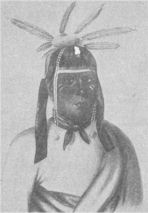
Major Pike described the men of the tribe as “straight and well made, about the middle size; their complexions generally fair for savages, their teeth good, their eyes large and rather languishing; they have a mild but independent expression of countenance that charms at first sight.” Although comparatively indolent, they are described as generally honest, theft being less common than among many other tribes. Drunkenness was their most serious fault, but even this did not prevail to the same extent as among some other Indians. Their beliefs and rituals are substantially the same as those of the Chippewa. They have usually been peaceful in character, seldom coming in contact with the Sioux, but bitter enemies of the neighboring Algonquian tribes. They formerly disposed of their dead by inclosing the bodies in long pieces of birch bark, or in slats of wood, and burying them in shallow graves. In order to protect the body from wild beasts, three logs were placed over the grave, two directly on the grave, and the third on these, all being secured by stakes driven on each side. Tree burial was occasionally practiced.
The Menominee as their name indicates, subsisted in part on wild rice (Zizania aquatica); in fact it is spoken of by early writers as their chief vegetal food. Although making such constant use of it from the earliest notices we have of them, and aware that it could be readily grown by sowing in proper ground, Jenks 3 who gives a full account of the Menominee method of gathering, preserving, and using the wild rice, states that they absolutely refuse to sow it evidently owing to their common unwillingness to “wound their mother, the earth.”
The earlier statements of Menominee population are unreliable. Most of the estimates in the nineteenth century vary from 1,300 to 2,500, but those probably most conservative range from 1,600 to 1,900. Their present population is about 1,600, of whom 1,370 are under the Green Bay school superintendency, Wis. Their villages (missions) were St Francis and St Michael.

