
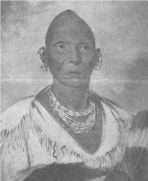
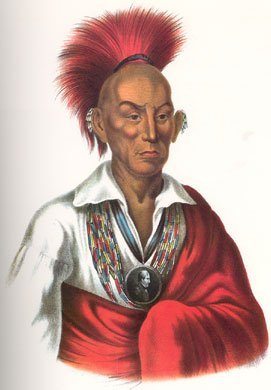
Original name Black Sparrow
A Saukie Brave (Sauk)
1767 – 1838
Black Hawk (Ma´katawimeshekÄ´käa, from ma´katäwi ‘it is black, mishi ‘big,’ kā´käa the name referring to the description of a bird, or sparrow hawk. W. J.)
A subordinate chief of the Sauk and Fox Indians and leader in the Black Hawk wars of 1832. He was born at the Sauk village at the mouth of Rock River, Illinois, in 1767, and belonged to the Thunder gens of the Sauk tribe. When only 15 years of age he distinguished himself in war; and before he was 17, at the head of a war party of young men, he attacked an Osage camp of 100 persons and came away safely with the scalp of a warrior. The next party that he led out, however, he brought to a deserted village, on account of which all except 5 of his party left him; but with these he kept on and brought away 2 scalps with which to efface his disgrace. At the age, of 19 he led 200 Sauk and Foxes in a desperate engagement with an equal number of Osage, destroying half of his opponents, killing 5 men and a woman with his own hands. In a subsequent raid on the Cherokee his party killed 28, with a loss of but 7; but among the latter was his own father, who was guardian of the tribal medicine, hence Black hawk refrained from war during the 5 years following and endeavored to acquire greater super-natural power. At the end of that time he went against the Osage, destroyed a camp of 40 lodges, with the exception of 2 women, and himself slew 9 persons. On a subsequent expedition against the Cherokee in revenge for his father’s death he found only 5 enemies, 4 men and a woman. The latter he carried off, but the men he released, deeming it no honor to kill so few.
On the outbreak of the war of 1812 Black Hawk, with most of his people, joined the British and fought for them throughout, committing many depredations on the border settlements. Afterward, in opposition to the head chief, Keokuk, who cultivated American friendship, he was leader of the British sympathizers who traded at Malden in preference to St Louis.
