
Comanche Indians. One of the southern tribes of the Shoshonean stock, and the only one of that group living entirely on the plains. Their language and traditions show that they are a comparatively recent offshoot from the Shoshoni of Wyoming, both tribes speaking practically the same dialect and, until very recently, keeping up constant and friendly communication. Within the traditionary period the two tribes lived adjacent to each other in south Wyoming, since which time the Shoshoni have been beaten back into the mountains by the Sioux and other prairie tribes, while the Comanche have been driven steadily southward by the same pressure. In this southerly migration the Penateka seem to have preceded the rest of the tribe. The Kiowa say that when they themselves moved southward from the Black hills region, the Arkansas was the north boundary of the Comanche.
In 1719 the Comanche are mentioned under their Siouan name of Padouca as living in what now is west Kansas. It must he remembered that from 500 to 800 miles was an ordinary range for a prairie tribe and that the Comanche were equally at home on the Platte and in the Bolson de Mapimi of Chihuahua. As late as 1805 the North Platte was still known as Padouca fork. At that time they roamed over the country about the heads of tile Arkansas, Red, Trinity, and Brazos rivers, in Colorado, Kansas, Oklahoma, and Texas. For nearly 2 centuries they were at war with the Spaniards of Mexico and extended their raids far down into Durango. They were friendly to the Americans generally, but became bitter enemies of the Texans, by whom they were dispossessed of their best hunting grounds, and carried on a relentless war against them for nearly 40 years. They have been close confederates of the Kiowa since about 1795. In 1835 they made their first treaty with the Government, and by the treaty of Medicine Lodge in 1867 agreed to go on their assigned reservation between Washita and Red rivers, south west Oklahoma; but it was not until after the last outbreak of the southern prairie tribes in 1874-75 that they and their allies, the Kiowa and Apache, finally settled on it. They were probably never a large tribe, although supposed to be populous on account of their wide range.
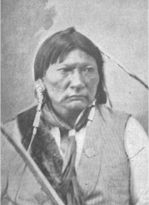
Within the last 50 years they have been terribly wasted by war and disease. They numbered 1,400 in 1904, attached to the Kiowa agency, Okla.
The Comanche were nomad buffalo hunters, constantly on the move, cultivating little from the ground, and living in skin tipis. They were long noted as the finest horsemen of the plains and bore a reputation for dash and courage. They have a high sense of honor and hold themselves superior to the other tribes with which they are associated. In person they are well built and rather corpulent. Their language is the trade language of the region and is more or less understood by all the neighboring tribes. It is sonorous and flowing, its chief characteristic being a rolling r. The language has several dialects.
The gentile system seems to be unknown among the Comanche. They have, or still remember, 12 recognized divisions or bands and may have had others in former times. Of these all but 5 are practically extinct. The Kwahari and Penateka are the most important. Following, in alphabetic order, is the complete list as given by their leading chiefs: Detsanayuka or Nokoni; Ditsakana, Widyu, Yapa, or Yamparika; Kewatsana; Kotsai; Kotsoteka; Kwahari or Kwahadi; Motsai; Pagatsu; Penateka or Penande; Pohoi (adopted Shoshoni); Tanima; Tenawa or Tenahwit; Waaih. In addition to these the following have also been mentioned by writers as Comanche divisions: Guage-johe, Keaston, Kwashi, Muvinabore, Nauniem, Parkeenaum.

