
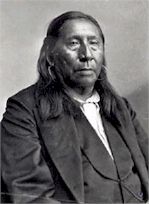
Nawat
Nawat (‘Left-hand’ ). The principal chief of the Southern Arapaho since the death of Little Raven in 1889.
He was born about 1840, and because noted as a warrior and buffalo hunter, taking active part in the western border wars until the treaty of Medicine Lodge in 1867, since which time his people, as a tribe, have remained at peace with the whites.
In 1890 he took the lead in signing the allotment agreement opening the reservation to white settlement, notwithstanding the Cheyenne, in open council, had threatened death to anyone who signed. He several times visited Washington in the interest of his tribe. Having become blind, he has recently resigned his authority to a younger man.
Little Raven
Little Raven (Hósa, ‘Young Crow’). An Arapaho chief.
He was first signer, for the Southern Arapaho, of the treaty of Fort Wise, Colo., Feb. 18, 1861. At a later period he took part with the allied Arapaho and Cheyenne in the war along the Kansas border, but joined in the treaty of Medicine Lodge, Kansas, in 1867, by which these tribes agreed to go on a reservation, after which treaty all his effort was consistently directed toward keeping his people at peace with the Government and leading then to civilization.
Through his influence the body of the Arapaho remained at peace with the whites when their allies, the Cheyenne and Kiowa, went on the warpath in 1874-75.
Little Raven died at Cantonment, Okla., in the winter of 1889, after having maintained for 20 years a reputation as the leader of the progressive element. He was succeeded by Nawat, ‘Left-hand’.

