
Geronimo
Geronimo (Spanish for Jerome, applied by the Mexicans as a nickname; native name Goyathlay, `one who yawns’). A medicine man and prophet of the Chiricahua Apache who, in the latter part of the 19th century, acquired notoriety through his opposition to the authorities and by systematic and sensational advertising; born about 1834 at the headwaters of Gila River, New Mexico, near old Ft Tulerosa. His father was Taklishim, ‘The Gray One,’ who was not a chief, although his father (Geronimo’s grandfather) assumed to be a chief without heredity or election. Geronimo’s mother was known as Juana.
When it was decided, in 1876, in consequence of depredations committed in Sonora, of which the Mexican government complained, to remove the Chiricahua from their reservation on the south frontier to San Carlos, Arizona, Geronimo and others of the younger chiefs fled into Mexico. He was arrested later when he returned with his band to Ojo Caliente, New Mexico, and tilled the ground in peace on San Carlos reservation until the Chiricahua became discontented because the Government would not help them irrigate their lands. In 1882 Geronimo led one of the hands that raided in Sonora and surrendered when surrounded by Gen. George H. Crook’s force in the Sierra Madre. He had one of the best farms at San Carlos, when trouble arose in 1854 in consequence of the attempt of the authorities to stop the making of tiswin, the native intoxicant.
During 1884-85 he gathered a band of hostiles, who terrorized the inhabitants of south Arizona and New Mexico, as well as of Sonora and Chihuahua, in Mexico. Gen. Crook proceeded against them with instructions to capture or destroy the chief and his followers.
In March 1886, a truce was made, followed by a conference, at which the terms of surrender were agreed on; but Geronimo and his followers having again fled to the Sierra Madre across the Mexican frontier, and Gen. Miles having been placed in command, active operations were renewed and their surrender was ultimately effected in the following August. The entire band, numbering about 340, including Geronimo and Nachi, the hereditary chief, were deported as prisoners of war, first to Florida and later to Alabama, being finally settled at Ft Sill, Oklahoma, where they now (1904) reside under military supervision and in prosperous condition, being industrious workers and careful spenders. (J. M. C. T. )
Consult further:
Cochise
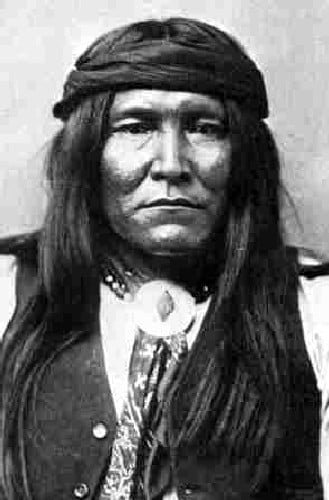
Cochise. A Chiricahua Apache chief, son and successor of Nachi. Although constantly at feud with the Mexicans, he gave no trouble to the Americans until after he went, in 1861, under a flag of truce, to the camp of a party of soldiers to deny that his tribe had abducted a white child. The commanding officer was angered by this and ordered the visiting chiefs seized and bound because they would not confess. One was killed and four were caught, but Cochise, cutting through the side of a tent, made his escape with three bullets in his body and immediately began hostilities to avenge his companions, who were hanged by the Federal troops. The troops were forced to retreat, and white settlements in Arizona were laid waste.
Soon afterward the military posts were abandoned, the troops being recalled to take part in the Civil war. This convinced the Apache that they need only to fight to prevent Americans front settling in their country. Cochise and Mangos Coloradas defended Apache pass in southeast Arizona against the Californians, who marched under Gen. Carleton to reopen communication between the Pacific coast and the east. The howitzers of the California volunteers put the Apache to flight. When United States troops returned to resume the occupancy of the country after the close of the Civil war, a war of extermination was carried on against the Apache.
Cochise did not surrender till September, 1871. When orders came to transfer his people from Canada Alamosa to the new Tularosa reservation, in New Mexico, he escaped with a hand of 200 in the spring of 1872, and his example was followed by 600 others. After the Chiricahua reservation was established Arizona, in the summer of 1872, he carne in, and there died in peace June 8, 1874. He was succeeded as chief by his son Taza. The southeastern most county of Arizona bears Cochise’s name.
Consult further:
Nahche
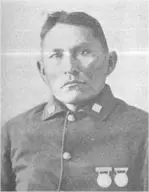
Nahche (Na-ai-che, `mischievous,’ `meddlesome.’-George Wrattan). An Apache warrior, a member of the Chiricahua band. He is the second son of the celebrated Cochise, and as hereditary chief succeeded his elder brother, Tazi, on the death of the latter. His mother was a daughter of the notorious Mangas Coloradas.
As a child Nahche was meddlesome and mischievous, hence his name. He was the leading spirit in the many raids that almost desolated the smaller settlements of Arizona and New Mexico and of northern Chihuahua and Sonora between 1881 and 1886, for which Geronimo’s, a Medicine-man and malcontent rather than a warrior, received the chief credit. In the latter year Geronimo’s band, so called, of which Nahche was actually the chief, was captured by General Miles and taken as prisoners of war successively to Florida, Alabama, and finally to Ft Sill, Okla., where Nahche still resides, respected by his own people as well as by the whites. He is now (1907) about 49 years of age. In his prime as a warrior he was described as supple and graceful, with long, flexible hands, and a rather handsome face. His present height is 5 ft. 10½ in. Col. H. L. Scott 1 , for four years in charge of the Chiricahua prisoners in Oklahoma, speaks of Nahche as a most forceful and reliable man, faithfully performing the duties assigned to him as a prisoner, whether watched or not. He was proud and self-respecting, and was regarded by the Chiricahua at Ft Sill as their leader. In recent years, however, he has lost his old-time influence as well as some of his trustworthiness. 1
Consult further:
Nakaidoklin
Nakaidoklini (? ‘freckled Mexican’ Matthews) An Apache medicine-man called Babbyduclone, Barbudeclenny, Bobby-dok-linny, Nakydoklunni, Nock-ay-Delklinne, etc., by the whites, influential among the White Mountain Indians in 1881, near Camp Apache, Arizona. He taught them a new dance, claiming it would bring dead warriors to life. In an attempt to arrest him, August 30, the Apache scouts with the troops turned upon the soldiers, resulting in a fight in which several were killed on each side, including the medicine-man himself.
Consult further:
- Bourke in 9th Rep. B. A. E. 505, 1892;
- Mooney in 14th Rep. B.A.E. 704, 1896.
Mangas Coloradas
Mangas Coloradas (Span: `red sleeves’) . A Mimbreños Apache chief. He pledged friendship to the Americans when Gen. S. W. Kearny took possession of New Mexico in 1846. The chief stronghold of the Mimbreños at that time was at the Santa Rita copper mines, south west New Mexico, where they had killed the miners in 1837 to avenge a massacre committed by white trappers who invited a number of Mimbreños to a feast and murdered them to obtain the bounty of $100 offered by the state of Chihuahua for every Apache scalp. When the boundary commission made its headquarters at Santa Rita trouble arose over the taking from the Mimbreños Apache of some Mexican captives and over the murder of an Indian by a Mexican whom the Americans refused to hang on the spot: The Mimbreños retaliated by stealing some horses and mules belonging to the commission, and when the commissioners went on to survey another section of the boundary the Indians conceived that they had driven them away. In consequence of indignities received at the hands of miners at the Pinos Altos gold mines, by whom he was bound and whipped,- Mangas Coloradas collected a large band of Apache and became the scourge of the white settlements for years. He formed an alliance with Cochise to resist the Californian volunteers who reoccupied the country when it was abandoned by troops at the beginning of the Civil war, and was wounded in an engagement at Apache pass, south east Arizona, that grew out of a misunderstanding regarding a theft of cattle. His men took him to Janos, in Chihuahua, and left him in the care of a surgeon with a warning that the town would be destroyed in case he were not cured: According to one account, soon after his recovery he was taken prisoner in Jan., 1863, by the Californians and was killed while attempting to escape, goaded, it is said, with a red-hot bayonet 2 , while Bell 3 states that in 1862 he was induced to enter Ft McLane, New Mexico, on the plea of making a treaty and receiving presents. The soldiers imprisoned him in a hut, and at night a sentry shot him under the pretext that he feared the Indian would escape.
Consult further:
- Bancroft, Arizona and New Mexico, 1880.

- Information from Geo. Wrattan, official interpreter, 1907.[↩][↩]
- Dunn, Massacres of the Mountains, 365, 374, 382, 1886[↩]
- Bell, New Tracks, II, 24, 1869[↩]
1
3
5
Need the family tree started My grandma maiden name was Inez moody than she married my Grandpa Wallace George sr. their sibling were jasper george ,jackson george Sr. ,georgianna george,and Nellie george