
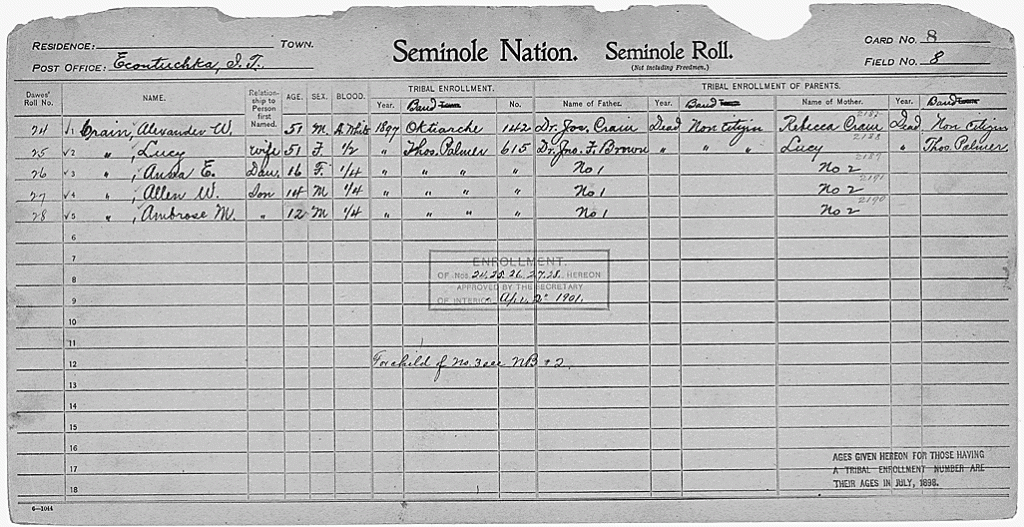
During the period of Indian Removal beginning in 1831 extensive records were generated through the turn of the century when Southeastern Indians were uprooted from their homelands in Georgia, Alabama, Mississippi and Florida. They were taken west of the Mississippi River in what is now Oklahoma. These records relate to treaties, trade, land claims, removal to Oklahoma, allotments, military affairs, military service and pensions, trust funds, and other activities. While the vast majority reference Southeastern Tribes, there are some which pertain to Western tribes as well.
Research for American Indian ancestors begins just like any other search for ancestors; you have to begin with what you know now. Prepare your ancestor charts beginning with yourself. Include all names, nicknames and any other identifying information on each person, be sure to check the more traditional resources: local and state records, census records, land records, court cases, probate records, church and school records…Jackie Matte, author of “They Say the Wind is Red”.
Native American rolls are viewed by many as one of the most useful resources for researching your Native American (Indian) Ancestors. However, until you know where your Native American ancestors resided, the rolls will be of no value to you. Proving Your Indian Ancestry is a guide to your Native American research.
To further your Indian Roll search we have added mailing lists. We have invited many individuals to join these lists with knowledge of the rolls and their history. It is hoped that we will be able to expand the descriptions of each of the rolls so the readers will have a better understanding of their uses.
Each roll is a link to a further explanation of that roll and why you need to search that roll. Where possible, we provide free online links to the actual rolls.
Reservation Rolls
Reservation Roll – 1817 History Cherokee Tribe A listing of those applying for a 640 acre tract in the East in lieu of removing to Arkansas. This was only good during their lifetime and then the property reverted back to the state. This is only an index of applicants, the people listed here did not in most instances receive the reservation they requested.
Reservation Roll Mailing list
Search – Reservation Roll Database
Armstrong Rolls
Armstrong Roll – Choctaw Tribe – Under the treaty of Dancing Rabbit Creek the information called for by the resolutions of the Senate of the 3d of March, in relation to the location of reservations under the treaty with the Choctaws of September 27th, 1830.
Armstrong Roll Mailing List
Search – Armstrong Roll Database
Emigration Rolls
Emigration Roll – 1817-1835 – Cherokee Tribe Those who filed to emigrate to Arkansas country, and after treaties in 1828 on to Oklahoma. These Cherokee became known as the Old Settlers after the Eastern Cherokee joined them in 1839
Emigration Roll Mailing List
Henderson Rolls
Henderson Roll – 1835 -Cherokee Tribe – A Census of over 16,000 Cherokee residing in Alabama, Georgia, Tennessee and North Carolina to be removed to Oklahoma under the terms of the treaty of New Echota in 1835. See Trail of Tears Roll below.
Henderson Roll Mailing List
Trail of Tears Rolls
Trail of Tears Roll – 1835 – Cherokee Tribe – This is actually a report from the Secretary of War, in compliance with resolutions of the Senate, statements showing the persons employed, the funds furnished, and the improvements valued under the Cherokee Treaty of December 1835.
Search – Trail of Tears Roll –
Mullay Rolls
Mullay Roll – 1848 – Cherokee Tribe – A census of 1,517 Cherokee remaining in North Carolina after the removal of 1838. John C. Mullay took the census pursuant to an act of congress in 1848.
Mullay Roll Mailing List
Muster Rolls
Ha Cubbees Band Muster Roll – 1847 – Choctaw Tribe – Muster roll of a party of immigrant Choctaw Tribe of the Ha Cubbees Band who arrived at Fort Coffee, in the Choctaw Nation West, on the 23 of June 1847
Muster Roll of Big Black River Band – 1847 – Choctaw Tribe – Muster roll of a party on immigrant Choctaw Tribe, known as the Big Black River Band who arrived at Fort Coffee, in the Choctaw Nation West on the 10th of June 1847.
Chapman Rolls
Chapman Roll – 1851 – Cherokee Tribe – Prepared by Albert Chapman as a listing of those Cherokee actually receiving payment based on the Siler Census.
Join the Chapman Roll Mailing List
Old Settlers Rolls
Old Settler Roll – 1851 – Cherokee Tribe – A listing of Cherokee, still living in 1851, who were already residing in Oklahoma when the main body of the Cherokee arrived in the winter of 1839, as a result of the Treaty of New Echota. Approximately one third of the Cherokee people at that time were Old Settlers and two thirds were new arrivals.
Join the Old Settler Roll Mailing List
Search – Old Settlers Roll –
Siler Rolls
Siler Roll – 1852 – Cherokee Tribe – A listing of those Eastern Cherokee entitled to a per capita payment pursuant to an act of Congress in 1850.
Siler Roll Mailing List
Act of Congress Rolls
Act of Congress Roll – 1854 – Cherokee Tribe
An Act of Congress of July 31, 1854 (10 Stat 333) Authorized the addition of 88 individuals whose names were omitted by Siler but who were included on the Roll prepared by Mullay.
Drennen Rolls
Drennen Roll – 1852 – Cherokee Tribe – The first census of the new arrivals of 1839. The New Echota Treaty group. The Drennen roll is a per-capita payment made to Cherokees living in the west who removed as a result and after the Treaty of 1835 Article 9. The roll was prepared by John Drennen and contains the payee’s name, Cherokee district and then family group.
Drennen Roll Mailing List
Search – Drennen Roll Database
Cooper Rolls
Cooper Rolls – 1855 – Choctaw Tribe – Census Rolls of Choctaw Families residing East of the Mississippi River and in the States of Mississippi, Louisiana and Alabama made by Douglas H. Cooper, US Agent for Choctaws, in conformity with Order of Commissioner of Indian Affairs dated May the 23rd, 1855.
Cooper Roll Mailing List
Search – Cooper Rolls
Land Allotments
Kansas Kickapoo Land Allotments – 1862 (hosted at Native Americans in Kansas)
1863 Pottawatomie Land Roll – 1863 (hosted at Native Americans in Kansas)
Swetland Rolls
Swetland Roll – 1869 – Cherokee Tribe – Prepared by S. H. Swetland as a listing of those Eastern Cherokee, and their descendants, who were listed as remaining in North Carolina by Mullay in 1848. Made pursuant to an act of Congress (1868) for a removal payment authorization.
Swetland Roll Mailing List
1871 Shawnee Census
Register of the names of members of the Shawnee Tribe of Indians who have moved to and located in the Cherokee Nation, Indian Territory, (prior to the 10th day of June, 1871) within two years from the 9th day of June 1869, in accordance with an agreement entered into by and between the Shawnee Tribe of Indians and the Cherokee Nation of Indians, through their Delegations in Washington City, D.C. United States of America, on the 7th day of June, 1869,and approved by the President of the United States on the 9th day of June, 1869, in accordance with the XV Article of the Cherokee Treaty with the United States proclaimed August the 11th, 1866.
Tribal Lists
Narragansett Tribal List – 1881 – A-I J-Z Final List of the Members of the Narragansett Tribe Entitled to a Share of the Purchase Money 1881
Hester Rolls
Hester Roll Index – 1883 – Cherokee Tribe
Compiled by Joseph G. Hester as a roll of Eastern Band of Cherokee Tribe in 1883. This Roll itself provides the Chapman roll number and English and Indian name.
Hester Roll Mailing List
Search – Hester Roll
Allotment Rolls
Citizens Band Land Allotment Rolls – 1887 (hosted at Native Americans in Kansas)
Land Allotment of Pottawatomie, Prairie Band – 1887 (hosted at Native Americans in Kansas)
Citizens Band Land Allotment Roll Kansas Potawatomie – 1887 (hosted at Native Americans in Kansas
Dawes/Final Rolls
Index to the Final Rolls of Citizens and Freedmen of the Five Civilized Tribes in Indian Territory (Dawes) 1889-1914
- 1896 Applications – History
- Index If your ancestor was not living in Indian Territory at this time, they will not be listed on Dawes!!
- Dawes Final Roll Please read Understanding the Final (Dawes) Roll
Final Roll Mailing List
Search – 1896 Applications – Dawes/Final Index – Dawes/Final Roll
McKennon Roll
McKennon Roll – 1889 – Choctaw Tribe – Proposed Legislation for the Full-blood and identified Choctaws of Mississippi, Louisiana, and Alabama: Memorial Evidence and Brief published I believe in 1913.
McKennon Roll Mailing List
Search – McKennon Roll
Wallace Rolls
Wallace Roll – 1890 – Cherokee Freedmen – Roll of Cherokee Freedmen in Indian Territory created by Special Agent John W. Wallace. Individuals on the schedule were entitled to share with the Shawnee and Delaware in the per capita distribution of $75,000, appropriated by Congress in October 1888, and issued under the supervision of his office. Database allows search for names, age, roll numbers.
Wallace Roll Mailing List
Search – Wallace Roll
Land Allotment Rolls
Kansas Kickapoo Land Allotment Roll – 1890 (hosted at Native Americans in Kansas)
Kansas Kickapoo Roll – 1891 (hosted at Native Americans in Kansas)
Citizens Band Pottawatomie Roll – 1892 (hosted at Native Americans in Kansas)
Kern Clifton Roll
Kern Clifton Roll – 1897 – Cherokee Freedmen – Census of the Freedmen and their descendants of the Cherokee Nation taken by the Commission appointed in the case of Moses Whitmire, Trustee of the Freedmen of the Cherokee Nation versus the Cherokee Nation and the United States in the Court of Claims at Washington, DC.
The Kern Clifton Roll came about due to the Cherokee Nation disputing the number of freedmen included in the Wallace Roll… yet the Kern Clifton Roll actually increased the number of people eligible for payment. This database allows you to search by surname of district.
Kern Clifton Roll Mailing List
Search – Kern Clifton Roll
Prairie Band Rolls
Pottawatomie, Prairie Band Roll – 1900 (hosted at Native Americans in Kansas)
Kansas Kickapoo Roll – 1905 (hosted at Native Americans in Kansas)
Churchill Roll
Churchill Roll – 1908 – Cherokee Tribe – By Inspector Frank C. Churchill to certify members of the Eastern Band of Cherokee Tribe. Like the Hester roll it includes a lot of information including degree of blood.
Churchill Roll Mailing List
Guion Miller Roll
Guion Miller Roll – 1909 – Cherokee Tribe – Compiled by Mr. Miller of all Eastern Cherokee, not old Settlers, residing either east or west of the Mississippi. Ordered by the Court of Claims as a result of a law suit won by the Eastern Cherokee for violations of certain treaties.
Guion Miller Roll Mailing List
Search – Guion Miller Roll
Prairie Band Rolls
Kansas Kickapoo Roll – 1915 (hosted at Native Americans in Kansas)
Citizen Band Potawatomi – 1918 (hosted at Native Americans in Kansas)
Pottawatomie, Prairie Band Roll – 1921 (hosted at Native Americans in Kansas)
Free RootsWeb Databases
Baker Roll – 1924 – Cherokee Tribe – This was supposed to be the final roll of the Eastern Band of Cherokee Tribe. The land was to be allotted and all were to become regular citizens of the United States. Fortunately the Eastern Band of Cherokee avoided the termination procedures, unlike their brothers of the western nation. The Baker Roll “Revised” is the current membership roll of the Eastern Band of Cherokee Tribe of North Carolina.
Baker Roll Mailing List
Search – Baker Roll
Ute Roll
Ute Roll – 1954 – Ute Tribe – The following database contains 2 rolls, the Full Blood Roll and the Mixed Blood Roll of the Ute Tribe of Uintah and Ouray Reservation in Utah. These are the PROPOSED rolls, and do not signify that the individuals listed upon it actually received any distribution under Title 25, Chapter 14, Subchapter 28, U.S. Code.
Search – Ute Roll

I am looking for information for my great grandmother ella sweet born 1895 died 1970 approx. Dates in oklahoma . her parents were church white born in kentucky and adeline or adline dupree. Born kentucky 1857-1912 I have been researching and i believe it says ella went to ponca reservation school in oklahoma not sure though. My grandmother is espanola shaw born 1927 lived in Springer oklahoma township. She married silas shaw. His parents were Lady Bea Whitefield 1899-1992 and Wesley Shaw . 1898-1962 I have been told she is cherokee freedmen but not sure and I havent found much info on church or churchill or churchele white. Those are the different spellings of what i have been told. Any info u could help me with would be great and appreciated
My grandmother frances ashcraft was western cherekee can anyone please help me find her ?
Searching if Mother-In-Law was American Indian. I have traced her material side to find they came from Scotland. Her father’s side is Ernest H. Sherman DOB 1903 Maine. His father Charles Sherman born in Maine, from census it states his father was born in Maine. Census states they are white, would one list them selves as American Indian on the census? Mother-In- law said she was half American Indian. Do not know what direction to take to find out tribe she came from.
My great great grandmother was Indiana Hawkins born in 1814 an only daughter of Isaiah Hawkins who was 66 years old at his daughters birth. Both persons were born in Chicago Arkansas. At the age of 7 around 1971 I remember speaking to my great, great uncle Isaiah Hawkins who was age 97. He was the son of Indiana Hawkins on my mothers father side of the family ( Richard Johnson). Uncle Isaiah lived in Little rock Arkansas and was a Cherokee Indian Tribe Native out of Chicago, Arkansas. Once I looked up Indiana Hawkins and it showed how she was the mother of the Chwrkee Indian Tribe. If any one knows anything about the Hawkins in Arkansas, the Browns, Johnson’s in Louisiana,
Willows Isand and Rayville, the plantation. and Missouri the Alexander’s or Johnson’s and Alice and Alma Roundtree please respond. Trying to locate my family
These are my family surnames same area
I am looking for my blood brother by the name of So Happy. We served in the 101ST ABN 1/327th Inf ABU Co. and tiger force in 1967. Can anyone please help me locate him or give me more information about him. He saved my life once and we became very close. He only wanted to be known by his Indian name so I honored his wishes. I was shot and medivaced out and he was still there. Please help me locate him.
My father is Robert E Buck, of New Bern NC, he once told me I full blooded Great Grandparents that were Cherokee.
My brother and I are trying to piece together our heritage but don’t know much about our fathers side, does anyone know a good resource?
My Gma is Buck also.
Her father is said tp be full blood.
Im trying to piece thing together also
Looking for Choctaw connection,my great grandmother was Mary Polly King,she was married to Andrew Jackson Gill ,her mother wasMary Margaret Parker who married John King of North Carolina,his father was James King who was married to Penny Jackson,have heard her father was a Choctaw Indian chief and that James was known as Chief Moushulatubbe,don’t know if this is true,can you help?
Trying to verify my grandfathers Indian heritage. Linwood Jones born in Arkansas, lived around Jonesboro, Mountain View, Leachville, AR areas. born early 1900’s said to be at least 1/2 Indian he looked like it. Good man. How do I find more information. Married my Grandmother Jerlean Green
I am trying to find information on my husband’s great great grandma. Her name is Lauretta Angelina Croy. She married George Washington Farrar. We are trying to find out if she was native american or not. Can’t find any birth records. Story passed down was court house caught fire burning records. I have exhausted all resources.
My grandmother had access to free healthcare, via the Seattle Indian Clinic, while living there. Having been called “half breed” growing up she never talked about nor wanted to know her bloodline. According to the BIA/DOI the only way she was eligible for the healthcare is her parents(Dad I’ve heard) registered her through a true bloodline. I’ve been told her grandfather was full blood native american. I’ve traced his surname back to Europe but found no proof of Indian blood. Recently my mother found a ring in my grandmother’s estate with Indian sounding names. So I moved my search closer to where the family lived, Iowa Wisconsin Nebraska. Still no solid connection, a lot of secrecy or resentment in the family makes it hard to trace my roots. The surname is Parsons, Elias- Clifford- Charlotte,my grandma. I have no other interest more than knowing my heritage. I want to know about how the tribe lived, their customs and traditions. The surname Parsons means pastor/preacher of the church, so I’m leaning toward the idea my defendants parents were killed and he was orphaned and the Parsons family made him part of the family. I live in Tx and have exhausted all local resources, any help or suggestions are welcome. good luck to us all.
Hi, trying to find out if my great grandmother Rebecca powell loving was from the powhatan indians. I was told this but have no proof.
none of my relatives ever applied to the Indians for money or anything , it just made me feel so lost , t got in touch in Washington DC .our government , they told me to get in touch with the Cherokee Nation ,again no response.
GBB
Kim: I wanted to ask if you had any other information on your Great Grandfather. I have searched the Dawes Enrollment Cards and the Eastern Cherokee Applications but did not find a Roy Lee Beck. Is there any other information such as his brothers, sisters, parents names? Do you happen to know where they were living in 1904? I did find a census record that matched Roy Lee Beck living in New Mexico married to a woman named Velma. Any other information you can offer would be greatly appreciated.
Hello I am looking for my great grand father who is assumed full blood Cherokee all the information I have is that his name was found on the Cherokee row call. I don’t have a number. Name Roy Lee Beck the date I was given is 3/16/1904. Can someone please help me I also need to know his parents names.
HUARACHON1:
I have looked on Ancestry.com census rolls and marriage certificates as well as public member trees. From the information I found, your great grandmother’s parents are John R Johnson Jr and Sarah Laura Prichard according to marriage information in Carroll County Arkansas. According to Sarah Laura Prichard’s death certificate it listed her father as Brown Prichard and Rhoda Robinson as her mother. I checked on fold3 Dawes Packets and Eastern Cherokee Applications and did not find any of these names listed.
If you find any other information that may help, I will check further. By the way, Ludie’s name was only listed with a J initial on one instance of a census record. Most info shows her middle name as Albert.
I got in touch with cherokee people in NC ,they were so ,they didnt want to.talk to me
I am from North Carolina ,and Cherokee , my book of my relatives are Cherokee.I have a book in the library of Congress of my family of Ashe Co. of NC.but they told in so many words I was too late .so
With the Eastern Cherokee s you have to a certain degree. With most Cherokees it is too late for the Eastern Cherokee. If I am not mistaken you have me 1/16th don’t quote me.
Western Cherokee are Not a recognized tribe. Unless it has changed. Check Federal Register and this will show you the recognized tribes.
https://www.federalregister.gov/documents/2019/02/01/2019-00897/indian-entities-recognized-by-and-eligible-to-receive-services-from-the-united-states-bureau-of
My great grandmothers name was Ludie Jane Johnson and she was born in 1897 and died in 1991. She married William George Wood in 1917 in Carroll County Arkansas. I am trying to find her parents names and am at a dead end. I know her mother, who would be my gg grandmother was Cherokee Indian. I have exhausted all means I can think of!! Thanks for any help.