
Since this is a discussion of the general characteristics of Plains Indians, we shall not take them up by tribes, as is usual, but by topics, Anthropologists are accustomed to group the facts of primitive life under the following main heads: material culture (food, transportation, shelter, dress, manufactures, weapons, etc.), social organization, religion and ceremonies, art, language, and physical type.
Food
The flesh of the buffalo was the great staple of the Plains Indians, though elk, antelope, bear and smaller game were not infrequently used. On the other hand, vegetable foods were always a considerable portion of their diet, many of the eastern groups cultivating corn (maize) and gathering wild rice, the others making extensive use of wild roots, seeds, and fruits. All the tribes living on the edges of the buffalo area, even those on the western border of the Woodlands, seem to have made regular hunting excursions out into the open country. Thus Nicolas Perrot writing in 1680-1718 says of the Indians in Illinois:
The savages set out in the autumn, after they have gathered the harvest, to go hunting; and they do not return to their villages until the month of March, in order to plant the grain on their lands. As soon as this is done, they go hunting again, and do not return until the month of July.
Early explorers in the plateaus to the west of the plains tell us that the Nez Perce and Flathead of Idaho and even the inhabitants of the Rio Grande pueblo of Taos, New Mexico, made periodical hunting excursions to the plains.
To most of the Plains tribes, the introduction of the European horse was a great boon. Unfortunately, we have no definite information as to when and how the horse was spread over the plains but it was so early that its presence is noted by some of the earliest explorers. It is generally assumed that by trade and by the capture of horses escaping from the settlements, the various tribes quickly acquired their stock, first from Mexico and the southern United States, whence the Apache, Comanche, Kiowa, and Pawnee obtained them, and in turn passed them on to the north. The Shoshoni and other tribes of the Plateau area were also pioneers in their use. Even as early as 1754 horses are reported in great numbers among the Blackfoot, one of the extreme Northern Plains groups. Hence, we have no detailed information as to the mode of life among these tribes before the horse was introduced, except what is gleaned from their tribal traditions. That the use of the horse made a great change in culture is quite probable. It must have stimulated roving and the pursuit of the buffalo and discouraged tendencies toward fixed abodes and agriculture.
Map showing the Distribution of the Buffalo about 1800

The larger area defines the limits of the buffalo range in 1800 as determined by Dr. J. A. Allen. The smaller area indicates the range of the Plains Indians. While the bison area is somewhat larger than the culture area, the largest herds were found within the bounds of the latter. On the other hand, the cultures of tribes along the borders of the area are often intermediate in character. Hence, we find a rather close correlation between the distribution of the bison and culture traits, the nine typical tribes living where the herds were thickest.
Buffalo Hunting
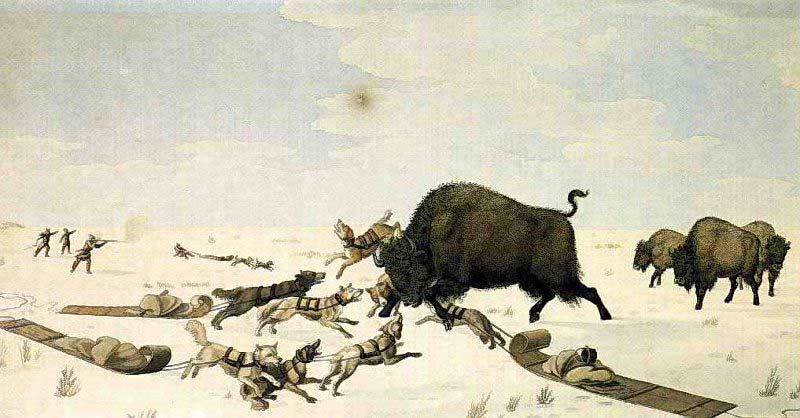
All Plains tribes seem to have practiced cooperative hunting in an organized military-like manner in hunting the buffalo. This usually took the form of a surround in which a large body of Indians on swift horses and under the direction of skilled leaders rode round and round a herd bunching them up and shooting down the animals one by one. Stirring accounts of such hunts have been left us by such eye-witnesses as Catlin, James, and Grinnell. All tribes seem to have used this method in summer and it was almost the only one followed by the Southern Plains tribes.
In winter, however, when the northern half of the plains was often covered with snow, this method was not practiced. Alexander Henry, Maximilian, and others, have described a favorite winter method of impounding, or driving the herd into an enclosure. Early accounts indicate that the Plains-Cree and Assiniboin were the most adept in driving into these en closures and may perhaps have introduced the method among the Plains tribes. The Plains-Cree are but a small outlying part of a very widely distributed group of Cree, the culture of whose main body seems quite uniform. Now, even the Cree east of Hudson Bay, Canada, use a similar method for deer, and since there is every reason to believe that the Plains-Cree are but a colony of the larger body to the east, it seems fair to assume that the method of impounding buffalo originated with them. However that may be, some form of it was practiced by the Blackfoot, Gros Ventre, Hidatsa, Mandan, Teton-Dakota, Arapaho, Cheyenne, and perhaps others.
We have some early accounts of another method used in the prairies of Illinois and Iowa. Thus, in Perrot we read:
When the village has a large number of young men able to bear arms they divide these into three bodies; one takes its route to the right, another that to the left, and half of the third party is divided between the two former ones. One of these latter parties goes away [from its main column] a league or thereabout to the right, and the other remains on the left, both parties forming, each on its own side, a long file; then they set out, in single file, and continue their march until they judge that their line of men is sufficiently long for them to advance into the depths [of the forest]. As they begin their march at midnight, one of the parties waits until dawn, while the others pursue their way; and after they have marched a league or more another party waits again for daylight; the rest march [until] after another half-league has been covered, and likewise wait. When the day has at last begun, this third party which had separated to the right and the left with the two others pushes its way farther; and as soon as the rising sun has dried off the dew on the ground, the parties on the right and the left, being in sight of each other, come together in [one] file, and close up the end of the circuit which they intend to surround.They commence at once by setting fire to the dried herbage which is abundant in those prairies; those who occupy the flanks do the same; and at that moment the entire village breaks camp, with all the old men and young boys who divide themselves equally on both sides, move away to a distance, and keep the hunting parties in sight so that they can act with the latter, so that the fires can be lighted on all four sides at once and gradually communicate the flames from one to another. That produces the same effect to the sight as four ranks of palisades, in which the buffaloes are enclosed. When the savages see that the animals are trying to get outside of it, in order to escape the fires which surround them on all sides (and this is the one thing in the world which they most fear), they run at them and compel them to reenter the enclosure; and they avail themselves of this method to kill all the beasts. It is asserted that there are some villages which have secured as many as fifteen hundred buffaloes, and others more or fewer, according to the number of men in each and the size of the enclosure which they make in their hunting.
The natural inference seems to be that the grass firing and impounding methods of taking buffalo were developed before the introduction of the horse and are therefore the most primitive. The individual hunting of buffalo as well as in small parties was, of course, practiced. In modern times swift horses were used to bring the rider in range when he shot down the fleeing beasts. But before horses were known the cooperative method must have prevailed.
Hunting Implements
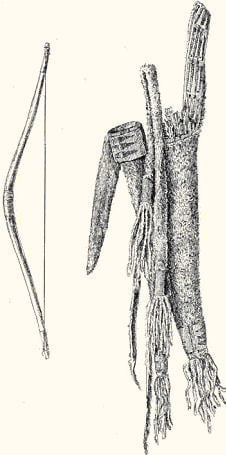
The implements used for killing buffalo were not readily displaced by guns. Bows and arrows were used long after guns were common. In fact, pioneers maintain that at close range the rapidity and precision of the bow was only to be excelled by the repeating rifle, a weapon developed in the 70’s. Even so, the bow was not entirely discarded until the buffalo became extinct. The bows were of two general types; the plain wooden bow, and the sinew-backed, or compound bow. It is generally held that the tribes east of the Mississippi River used the simple wooden bow while those on the Pacific Coast used the sinew-backed type. It is quite natural, there fore, that among the Plains tribes, we should find both types in general use and that the sinew-backed was more common among the Shoshoni and other Plateau tribes.
Some curious bows were made from mountain sheep horn backed with sinew, a fine example of which is to be seen in the Nez Perce collection (Fig. 1). The Crow, Hidatsa, and Mandan sometimes used a bow of elkhorn, probably one of the finest examples of Indian workmanship: “They take a large horn or prong, and saw a slice off each side of it; these slices are then filed or rubbed down until the flat sides fit nicely together, when they are glued and wrapped at the ends. Four slices make a bow, it being jointed. Another piece of horn is laid on the center of the bow at the grasp, where it is glued fast. The whole is then filed down until it is perfectly proportioned, when the white bone is ornamented, carved, and painted. Nothing can exceed the beauty of these bows, and it takes an Indian about three months to make one.” 1 All these compound bows are sinew-backed, it being the sinew that gives them efficiency. Some fine old wooden bows may be seen in the Museum s Dakota collection.
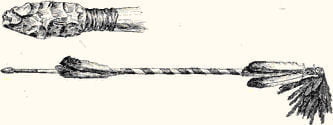
A lance was frequently used for buffalo : in the hands of a powerful horseman, this is said to have been quite effective. There is a stone-pointed lance in the Nez Perce collection which may be of the type formerly used, Fig. 2. Wounded animals and those in the enclosure of the pound were often brought down by knocking on the head with stone-headed clubs and mauls.
Pemmican
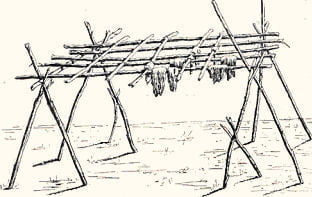
As buffalo could not be killed every day, some method of preserving their flesh in an eatable condition was necessary to the well-being of the Plains Indian. The usual method was by drying in the sun. Steaks were cut broad and thin, and slashed by short cuts which gaped open when the pieces were suspended, giving the appearance of holes. These steaks were often placed in boiling water for a few moments and then hung upon poles or racks out of reach of dogs. In the course of a few days, if kept free from moisture, the meat became hard and dry. It could then be stored in bags for future use. Fat, also, could be dried if slightly boiled.
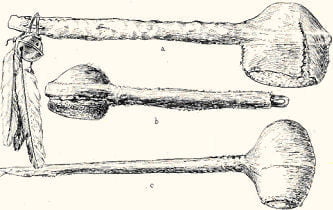
Dried meat of the buffalo and sometimes of the elk was often pounded fine, making what was known as pemmican. While some form of pemmican was used in many parts of North America, the most characteristic kind among the Plains Indians was the berry pemmican. To make this, the best cuts of the buffalo were dried in the usual manner. During the berry season wild cherries (Prunus demissa) were gathered and crushed with stones, pulverizing the pits, and reducing the whole to a thick paste which was partially dried in the sun. Then the dried meat was softened by holding over a fire, after which it was pounded fine with a stone or stone-headed maul. In the Dakota collection may be seen some interesting rawhide mortars for this purpose. This pulverized meat was mixed with melted fat and marrow, to which was added the dried but sticky cherry paste. The whole mass was then packed in a long, flat rawhide bag, called a parfleche. With proper care, such pemmican would keep for years. In pioneer days, it was greatly prized by white trappers and soldiers.

- Belden, 112.[↩]