
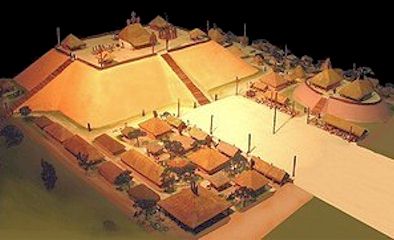
When English and Scottish settlers first arrived in what was to become the United States, they encountered literally thousands of abandoned earthen and shell mounds that seemed not to be associated with occupied Indian villages. Typically, the new arrivals assumed that the “savages” were intellectually incapable of carrying out major public works. Therefore, they speculated that Europeans or advanced societies from the Middle East had once lived in the New World until they were exterminated by the Indians. It would not be for another 200 years that the public would become generally aware that about 90-95% of the societies who built those mounds had died of diseases or had been enslaved in the decades following Spanish exploration of the region.
Some tribes in the Lower Mississippi Valley were still occupying mounds when French settlers arrived, so there was no French speculation about the origin of abandoned mounds. The best known of these last mound builders were the Natchez. They also stopped building mounds after the 1720s.
“Indian mound” is the common name for a variety of solid structures erected by some of the indigenous peoples of the United States. Most Native American tribes did not build mounds. The majority were constructed in the Lower Southeast, Ohio River Valley, Tennessee River Valley and the Mississippi River Valley. Some types of shell mounds can be found along the entire length of the United States’ Atlantic Coast.
Construction Materials
Mounds could be built out of topsoil, packed clay, detritus from the cleaning of plazas, sea shells, freshwater mussel shells or fieldstones. All of the largest mounds were built out of packed clay.
Construction Method
All of the mounds were built with individual human labor. Native Americans had no beasts of burden or excavation machinery. Soil, clay, or stones were carried in baskets on the backs of laborers to the top or flanks of the mound and then dumped. Hundreds of thousands of man-hours of work were required to build each of the larger mounds. It is likely that the shells in shell mounds were thrown there after large community feasts.
Between 900 AD and 1600 AD most mounds in the Lower Southeast were plastered with bands of brightly colored clays. The more advanced societies of the Lower Southeast and Mississippi Basin had professional architects, who laid out the structures in advance, then directed the work crews. It is believed that mound construction in the Ohio Valley and Lower Southeast during the period between 200 BC and 600 AD was supervised by religious leaders.
Uses of Mounds
The earliest mounds seem to have functioned both as public landmarks for seasonal gatherings and platforms for villages. Many of the shell mounds within the interior of the Southeast seem merely to have been piles of discarded freshwater mussel shells that marked the location of annual harvests and feasts. Burial mounds were built in the Southeast throughout several cultural periods. The massive geometric earthworks of the Hopewell Culture apparently defined locations of major regional trade festivals and religious gatherings. On the other hand, the pyramidal mounds of the Southeast, western Tennessee and Louisiana either were the bases of temples or the locations of important rituals. Some pyramidal mounds, built between 300 AD and 750 AD were the bases of mortuary temples, where human remains were applied special rituals and then cremated. Beginning around 700 AD in southern Florida, 900 AD farther north and 1000 AD in the middle Mississippi Basin, both pyramidal and conical mounds were the bases of conventional temples or the houses of important leaders. This architectural tradition continued until the 1600s, when most mound construction stopped in the Southeast.
Chronology
The earliest known mound is located near Watkins Brake, LA. It consists of an earthen ring over 300 feet (100m) in diameter with conical mounds of varying size dispersed around the crest of the ring. Archaeologists believe that it was constructed around 3500 BC as a ceremonial center for a community that migrated seasonally.
Between 2500 BC and 1200 BC many shell rings were constructed along the South Atlantic Coast. The largest concentration of shell ring construction is found on Sapelo Island, GA at the mouth of the Altamaha River. Some of the rings were quite large and apparently were the bases of small villages. More typical rings are about an acre in size or larger. Some shell rings were constructed in southern Florida, New England coast and the Mid-Atlantic coast after most construction stopped in the Southeast.
Beginning around 1600 BC and continuing though to around 1000 AD, native peoples living in the interior of the eastern United States constructed dome shaped mounds from either earth or fresh water mussel shells at locations where they congregated seasonally to fish, harvest shellfish or hunt. Some of these mounds were possibly used for burials.
Between 1200 BC and 500 BC massive semi-circular platforms were constructed in northern Louisiana and used as the bases of permanent villages. The larger villages, such as near Poverty Point, LA also constructed mounds on top of these platforms in the shapes of animals.
Between around 800 BC and 200 BC, an ethnic group, now known as the Adena People constructed hundreds of dome and cone shaped mounds in the Ohio River basin.
During the same period as the Adena Culture, Native peoples in the Southeast built many burial cairns and some large effigies out of fieldstone. They also constructed some cone shaped, earthen burial mounds.
Between 200 BC and 500 AD, participants in the Hopewell Trading Network built mounds and earthworks. Initially the mounds were simple cones like those of their neighbors the Adena. Over time they grew to massive, complex geometric forms. Toward the end of the Hopewell Period some of their mounds resembled the earthen pyramids of the Lower Southeast. Very few Hopewell houses have been discovered by archaeologists. Apparently, the villages were small seasonal settlements and did not contain mounds.
The Native peoples in the Lower Southeast possibly traded with those of the Hopewell Culture, but built permanent communities and ceremonial centers that resembled more the architecture of that time in Mexico. Around 0 AD, a massive pyramidal shaped mound that covered two acres was begun on the Etowah River in northwestern Georgia. Adjacent to it was a large plaza, smaller mounds and houses. The town around the mound was occupied for about 600 years. During that same era, Kolomoki, a town with as many as 20 mounds, that seems to have been a ceremonial center, was occupied in southwestern Georgia. There were also large complexes in the Okefenokee Swamp of Georgia and northern Florida.
Beginning around 300 AD an advanced culture began developing in southern Florida in the vicinity of Lake Okeechobee. By 700 AD, large towns with dozens of earthen structures were evolving in the region. Several of the towns seemed to have been influenced by the Mayas.
In 900 AD a large trading center was founded on the Ocmulgee River in what is now Macon, GA called Achese. Construction began on earthen mounds in the simplified forms of Maya architecture.
A little after 1000 AD, construction was begun on a massive mound near modern day St. Louis at a site now known as Cahokia. About that time, another major town was founded on the Etowah River in NW Georgia, now known as Etowah. About 1100 a very large ceremonial town began developing on the Black Warrior River near Tuscaloosa, AL. Monks Mound at Cahokia, Mound A at Etowah and Mound A near Tuscaloosa eventually became the largest, second largest and third largest mounds, respectively, constructed north of Mexico.
Between 1250 AD and 1300 AD there seems to have been a cultural or political change in the Southeast. Mounds built after this time tended to be smaller. Most towns were smaller two, but the number of towns grew dramatically.
Mound building stopped in most of the Southeast around 1600 AD, but continued for another hundred years on a smaller scale, in the Lower Mississippi River Valley.
Architectural Forms of Mounds
- Earthen rings
- Most mussel shell mounds were irregular ovals.
- Conical
- Dome shaped
- Truncated four sided pyramids
- Truncated five sided pyramids
- Ovals
Since most Indian mounds in the United States have been abandoned since 1600 AD or earlier, erosion, cultivation and exploratory excavations have radically changed their appearance from when they were in use. Visitors to historic sites, where mounds have been preserved, do not realize that they were once earthen buildings with brightly colored decorative motifs on the side. Most mounds also had large ceremonial ramps or at least wooden steps leading to the top. As a result, laymen often view the remnants of these huge structures as something akin to landscaping, rather than true forms of public architecture.

