
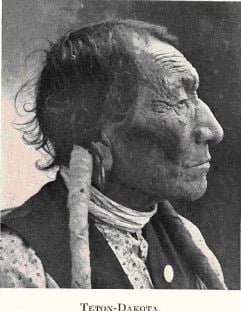
The materials for the following pages were gathered during a residence of seven years in the immediate neighborhood nay in the very midst of the once powerful but now nearly extinct tribe of Sioux or Dahcotah Indians.
Fort Snelling is situated seven miles below the Falls of St. Anthony, at the confluence of the Mississippi and St. Peter’s rivers built in 1819, and named after the gallant Colonel Snelling, of the army, by whom the work was erected. It is constructed of stone; is one of the strongest Indian forts in the United States; and being placed on a commanding bluff, has somewhat the appearance of an old German castle, or one of the strongholds on the Rhine.
The then recent removal of the Winnebago was rendered troublesome by the interference of Wabashaw, the Sioux chief, whose village is on the Mississippi, 1800 miles from its mouth. The father of Wabashaw was a noted Indian; and during the past summer, the son has given some indications that he inherits the father’s talents and courage. When the Winnebago arrived at Wabashaw’s prairie, the chief induced them not to continue their journey of removal; offered them land to settle upon near him, and told them it was not really the wish of their Great Father, that they should remove. His bribes and eloquence induced the Winnebago to refuse to proceed; although there was a company of volunteer dragoons and infantry with them. This delay occasioning much expense and trouble, the government agents applied for assistance to the command at Fort Snelling. There was but one company there; and the commanding officer, with twenty men and some friendly Sioux, went down to assist the agent.
[box]Dahcotah is an alternate spelling for the tribe better known as the Dakota Tribe.[/box]
- Introduction
- Preliminary Remarks On The Customs Of The Dahcotahs
- Mock-Pe-En-Dag-A-Win; or, Checkered Cloud, the Medicine Woman
- Red Earth; or, Mocka-Doota-Win
- Wenona; or, the Virgin’s Feast
- The Dahcotah Convert Wabashaw
- Wabashaw or the Leaf
- The Dahcotah Bride
- Shah-Co-Pee. The Orator of the Sioux
- Oye-Kar-Mani-Vim, The Track Maker
- Eta Keazah or, Sullen Face
- Tonwa-Yah-Pe-Kin, The Spies
- The Maiden’s Rock or, Wenona’s Leap
- The Indian in a Trance
- Oeche-Monesah, The Wanderer
- Tah-We-Chu-Kin, The Wife
- Wah-Zee-Yah, Another of the Giant Gods of the Dahcotahs
- Storms in Life and Nature; or, Unktahe and the Thunder Bird
- Haokah Ozape, The Dance of the Giant
- U-Mi-Ne-Wah-Chippe, or, To Dance Around
