
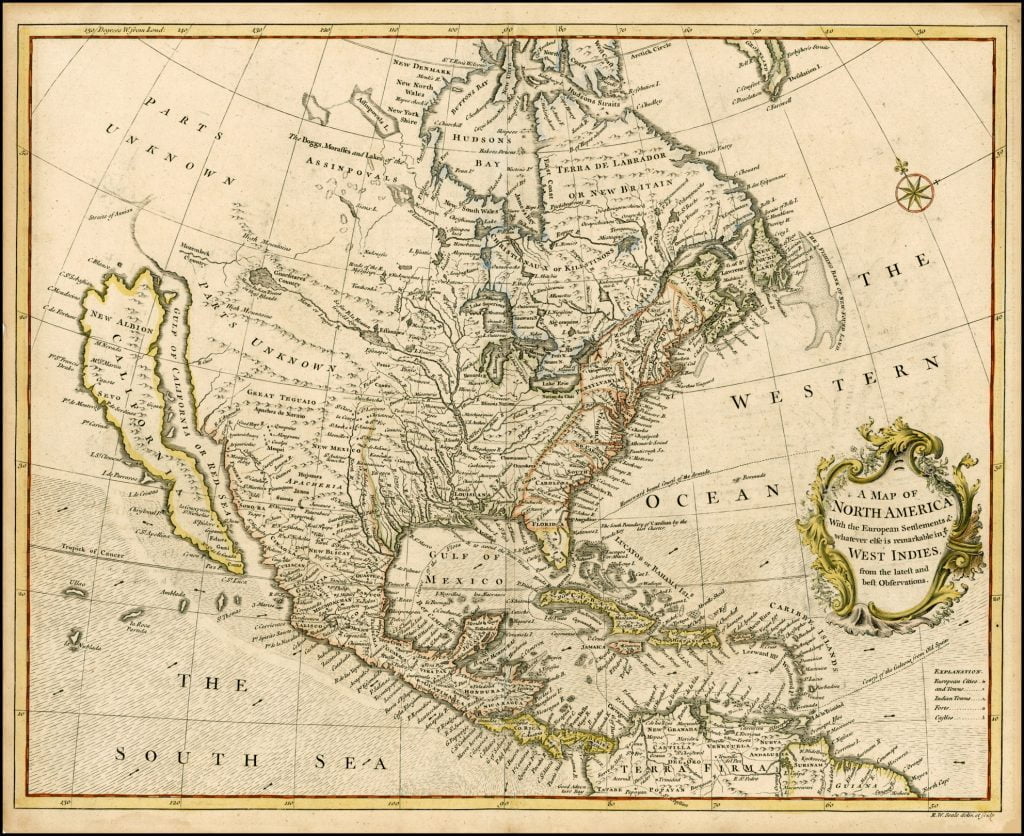
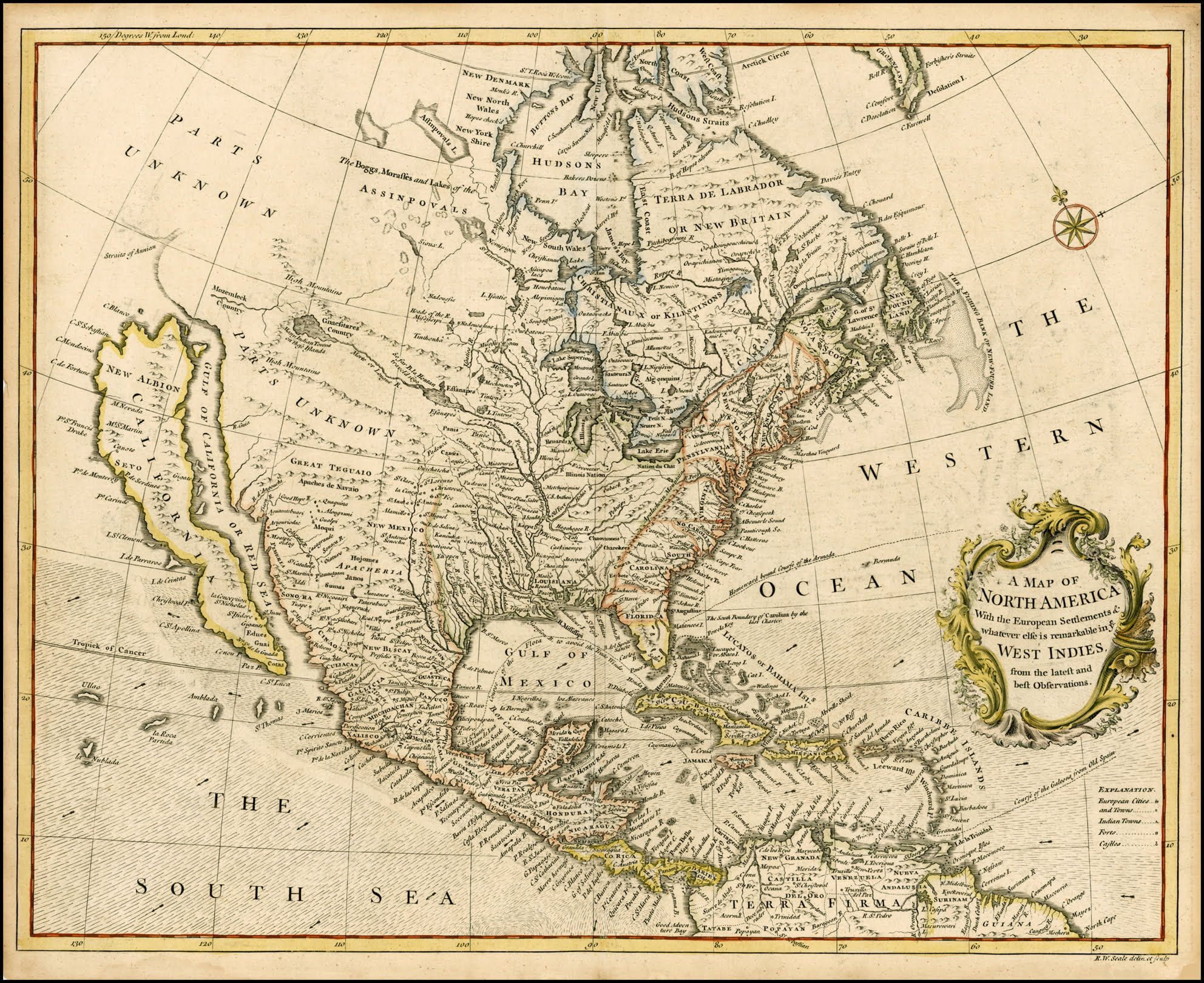
A Map of North America With the European Settlements & whatever else is remarkable in ye West Indies from the latest and best Observations
Tuskegee Indians. Many dialects were spoken anciently near the junction of the Coosa and Tallapoosa. Adair says:
I am assured by a gentleman of character, who traded a long time near the late Alebahma garrison, that within six miles of it live the remains of seven Indian nations, who usually conversed with each other in their own different dialects, though they understood the Muskohge language; but being naturalized, they are bound to observe the laws and customs of the main original body. 1
Some of these “nations” have already been considered. We now come to a people whose language has not been preserved to the present day, but they are known from statements made by Taitt and Hawkins to have spoken a dialect distinct from Muskogee. 2 These were the Tuskegee, 3 called by Taitt northern Indians. On inquiring of some of the old Tuskegee Indians in Oklahoma regarding their ancient speech I found that they claimed to know of it, and I obtained the following words, said to have been among those employed by the ancient people. Some of these are used at the present day, and the others may be nothing more than archaic Muskogee, but they perhaps have some value for future students.
- lutcu‛å, a mug.
- ki‛lås, to break.
- sia‛łito, I will be going; modern form, aibaatce‛.
- tcibūksa‛tce‛, come on and go with us! (where one person comes to a crowd of people and asks them to go with him).
- ili-hu‛ko-lutci, hen (-utci, little).
- talu‛sutci, chicken.
- ilisai‛dja, pot; modem form, lihai‛a łå‛ko.
- apa‛lå, on the other side; modem form, tåpa‛la.
- wilikå‛pkå, I am going on a visit; modern form, tcukupileidja-lani.
The town Tasqui encountered by De Soto between Tali and Coosa was perhaps occupied by Tuskegee. Ranjel is the only chronicler who mentions it, and it can not have impressed the Spaniards as a place of great importance. 4 In 1567 Vandera was informed by some Indians and a soldier that beyond Satapo, the farthest point reached by the Pardo expedition, two days’ journey on the way to Coosa, was a place called Tasqui, and a little beyond another known as Tasquiqui. 5 The second of these was certainly, the other probably, a Tuskegee town. It is possible that a fission was just taking place in this tribe.
Later in the seventeenth century, when English and French began to penetrate into the region, we find the Tuskegee divided into two or more bands, the northernmost on the Tennessee River. Coxe, who gives their name under the distorted form Kakigue, places these latter upon an island in the river. 6 While they are noticed in documents and on maps at rare intervals (I find the forms Cacougai, Cattougui, Caskighi), the clearest light upon their later history and ultimate fate is thrown by Mr. Mooney in his “Myths of the Cherokee.” 7 He says :
Another refugee tribe incorporated partly with the Cherokee and partly with the Creeks was that of the Taskigi, who at an early period had a large town of the same name on the south side of the Little Tennessee, just above the mouth of Tellico,in Monroe County, Tennessee. Sequoya, the inventor of the Cherokee alphabet, lived here in his boyhood, about the time of the Revolution. The land was sold in 1819. There was another settlement of the name, and perhaps once occupied by the same people, on the north bank of Tennessee River, in abend just below Chattanooga, Tennessee, on land sold also in 1819. Still another may have existed at one time on Tuskegee Creek, on the south bank of Little Tennessee River, north of Robbinsville, in Graham County, North Carolina, on land which was occupied until the removal in 1838. It is not a Cherokee word, and Cherokee informants state positively that the Taskigi were a foreign people, with distinct language and customs. They were not Creeks, Natchez, Uchee, or Shawano, with all of whom the Cherokee were well acquainted under other names. In the town house of their settlement at the mouth of Tellico they had an upright pole, from the top of which hung their protecting ”medicine,” the image of a human figure cut from a cedar log. For this reason the Cherokee in derision sometimes called the place Atsĭnăk taŭñ (“Hanging-cedar place”). Before the sale of the land in 1819 they were so nearly extinct that the Cherokee had moved in and occupied the ground.
While part of these people may have removed to the south to join their friends among the Creeks, the majority were probably absorbed in the surrounding Cherokee population.
A few maps, such as one of the early Homann maps and the Seale map of the early part of the eighteenth century, place Tuskegee near the headwaters of the Coosa. This may be intended to represent the Tennessee band of Tuskegee or it may show that the migration of the Alabama Tuskegee southward was a comparatively late movement, something which took place late in the seventeenth century or very early in the eighteenth.
The Tuskegee are placed on the Coosa north of the Abihka Indians on the Couvens and Mortier map of the early part of the eighteenth century. Perhaps these were the southern band mentioned by Adair, in the badly misprinted form Tae-keo-ge, as one of those which the Muskogee had “artfully decoyed to incorporate with them.” 8 He is confirmed in substance by Milfort, who states that they were a tribe who had suffered severely from their enemies and had in consequence sought refuge with the Creeks. 9 The town appears in the census estimates of 1750. 10 In the enumeration of 1761 we find ”Tuskegee including Coosaw old Town” with 40 hunters. 11 The name does not occur in Bartram’s list, but, as I have said elsewhere, it appears to be the town which he calls Alabama. 12 Hawkins (1799) has the following to say regarding it:
Tus-kee-gee: This little town is in the fork of the two rivers, Coo-sau and Tal-la-poo-sa, where formerly stood the French fort Toulouse. The town is on a bluff on the Coo-sau, forty-six feet above low-water mark; the rivers here approach each other within a quarter of a mile, then curve out, making a flat of low land of three thousand acres, which has been rich canebrake; and one-third under cultivation in times past; the center of this flat is rich oak and hickory, margined on both sides with rich cane swamp; the land back of the town, for a mile, is flat, a whitish clay; small pine, oak, and dwarf hickory, then high pine forest.
There are thirty buildings in the town, compactly situated, and from the bluff a fine view of the flat lands in the fork, and on the right bank of Coosau, which river is here two hundred yards wide. In the yard of the town house there are five cannon of iron, with the trunions broke off, and on the bluff some brickbats, the only remains of the French establishment here. There is one apple tree claimed by this town now in possession of one of the chiefs of Book-choie-oo-che [Okchaiyutci]. 13
The fields are the left side of Tal-la-poo-sa, and there are some small patches well formed in the fork of the rivers, on the flat rich land below the bluff.
The Coosau extending itself a great way into the Cherokee country and mountains, gives scope for a vast accumulation of waters, at times. The Indians remark that once in fifteen or sixteen years, 14 they have a flood, which overflows the banks, and spreads itself for five miles or more 15 in width, in many parts of A-la-ba-ma. The rise is sudden, and so rapid as to drive a current up the Tal-la-poo-sa for eight miles. In January, 1796, 16 the flood rose forty-seven feet, and spread itself for three miles on the left bank of the A-la-ba-ma. The ordinary width of that river, taken at the first bluff below the fork, is one hundred and fifty yards. The bluff is on the left side, and forty-five feet high. On this bluff are five conic mounds of earth, the largest thirty yards diameter at the base, and seventeen feet high; the others are smaller.
It has been for sometime a subject of enquiry, when, and for what purpose, these mounds were raised; here it explains itself as to the purpose; unquestionably they were intended as a place of safety to the people, in the time of these floods; and this is the tradition among the old people. As these Indians came from the other side of the Mississippi, and that river spreads out on that side for a great distance, it is probable, the erection of mounds originated there; or from the custom of the Indians heretofore, of settling on rich flats bordering on the rivers, and subject to be overflowed. The name is E-cun-li-gee, mounds of earth, or literally, earth placed. But why erect these mounds in high places, incontestably out of the reach of floods? From a super-stitious veneration for ancient customs.
The Alabama overflows its flat swampy margins, annually; and generally, in the month of March, but seldom in the summer season.
The people of Tuskogee have some cattle, and a fine stock of hogs, more perhaps than any town of the nation. One man, Sam Macnack [Sam Moniack], a half breed, has a fine stock of cattle. He had, in 1799, one hundred and eighty calves. They have lost their language, and speak Creek, and have adopted the customs and manners of the Creeks. They have thirty-five gun men. 17
After their removal west the Tuskegee formed a town in the south-eastern part of the nation. Later a portion, consisting largely of those who had negro blood, moved northwest and settled west of Beggs, Oklahoma, close to the Yuchi.
Although our early histories, books of travel, and documents are well-nigh silent on the subject, it is evident from maps of the southern regions that part of the Tuskegee got very much farther east at an early date. A town of Tuskegee, spelled most frequently “Jaska-ges,” appears on Chattahoochee River below a town of the Atasi and above a town of the Kasihta. This appears on the maps of Popple (1733), D’Anville (1746, 1755), Bellin (1750-55), John Rocque (1754-61), Bowen and Gibson (1755), Sr Le Roque (1755), MitcheD (1755, 1777), Bowles (1763), D’Anville altered by Bell (1768), D’Anville by Evans (1771), and Andrews (1777). Another appears on the Ocmulgee, oftenest on a small southern affluent of it, in the maps of Moll (1720), Popple (1733), Bellin (1750-55), and in Homann’s Atlas (1759). This seems to mean that there was a Tuskegee village among the Lower Creeks, originally on Ocmulgee River, and after the Yamasee war on the Chattahoochee. The town is referred to in a letter of Matheos, the Apalachee lieutenant under the govemor of Florida, written May 19, 1686. 18 Evidently it was then on or near the Ocmulgee. In a letter of September 20, 1717, Diego Pena in narrating his journey to the Lower Creeks says that he spent the night at “Tayquique,” evidently intended for Tasquique, “within a short league” of Coweta. It must have been on the Chattahoochee, at a place given on none of the maps. 19

- Adair, Hist. Am. Inds., p. 267.[↩]
- Taitt in Trav. in Amer. Col., p. 541 ; Hawkins, see p. 210. To-day some Indians repeat a tradition to the effect that the Tuskegee are a branch of the Tulsa, but this is evidently a late fabrication based on the friendship which in later years has subsisted between these two towns.[↩]
- This name perhaps contains the Alabama and Choctaw word for warrior, táska.[↩]
- Bourne, Narr. of De Soto, II, p. 111.[↩]
- Ruidiaz, La Florida, II, p. 485.[↩]
- French, Hist. Colls. La., 1850, p. 230.[↩]
- 19th Ann. Rept. Bur. Amer. Ethn., pp. 388-389.[↩]
- Adair, Hist. Am. Inds., p. 257.[↩]
- Milfort, Mémoire, p. 267.[↩]
- MS., AyerColl.[↩]
- Ga. Col. Docs., VIII, p. 524.[↩]
- Bartram, Travels, p. 461; see also p. 197.[↩]
- The Lib. Cong. MS. has ” Hook-choie.”[↩]
- The Lib. Cong. MS. has “fifteen or twenty years.”[↩]
- The Lib. Cong. MS. has “five or six miles.”[↩]
- The Lib. Cong. MS. has “1795.”[↩]
- Ga. Hist. Soc. Colls., III, pp. 37-39.[↩]
- Serrano y Sans, Doc. Hist., pp. 194-195.[↩]
- Ibid., p. 229. For a more particular account of the later condition and ethnology of these people see Speck, The Creek Indians of Taskigi town, in Mem. Am. Anthr. Asso., II, pt. 2.[↩]