
The Umatilla reservation was established by the government in the year 1800, and the following tribes have been here ever since:
The Cayuses, who are natives, lived on the banks of the Umatilla River on this reservation.
The tribe, who occupied a section below the reservation to the mouth of the Umatilla River and up and down the Columbia river on either bank, for about; 20 or 30 miles in Oregon.
The Walla Wallas, who originally were inhabitants of the banks of the Columbia, River for about 80 miles above the mouth or Lewis River, and upon said river and the Walla Walla for about 20 miles east, and on the west along the Yakama River for about 30 miles, in what is now the state of Washington.
The tribes and bands named are situated much as they were when first visited by white people and Lewis and Clarke, and retain their habits and customs. As in former days, each band lives distinct from the other, but are gradually overcoming some customs, They do not intermarry among the 3 tribes,-John W. Horsford, United States Indian agent.
Umatilla Reservation
The Umatilla reservation is situated in the northeastern part of Oregon, in the county of the same name, and contains 268,800 acres. A large portion of this area is fine wheat land, yielding an average of 35 bushels to the acre. The balance is good grazing and timberland. The eastern boundary of the reserve follows the middle of the channel of Wild Horse creek and the Union Pacific branch railroad line from Pendleton, Oregon, to Spokane Falls, Washington, traversing the reservation along this creek for a distance of 20 miles, In this distance 2 towns have sprung up just of the reservation, one known as Adams and the other as Athena or Centerville. The former has a population of about 400 and the latter about 1,000. These towns are about 18 or 20 miles distant from the agency, and are favorite resorts for those Indians who drink ruin. The land along Wild Horse, creek in the vicinity of these towns is occupied by mixed bloods and whites, who claim rights on the reservation by reason of their Indian blood, their adoption, or their marriage to women of Indian blood. This matter of the adoption of mixed bloods has been a constant source of dissatisfaction to the Indians of the other tribes. Adoption carries with it the right to take land in severalty on the reservation, and as the persons adopted are generally married to white men or are mixed bloods who have always lived among the whites, and who, prior to taking up their residence on the reservation, were citizens, they have selected the choicest land, and when the time comes for allotment the Indians, who have, hereditary rights, will be compelled to take inferior land.
A list of mortgages and bills of sale on the growing crops of grain in Umatilla County for the year ended June 30, 1890, shows that persons on the reservation to the number of 44 have given such security in the total sum of $52,743.69. One party had bills of sale and. mortgages outstanding aggregating $7,035.29. The persons giving these securities were mixed bloods, white husbands of Indian women, and white renters on the reservation. These securities are given to merchants who have furnished the Indians with all sorts of extravagancies. Some little of the indebtedness was incurred for agricultural machinery, but the greater portion was for articles of food, clothing, and personal adornment. No allotments have yet been made, and therefore no boundaries are fixed to any of the land claims. An Indian may be entitled to 400 acres for himself and family and rent this acreage to a white man. This man comes on the ground and goes to work, but finds that he is not getting fully 400 acres, and encroaches on his neighbors. The renter causes interminable disputes and wrangles. Many of the Indians rent their laud to the whites and go into the mountains, where they remain until driven out by snow.
There are many of the Wasco and Warm Springs Indians residing on the Warm Springs reservation who did noble service for the government during the Modoc Indian war.
The death rate, among scholars sent from this region has become so noticeable that parents refuse to allow their children to attend the school at Chemawa. The same experience has been had at Umatilla, and as a result there are to be found but very few pupils at Chemawa who hail from eastern Oregon.
The location of the new school buildings at Umatilla is beautiful and healthful, and is within easy reach of all the reservations of that region. Some opposition to the school has already developed, and of the 3 chiefs on the reservation only 1 advocates a government school. Shortly after the treaties were made with the Indians of eastern Washington and Oregon an Indian named Smohalla, who with a few followers had refused to go on any reservation and who was living on the Columbia river near where Cello now stands, began to preach a new doctrine. Smohalla had listened to the teachings of the priests and missionaries and had gained considerable knowledge of the belief’s of different denominations. From the knowledge thus gained he formulated the doctrine which lie preached for many years. He taught the Indians to refrain from eating the food of the whites, to avoid their, mode of dress, and to abjure all their habits and customs. He preached against schools and churches and advocated plurality of wives, that the number of their people might increase and speedily accomplish the, extermination of’ the whites. Smohalla would go into trances, claiming to visit heaven, and predicted the resurrection of dead warriors, who would lead them to victory against the whites. He predicted the utter extermination of the whites and the restoration of all the country to the Indian. This religion of Smohalla has still a firm hold on several of the tribes of the northwest. The Indians of the Walla Walla tribes on the Umatilla and Warm Springs reservations are believers, and the chiefs of the tribes are high priests. Services are held regularly once a week, generally on the Sabbath, and are always attended with religious dances. Smohalla is still alive, but is an old and decrepit man.
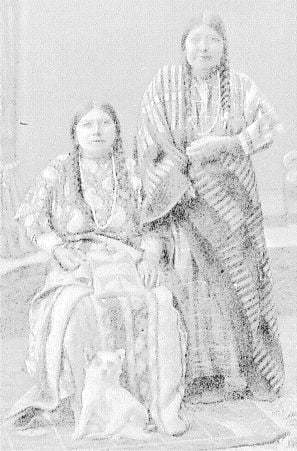
A large number of the Indians of Umatilla can not be regarded as having adopted the habits of civilized life. They live in tepees or lodges, dress in blankets, leggings, and moccasins, wear long hair, paint their faces, and seldom converse in. English. A young man, a half-breed, and a graduate of the Chemawa school, wore his hair long, had feathers stuck in his hat, and wore a necklace of beads. I asked why he dressed in that manner; he replied that it was cheaper than citizens dress. The women generally wear a blanket as a shawl, and use it when riding to cover their legs, which would otherwise be exposed, as they all ride after the fashion of men. The moral character of the women and young people among the full bloods is good, and their conduct is a refreshing contrast to that of the mixed bloods in the vicinity of Athena, who are, as a rule, dissolute and dissipated.
I found no evidence of valuable minerals existing on this reserve, and only the more recent and sedimentary rocks occur on the surface.
The census for 1890 was fairly well taken., bat each habitation was not visited, the Indians being called in to furnish the information.
The houses of the agent, clerk, wagon maker, and physician are all good, but others were built 30 years ago. The office and storehouse answer fairly well the purposes for which they were built.
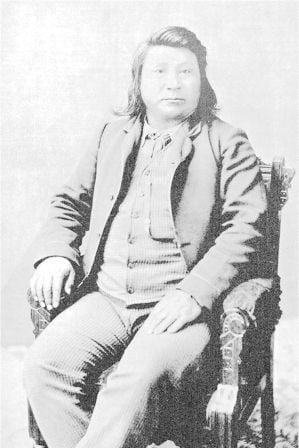
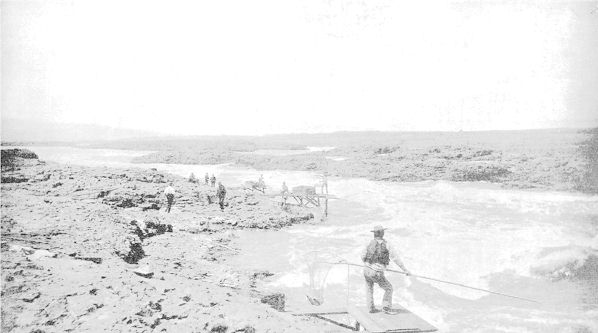
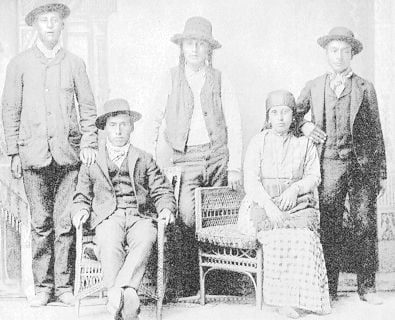
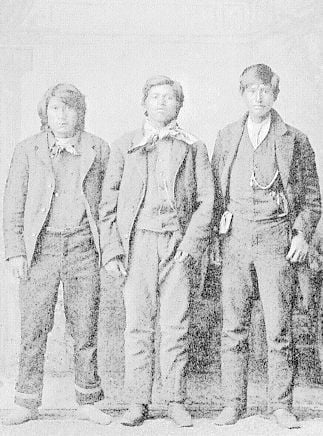



General Remarks and Recommendations
Umatilla -The act of March 3, 1885, settles the question of allotment on the Umatilla reservation. I suggest that allotment be made as soon as possible. Where an Indian woman is married to a white man the woman should not be recognized as the head of a family and allotted 160 acres, for she then receives for herself and family the same acreage as though she were married to an Indian, and the husband receives the immediate benefit. The Indian wife and children of a white man who has had since his marriage the benefit of the homestead laws should not be entitled to allotment; neither should the mixed bloods who have had the same benefits and who have been citizens but have abandoned their rights as citizens and gone on the reservation simply to secure land. Patents should not be issued at Umatilla for a period of 5 years.
During that time it should be unlawful for any but the old and in firm Indians to lease their land. At the end of 5 years, when patents have been issued, the agency should be abandoned. The school at Umatilla should be made an industrial training school, conducted at government expense, and the superintendent of the school should look after the Indians’ interests after the agency is abolished.
