
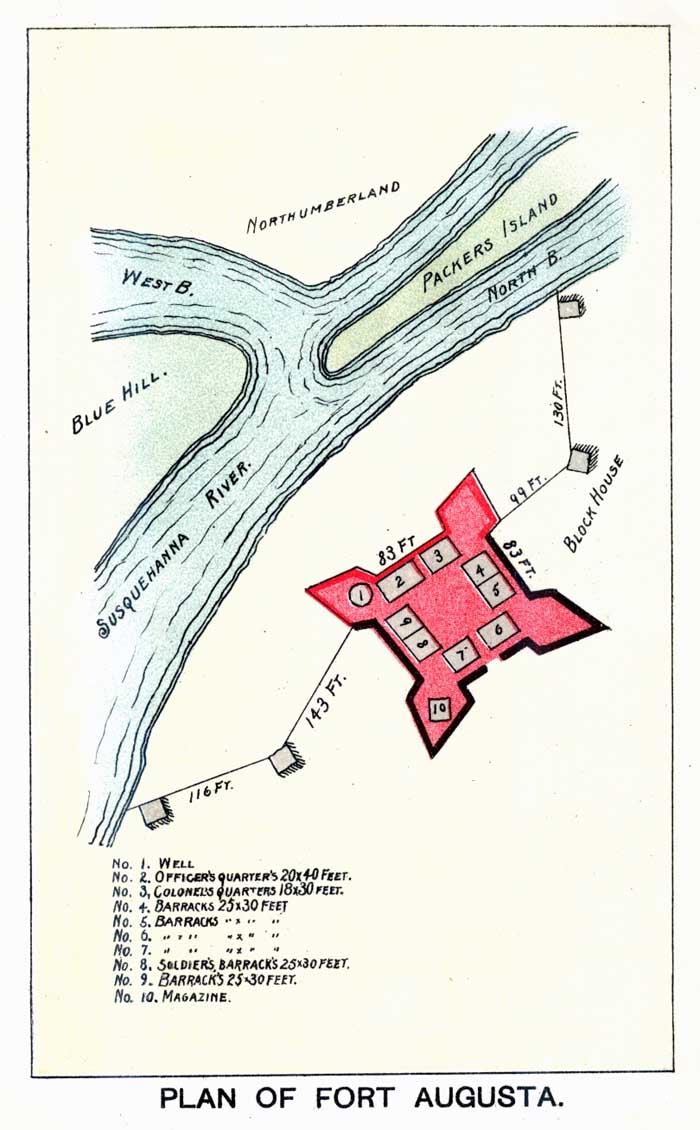
Fort Augusta was built in 1756, on the east bank of the main river just below the junction of the North and West branches of the Susquehanna that here form the main river, the artillery covering the debouchure of the branches, as well as the main river, at once closing the path by land and movement by water to the settlements below from an enemy; it stood at the upper end of the now enterprising town of Sunbury, was a regularly laid out fort, and when completed, mounted as the returns of the times show, at least twelve cannon and two swivels; quite a formidable armament for the time and place; seven blunder-busses were also included in its armament; it was one of those military necessities barely acted upon in time.
The causes that led to the building of the fort were:
The French and English were struggling for the supremacy at this time in America. The English, in our State, had pushed settlements up to the Blue mountains on the north, and were moving through the passes of the Alleghenies towards Duquesne: the French owned Canada and the Lakes and had an eye to the ultimate conquest of our State or a part of it. In pursuance of this object, as they held Duquesne, now Pittsburgh, they had fortified Lake Erie at Presqu’ Isle, and run a line of forts by the waters of the Allegheny River, from Presqu’ Isle to Fort Duquesne. The forks of the Susquehanna, after securing their communication with Duquesne attracted their attention; the branches of the Susquehanna, the one rising in one of the lesser lakes in the State of New York, the other overlapping some of the branches of the Allegheny, offered them water communication a part of the distance to the forks of the Susquehanna. When we take into consideration that Braddock’s defeat had occurred but a year before this and their allies, the Indians, were still elated over this great victory and ready for new conquests; the movements of the French at this time indicate this plainly, as shown by the Tradition of the Cannon Hole at the Race Ground Island, in the West Branch, as told the English by the Indians after peace, was that a party of French and Indians had left the lake country in the fall of 1756 to make permanent advance to the forks of the Susquehanna, bringing along three small brass cannon. Striking the headwaters of the Susquehanna (West branch), they descended by water to about the mouth of Loyal Sock creek, where, landing, they sent a reconnoitering party to the top of the Blue hill overlooking the forks and Fort Augusta, then partially built. Seeing the advancement of the fort and the number of men guarding it, considered it imprudent to attack and so reported to the main body who after consultation, decided to return; as the water was falling, finding themselves encumbered with their cannon, they threw them in the deep pot hole, or eddy, at the upper end of the old time race ground island, which has been known as the Cannon Hole ever since. Fort Augusta continued on the alert for French aggressions until some time after the capture of Quebec by Wolf in 1759, which virtually decided the control of the Canadas and, of course, of the Indian allies of the French.
The friendly Indians at Shamokin urged Gov. Morris to erect a strong house at Shamokin for his and their defense, and as a rallying point for such Indians as were or might become friendly to the English interests. The Governor was slower to comprehend the military necessity of the move than the Indians. After considerable delay he finally secured the consent of the Royal Commissioners and, upon the Assembly voting £2,000 for the King’s use, he directed Colonel William Clapham to recruit a regiment of four hundred men for that purpose; when the regiment was completed he furnished him a plan of a regular fort to be built on the east bank of the Susquehanna river, at Shamokin. Col. Clapham, after building Fort Halifax and leaving fifty men to garrison it to keep open his communications and protect the inhabitants on the upper part of his route, arrived at Shamokin in July 1756, after building a protection for his men and stores, proceeded to execute the Governor’s commands, and before winter, had it quite secure. Col. Clapham did not remain here a great length of time after completing the fort, being called away by other duties. He was killed by the Indians in 1763, together with his family, on Sewickley creek, in Western Pennsylvania. Col. James Burd, who succeeded him, continued to strengthen the work, as his interesting journal shows. (See Archives, second series. Vol. ii, pp. 745-820.) Col. Burd participated in the Bouquet expedition and had command of 582 men. He was in the battle of Loyal Hanna (Bushy Run) and, after that victory, accompanied the army to Fort Duquesne.
For the correspondence in the matter, see History of the Forts, Appendix to Penna. Archives, Vol. xii, first series, where it is fully collated with references, and shows the magnitude of the undertaking at so great a distance from his base of supplies, with the difficulties of transportation.
Fort Augusta was at once armed with eight cannon and two swivels; the number was increased to twelve, or fifteen cannon and two swivels.
Upon the close of the “French and Indian War,” not with standing the great importance of Fort Augusta as a strategic point to the Province, a clamor was raised by the “peace at any price” party of that day, and the fort was partly dismantled. The condition of affairs in the Province at this time is ably described by Dr. Egle, in his History of Pennsylvania, which says; “The situation of the frontiers was truly deplorable owing to the supineness of the Provincial authorities, for the Quakers who controlled the Government were, to use the language of Lazarus Stewart, ‘more solicitous for the welfare of the bloodthirsty Indian than for the lives of the frontiersman.’ In this blind partiality, bigotry and political prejudice they would not readily accede to the demands of those of a different religious faith. To them, therefore, was greatly attributable the reign of horror and devastation in the border counties. The Government was deaf to all entreaties, and General Amherst, commander of the British forces in America, did not hesitate to give his feelings an emphatic expression. ‘The conduct of the Pennsylvania Assembly,’ he wrote, *is altogether so infatuated and stupidly obstinate that I want words to express my indignation thereat.’ Nevertheless, the sturdy Scotch-Irish and Germans of the frontier rallied for their own defense and the entire force of Colonel Bouquet was composed of them.”
Fort Augusta, at time of building, held a place of great strategic importance, being far in advance of the English settlements of the Province, holding the only passage by water and blocking the pathway along the river by land, to the pioneer settlements below.
Readily reinforced and provisioned by bateaux from below, the country spreading out fan-like before it, requiring an elaborate system of forts in front of it to restrain it; a safe depot for supplies and the accumulation of a force for aggression, a point where the main Indian paths could be readily reached, and communications kept with them and supply them with the necessary beads and gew-gaws to keep them on friendly terms, or, on the other hand, to restrain them. Here Colonel Hartley drew his supplies in part in his famous march to the destruction of Tioga in l778, returning by way of the North Branch. Here, Colonel Plunket organized his expedition against Wyoming, ending in the fiasco of Nanticoke and also ending the doughty Colonel’s military aspirations.
After the commencement of the Revolution Fort Augusta became the headquarters of this that may be properly termed the military department of the upper Susquehanna. Col. Hunter was appointed county lieutenant and exercised authority here to the close of the war. Col, Hartley, with his regiment was stationed here a part of 1777 and 1778. On the breaking out of the Indians these settlements, which had furnished the main body of their men capable of bearing arms to the Continental army cried loudly for aid. After the battle of Brandywine, Gen. Washington consolidated the 12th Pennsylvania regiment that, by its fierce fighting at Brandywine and other places was almost decimated, with the 3d and fith Pennsylvania regiments, mustered out the officers and sent them home to help the people organize for defense, Capt. John Brady, Capt. Hawkins Boone and Capt. Samuel Daugherty being among the number. A system of forts were decided upon to cover the settlements as much as they were possibly able to do so, and were designed to run across the country from near opposite Nescopeck, commencing on the north bank of the North Branch, where was quite a settlement on the river flats; via Meelick’s, on Fishing creek, to Bosley’s mills, covering most of the settlers on Chilisquaqua, to Freeland’s mill, on Warrior Run, thence to Widow Smith’s mills on west side of West Branch; thence returning to Muncy and thence to Hall’s, continuing on up and crossing to Antes Fort; continuing up on the south side of the river to Mr. Reid’s, at now Lock Haven. A few of these places were fortified in 1777, but a portion were fortified in the spring of 1778. As the Indians became quite active in the spring of 1778, the military authorities of Fort Augusta were kept very actively engaged. The massacre at Wyoming in that year with the Big Runaway, on the West Branch, deluged Fort Augusta with the destitute and distressed; already over-loaded, they were now overwhelmed. The most of these destitute and distressed people soon passing down the river, most of the garrisons were withdrawn. The Indians soon followed and burned everything undefended. At this time the valley of the West Branch presented a pitiable spectacle, which it did not regain to any extent until peace was proclaimed.
It has been claimed by some that at the time of the Big Runaway Col. Hunter lost his head and precipitated matters by withdrawing the garrisons of these forts on the West Branch. To one looking at his exhausted means for defense we cannot see how, as a prudent military man, he could do otherwise. Without means to reinforce the feeble garrisons that were menaced by a foe more powerful than himself, to have left them to their fate would have been improper and likely to have been condemned by those who were so ready to find fault with him for doing the only thing in his power to do as a military head to this department. Colonel Hunter, at this time, had commanded this department fifteen years and knew the country and its people intimately; had become so thoroughly affiliated with their interests as to be one of them; their fears and misfortunes affected him as they did them. What few rays of joy that broke through the black clouds of adversity were as exhilarating to him as to them. He was an openhearted, hospitable, brave, generous man, who eventually spent twenty years of his life in their service and died in 1781, before he saw the full effects of peace, and was buried by the side of the fort he so ably defended, and among the people he worked for and loved so ardently. He was one of the many prominent men who settled in this region.
General Potter, who served in the Continental army and lived in the Buffalo Valley, was a man of great ability, forced by bad health to resign from the Continental army before the close of the Revolution. He was indefatigable in his endeavors to resist the foe and place his people in a safe position of defense. He, too, merits the approbation of the succeeding generations.
Colonel John Kelly and Colonel Hartley are entitled to worthy remembrance for the many acts of military ability shown by them.
Moses Van Campen, whose young manhood developed on the waters of the Fishing creek, detained by the Committee of Safety from the Continental army for the defense of the frontiers, spent the summer of 1777 in Colonel Kelly’s regiment in holding Fort Reid and scouting duty, being orderly sergeant of Captain Gaskin’s company. In 1778 we find him a lieutenant, and early in the season building Fort Wheeler on the Fishing creek and on scouting duties; in 1779 scouting duties and quartermaster to collect stores for Sullivan’s army. Arriving at Tioga he volunteered, with many important scouts entrusted to him, in which he acquitted himself well. In 1780, captured by the Indians, his father, brother and uncle killed, he, Peter Pence and Abram Pike, rising on their captors, killed nine and wounded the only remaining one. This was about fifteen miles below Tioga; 1781 engaged in scouting and looking after Tories; winter spent in guarding British prisoners; spring of 1782 marched Robinson’s Rangers, of which he was lieutenant, back to Northumberland; after a few day’s rest, ordered to rebuild Fort Muncy. Having commenced the work, on arrival of his captain he was sent with a detail of men to the neighborhood of the Big Island, where he was attacked by a large body of Indians led by a white man, when in the fight that ensued, his party were killed or captured, he included among the latter, ran the gauntlet at the Indian towns. Fortune favored him, and he was not recognized as the leader who killed the Indians when a captive until after he was sold to the English. A tedious captivity ensued, enlivened occasionally by practical jokes, etc. He was at last exchanged and returned home, where, after recruiting his health he was sent to assist garrisoning Fort Wilkes-Barre. At this place he remained to the close of the war. Having during his service, built Fort Wheeler and defended it for a time, built Fort McClure and assisted at rebuilding Fort Muncy, besides being actively engaged on frontier duties from the commencement to the close of the war. He removed to the state of New York before 1800 where, after an active life as surveyor and engineer he died, at the advanced age of ninety-two, universally respected.
Visiting with the Forts Commission the ruins of Fort Augusta in the summer of 1894, under the guidance of Mr. M. L. Hendricks, of Sunbury, we found the magazine still there and in good condition. John F. Meginness, in his Otzinachson, or History of the West branch Valley, page 269, gives a description of it as we saw it: “The magazine was built according to report, on plans of Capt. Gordon, who served as engineer, and today is still in a good state of preservation, being the only evidence of the existence of the fort. It is located in a small field about sixty feet south of the brick house known as the ‘Hunter Mansion,’ and one hundred and sixty-five feet from the river bank. A small mound of earth marks the spot where it may be found, and upon examination an opening in the ground is discovered which is two and a half feet wide. There are twelve four-inch stone steps leading below. On descending these steps the ground space inside the magazine is found to be 10×12 feet, and it is eight feet from the floor to the apex of the arched ceiling. The arch is of brick and commences on an offset purposely made in the wall five feet above the ground floor. The brick are of English manufacture and were transported from Philadelphia to Harris’s and then up the river by bateaux. On entering the ancient magazine one is reminded of a huge bake oven: it has been stated that an underground passage led from the magazine to the river, but has been closed up. Although a break or narrow cave-in in the river bank directly opposite the magazine which had existed for years would indicate that such was the fact, yet there is no evidence on the inside walls that there ever was such a passage. A recent careful examination failed to show any signs of an opening having existed. The stone basement walls are as solid apparently as when they were first laid. There are no marks or other evidence whatever that there had been an opening in the wall or that it had been closed up since the construction of the magazine.” (Query: Would a magazine in a warlike fort have communication with the outside world.) “There was such a passage starting from one of the angles of the fort, but it had no connection with the magazine.”
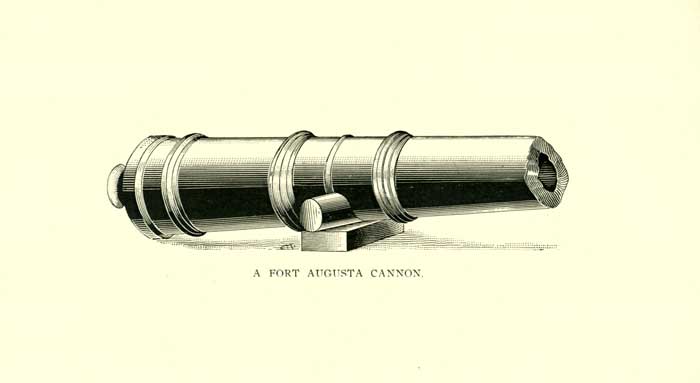
There is but one of the cannon that was formerly mounted upon the fort known to be in existence. Mr. Hendricks took the commission to Fire Engine House No. 1 and showed us the highly prized relic. Dr. R. H. Awl, of Sunbury, furnished J. F. Meginness its history for his History of the West Branch Valley and a cut of the old cannon. It is securely fastened and carefully guarded. It is supposed it was thrown in the river at the time of the great Runaway in 1778, after being spiked. In 1798 it was reclaimed from the river by George and Jacob Mantz, Samuel Hahn and George Shoop. After heating, by burning several cords of hickory wood, they succeeded in drilling out the spiked file. It has had quite a checkered experience, being stolen from one place to another to serve the different political parties, between times hidden in places considered secure until 1834, when Dr. R. H. Awl and ten other young men of Sunbury made a raid on Selinsgrove at night, secured the much-prized relic and have retained it ever since. Of the eleven young men engaged in its rescue sixty years ago the doctor is the only one living to tell the tale of its return. II is of English make, weighs about one thousand pounds and has about three and one-half inch bore. A drunken Negro sledged off the ring at the muzzle, out of pure wantonness in 1838.
The Maclay mansion, built by William Maclay, one of the most prominent citizens of his time, in 1773, is a historic building. The back part of the lot was stockaded during the Revolution. The house is built of limestone and is now owned and occupied by Hon. S. P. Wolverton, present member of Congress from this district, who prizes it highly for its antiquity and historic reminiscences.
Near here Conrad Weiser built the “Locke house” for Shickelimy in 1754, the first building in the “Shamokin country,” and built for a place to confine refractory Indians. Shickelimy is said to have at one time exercised almost unlimited control over the Indian tribes, north, west and south. Here the Vice-King died and was buried in 1759. When the grave of Shickelimy was removed some years ago, Mr. M. L. Hendricks, the antiquarian of Sunbury, secured the strings of wampum, the pipe and many other relics that were buried with the Vice-King. He was the father of Logan, the Mingo chief.
The Bloody Spring. The Hon. S. P. Wolverton also owns the land on which this spring is located. Its history, as related by Col. Samuel Miles, is as follows, and shows the constant danger menacing the garrisons of Fort Augusta. In the summer of 1756, I was nearly taken prisoner by the Indians. At about half a mile distant from the fort stood a large tree that bore excellent plums, in an open piece of ground, near what is now called the Bloody Spring. Lieut. S. Atlee and myself one day took a walk to this tree to gather plums. While we were there a party of Indians lay a short distance from us, concealed in the thicket, and had nearly gotten between us and the fort, when a soldier belonging to the Bullock guard not far from us came to the spring to drink. The Indians were thereby in danger of discovery and in consequence thereof fired at and killed the soldier, by which means we got off and returned to the fort in much less time than we were coming out. The rescuing party from the fort found the soldier scalped and his blood trickling into the spring, giving the water a crimson hue, and was ever afterwards called the Bloody Spring. John F. Meginness, who visited this spring a few years ago, says: “This historic spring is located on the hillside. The space occupied by it is about the size of an ordinary town lot, and it looks as if it might have been dug out and the earth taken away with horse and cart. The distance across is about twenty-five feet and has a depth of ten or twelve feet, and then runs out with the declivity. The spring has been gradually filling up and there is no doubt it would flow constantly if it were cleaned out. The spring now only runs over a couple of months in the spring of the year.
The Blue Hill, standing out boldly, opposite Northumberland, is here in bold relief surmounted in our younger days by Mason’s observatory overhanging the cliff of some four hundred feet in height; it is now capped by a fine health resort hotel.
The famous thief, Joe Disbury, was tried at Sunbury in 1784 for some of his many misdemeanors, found guilty, sentenced to receive thirty-nine lashes, stand in the pillory one hour, have his ears cut off and nailed to the post, that be imprisoned three months, and pay a fine of £30. The venerable Dr. Awl still shows the place on the old square where punishment was inflicted by the pillory and whipping post. The famous Dr. Plunket, after attaining notoriety as a military leader, took to the bench. As a jurist he dispensed law impartially; as to “rogues,” he saw they did not go unwhipped of justice.
