
The following are Wampanoag Chiefs and leaders.
Annawan
A Wampanoag sachem, the chief captain and counselor of Philip, who under that chief’s father had won a reputation for prowess in wars with many different tribes. When King Philip fell Annawan rallied the warriors and safely extricated them from the swamp where they were surrounded. Afterward he ranged through the woods, harrying the settlers of Swansea and Plymouth, until Capt. Benjamin Church raised a new expedition to hunt the Indians as long as there was one of them in the woods. Some were captured by Capt. Church’s Indian scouts, but Anna wan eluded pursuit, never camping twice in the same spot. Having learned from a captive where the old chief was, Church went with his Indian soldiers and only one white companion to capture him. When he reached the retreat, a rocky hill in the middle of a swamp, he sent the captives forward to divert the attention of Annawan’s people. Church and his scouts then stole up, the noise they made being drowned by the sound of a pestle with which a woman was pounding corn, and jumped to the place where the arms were stacked. Anna wan and his chief counselors, thus surprised and ignorant of the fewness of their assailants, gave themselves up and were bound. The fighting men, who were encamped near by, surrendered when they were told that the place was surrounded by English soldiers. Annawan brought the wampum belts and other regalia of King Philip, which he gave to Capt. Church as his conqueror, who had now overcome the last company that stood out against the English. Annawan’s captor interceded to have his life spared, but the authorities at Plymouth, extracting from him a confession that he had put to death several English prisoners, some of them with torture, beheaded him in 1676 while Capt, Church was absent.
Hobomok
A chief of the Wampanoag who was the life-long friend of the English, from the time he met them at Plymouth in 1621. He helped to strengthen the friendship of Massasoit for the colonists, but, unlike Massasoit, he became a Christian, and died, before 1642, as a member of the English settlement at Plymouth. He was of great service to the English in warning them of Indian conspiracies. He was present at some of the battles in which Standish performed valorous deeds, but was not an active participant. The name is identical with Abbamocho, Hobbamoco, Habamouk, Hobbamock, Hobomoko, etc. See the following. (A. F. C.)
Hobomoko
Whittier, in the notes to his Poems 1 cites the saying concerning John Bonython: “Here lies Bonython, the Sagamore of Saco, He lived a rogue and died a knave, and went to Hobomoko.” Mentioned by early writers as an evil deity of the Massachuset and closely related Algonquian tribes. (A. F. C.)
Massassoit
Massassoit (‘great chief’; proper name, Woosamequin [Wasainegin, Osamekin, etc.], ‘Yellow Feather’). A principal chief of the Wampanoag of the region about Bristol, Rhode Island who was introduced by Samoset to the Puritans at Plymouth in 1621. He was preeminently the friend of the English. Drake 2 says of him: “He was a chief renowned more in peace than war, and was, as long as he lived, a friend to the English, notwithstanding they committed repeated usurpations upon his lands and liberties.” He had met other English voyagers before the advent of the Puritans. While ill in 1623 he was well treated by the English. In 1632 he had a brief dispute with the Narraganset under Canonicus, and in 1649 he sold the site of Duxbury to the English.
His death took place in 1662. Of his sons, one, Metacomet, became famous as King Philip, the leading spirit in a long struggle against the English. See Massassoit, Chief of the Wampanoago.
King Philip
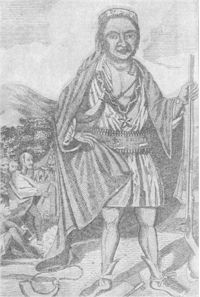
King Philip, Metacom, second son of Massasoit, sachem of the Wampanoag, who attained that office himself through the death of his father and elder brother in 1661-62, and to the English was better known as Philip of Pokanoket, or King Philip. He was the most remarkable of all the Indians of New England. For 9 years after his elevation to the chieftaincy, although accused of plotting against the colonists, he seems to have devoted his energies to observation and preparation rather than to overt actions of a warlike nature. He even acknowledged himself the king’s subject. But war with the English teas inevitable, and the struggle called King Philip’s war (1675-76) broke out, resulting in the practical extermination of the Indians after they had inflicted great losses upon the whites.
The ability of King Philip is seen in the plans he made before the war began, the confederacy he formed, and the havoc lie wrought among the white settlements. Of 90 towns, 52 were attacked and 12 were completely destroyed. The bravery of the Indians was in many cases remarkable. Only treachery among the natives in all probability saved the colonists from extinction.
In the decisive battle, a night attack, at a swamp fortress in Rhode Island, Aug. 12, 1676, the last force of the Indians vas defeated with great slaughter, King Phillip himself being among the slain. His body was subjected to the indignities usual at that time, and his head is said to have been exposed at Plymouth for 20 years. His wife and little son were sold as slaves in the West Indies. Widely divergent estimates of King Philip’s character and achievements have been entertained by different authorities, but he can not but be considered a man of marked abilities. Weeden 3 says: “History has male him ‘King Philip,’ to commemorate the heroism of his life and death. He almost made himself a king by his marvelous energy and statecraft put forth among the New England tribes. Had the opposing power been a little weaker, he might have founded a temporary kingdom on the ashes of the colonies.”
King Phillip has been the subject of several poems, tales and histories. The literature includes:
- Church, History of King Phillip’s War, 1836;
- Apes Eulogy on King Phillip, 1836;
- Freeman, Civilization and Barbarism, 1878;
- Markham, Narrative History of King Philip’s War, 1883.
Squanto
A Wampanoag 4 who is said to have been the only person in Patuxet that escaped the plague of 1619. He was a friend of the English, and did them much service besides acting as interpreter and guide, though he seems to have been also at one time the agent or spy of Caunbitant, sachem of Mattapoisett. He died at Chatham in 1622. The name Squanto was contracted from Tisquantum.

1
the way massasoit is spelled is wrong