

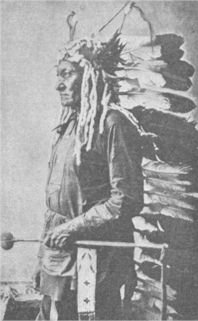
(Tatanka Yotanka, ‘sitting buffalo bull’). A noted Sioux warrior and tribal leader of the Hunkpapa Teton division, born on Grand Rivers, South Dakota, in 1834, his father being Sitting Bull, alias Four Horns, a subchief.
As a boy he was first known as Jumping Badger. He manifested hunting ability when but 10 years of age, in the pursuit of buffalo calves. When he was 14 he accompanied his father on the warpath against the Crows and counted his first coup on the body of a fallen enemy. On the return of the party his father made a feast, gave away many horses, and announced that his son had won the right to be known henceforth by his own name. According to the native interpretation of a Dakota winter count his name was Four Horn, and was changed to Sitting Bull when he” made medicine” in 1857. The name is quite common among the Plains tribes. He rapidly acquired influence in his own band, being especially skilful in the character of peacemaker. He took an active part in the Plains wars of the ’60’s, and first became widely known to the whites in 1866, when he led a memorable raid against Ft Buford. Sitting Bull was on the warpath with his band of followers from various tribes almost continuously from 1869 to 1876, either raiding the frontier posts or making war on the Crows or the Shoshoni, especially the former. His autographic pictorial record in the Army Medical Museum at Washington refers chiefly to contests with the Crows and to horse stealing.
His refusal to go upon a reservation in 1876 led Gen. Sheridan to begin against him and his followers the campaign which resulted in the surprise and annihilation of Custer’s troop on Little Bighorn river, Montana, in June. During this battle, in which 2,500 to 3,000 Indian warriors were engaged, Sitting Bull was in the hills “making medicine,” and his accurate foretelling of the battle enabled him “to come out of the affair with higher honor than he possessed when he went into it” (McLaughlin). After this fight the hostiles separated into two parties. Sitting Bull, in command of the western party, was attacked by Gen. Miles and routed; a large number of his followers surrendered, but the remainder of the band, including Sitting Bull himself, escaped to Canada, where they remained until 1881, when he surrendered at Ft Buford tinder promise of amnesty and was confined at Ft Randall until 1883.
Although he had surrendered and gone upon a reservation, Sitting Bull continued unreconciled. It was through his influence that the Sioux refused to sell their land in 1888; and it was at his camp at Standing Rock agency and at his invitation that Kicking Bear organized the first Ghost dance on the reservation. The demand for his arrest was followed by an attempt on the part of some of his people to rescue him, during which he was shot and killed by Sergeants Red Tomahawk and Bullhead of the Indian police, Dec. 15, 1890. His son, Crow Foot, and several others, with six of the Indian police, were also killed in the struggle. Although a chief by inheritance, it was rather Sitting Bull’s success as an organizer and his later reputation as a sacred dreamer that brought him into prominence. According to McLaughlin, “his accuracy of judgment, knowledge of men, a student-like disposition to observe natural phenomena, and a deep insight into affairs among Indians and such white people as he came into contact with, made his stock in trade, and he made “good medicine.” He stood well among his own people, and was respected for his generosity, quiet disposition, and steadfast adherence to Indian ideals. He had two wives at the time of his death (one of whom was known as Pretty Plume), and was the father of 9 children. His eldest son was called Louis.
Consult:
- Dunn, Massacres of the Mts., 1886;
- Finerty, War Path and Bivouac, 1890;
- W. F. Johnson, Life of Sitting Bull, 1891;
- McLaughlin, My Friend the Indian, 1910;
- Mooney in 14th Rep. B. A. E., 1896;
- Walker, Campaigns of General Ouster and Surrender of Sitting Bull, 1881.
