
Washakie’s Band
The easternmost division of the Shoshoni proper, so called from their chief. They formerly ranged from Wind river in lat. 43° 30′ on the north, in Wyoming, and from South pass to the headwaters of the North Platte on the east, and to Bear river near the mouth of Smith fork, in Idaho, on the west. On the south they extended as far as Brown’s hole, on Green river, Wyo. They are known officially as Shoshoni in distinction front the Bannock, Sheepeaters, etc., and were placed upon the Shoshoni reservation in west Wyoming by treaty of 1868. They numbered 870 in 1885, while the Shoshoni under the Shoshoni agency numbered 816 in 1909.
Washakie
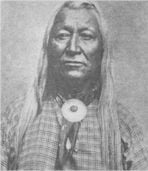
Washakie (‘shoots [the buffalo] running.’ Corbusier. It is also said that the name means ‘gambler’s gourd,’ and that its bearer was originally known as Pinaquana, meaning ‘smell of sugar’). A Shoshoni chief, of mixed Shoshoni and Umatilla blood (according to some authorities he was half white), born about 1804. Before reaching maturity he left the Umatilla and joined his mother’s people, the Shoshoni.
Washakie was noted chiefly for his friendship toward the whites and as a warrior against his tribal enemies. He early became the chief of the Eastern Band of Shoshoni of Wyoming, known also as Washakie’s Band, by reason of his prowess and leadership, but when about 70 years of age some of the younger men aspiring to the chiefship, took steps to depose him. Washakie disappeared from the camp, and two months later, on the night when the council met to take action, he suddenly appeared with six scalps which he had taken alone on the war-path, thus setting at rest all further opposition to his chieftaincy on the ground of age. Washakie is described as having been light in color, of commanding figure, very tall, powerfully built, and of dignified carriage, and had a reputation for great endurance. He realized the importance of his position, and was fond of form and ceremony in his dealings with white people. When in the 50’s emigrants passed in large numbers through the Shoshoni country in Wyoming, Washakie and his people exercised great forbearance, following the injunctions of the Government agents to aid overland travelers in recovering strayed or lost stock, helping the emigrants across dangerous fords, and refraining from all acts of reprisal when animals of the white men destroyed the Indian root and herding grounds. So friendly and helpful were Washakie and the members of his band that 9,000 emigrants signed a paper commending their kind treatment. Washakie owed his great popularity among his people to his exploits on the war-path, especially against the Siksika (Blackfeet) and the Crows, and also, it is asserted, because in his younger days he brooked no opposition in the tribe and allowed no asylum to a horse thief or a vagabond. Another war-chief of the Shoshoni, named Pushican, or Purchican, bore on his forehead the scar of a blow from Washakie’s tomahawk received during an altercation. He was for many years in the employ of the American and Hudson’s Bay fur companies, and was long the valued companion of white hunters and trappers. Before the battle of Bear river in 1863, in which Gen. Connor defeated the Bannock and hostile Shoshoni who refused to heed Washakie’s warning, he fled with the greater portion of his tribe to Ft Bridger, Wyoming, thus saving many of his people from destruction. When Ft Brown was established on the site of Lander, Wyo., in 1869, Washakie met the soldiers and avowed his friendship for the whites, and frequently served as a scout in campaigns against the Cheyenne, Sioux, Arapaho, Ute, and other hostile tribes. Members of his hand also performed valiant service against the Cheyenne following the Custer defeat in 1876. At the time of his death, Feb. 20, 1900, Washakie was a devout member of the Protestant Episcopal church and a firm friend of the missionaries. He Was buried, with military honors, in the cemetery at Ft Washakie, Wyo., where a monument has been erected over his grave. He was succeeded by his son, known as Dick Washakie.

