
Bannock Indians (from Panátǐ, their own name). A Shoshonean tribe whose habitat previous to being gathered on reservations can not be definitely outlined. There were two geographic divisions, but references to the Bannock do not always note this distinction. The home of the chief division appears to have been south east Idaho, whence they ranged into west Wyoming. The country actually claimed by the chief of this southern division, which seems to have been recognized by the treaty of Ft Bridger, July 3, 1868, lay between lat. 42° and 45°, and between long. 113° and the main chain of the Rocky Mountains. It separated the Wihinasht Shoshoni of west Idaho from the so-called Washaki band of Shoshoni of west Wyoming. They were found in this region in 1859, and they asserted that this had been their home in the past. Bridger 1 had known them in this region as early as 1829. Bonneville found them in 1833 on Portneuf River, immediately north of the present Ft Hall reservation. Many of this division affiliated with the Washaki Shoshoni, and by 1859 had extensively intermarried with them.
Bridger states that when he first knew them (about 1829) the southern Bannock numbered 1,200 lodges, indicating a population of about 8,000.
In 1869 they were estimated as not exceeding 500, and this number was probably an overestimate as their lodges numbered but 50, indicating a population of about 350. In 1901 the tribe numbered 513, so intermixed, however, with the Shoshoni that no attempt is made to enumerate them separately. All the Bannock except 92 under Lemhi agency are gathered on Ft Hall Reservation, Idaho.
Bannock Tribe History
Ft Hall reservation was set apart by Executive order in 1869, and 600 Bannock, in addition to a large number of Shoshoni, consented to remain upon it. Most of them soon wandered away, however, and as late as 1874 an appropriation was made to enable the Bannock and Shoshoni scattered in south east Idaho to be moved to the reservation. The Bannock at Ft Hall were said to number 422 in 1885. The northern division was found by Gov. Stevens in 1853 2 living on Salmon River in east Idaho. Lewis and Clark, who passed through the country of this northern division in 1805, may have included them under the general term Shoshone, unless, as is most likely, these are the Broken Moccasin Indians they mention 3 . In all probability these Salmon River Bannock had recently crossed the mountains from the eastward owing to pressure of the Siksika, since they claimed as their territory south west Montana, including the rich areas in which are situated Virginia City, Bozeman, and other towns 4 . Stevens (1853) states that they had been more than decimated by the ravages of smallpox and the inroads of the Siksika. It is probable that at no distant time in the past, perhaps before they had acquired horses, the various groups of the entire Bannock tribe were united in one locality in south east Idaho, inhere they were neighbors of the Shoshoni proper, but their language is divergent front the latter.
Bannock Culture
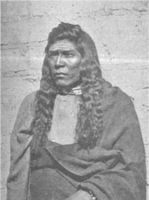
The Bannock were a widely roving tribe, a characteristic which favored their dispersal and separation into groups. Both the men and the women are well developed; and although Shoshonean in language, in physical characters the Bannock resemble more closely the Shahaptian Nez Percé than other Shoshonean Indians. Kroeber reports that the language of the Fort hall Bannock connects them closer with the Ute than with any other Shoshonean tribe. At the same time Powell and Mooney report that the tribes of west Nevada consider the Bannock very nearly related to themselves.
The loss of hunting lands, the diminution of the bison herds, and the failure of the Government to render timely relief led to a Bannock outbreak in 1878, the trouble having been of long standing. During the exciting times of the Nez Percé war the Bannock mere forced to remain on their inhospitable reservation, to face the continued encroachment of the whites, and to subsist on goods provided from an appropriation amounting to 2½ cents per capita per diem. During the summer a drunken Indian of the tribe shot and wounded two teamsters; the excitement and bitter feeling caused by his arrest, Nov. 23, 1877, resulted in the killing of an agency employee. Troops were called for, and the murderer was pursued, captured, tried, and executed. This episode so increased the excitement of the Indians that, fearing what was assumed to be threatening demonstrations, the troops surrounded and captured two Bannock camps in Jan., 1878; but most of the Indians were afterward released. On account of insufficient food the Bannock left the reservation in the spring and went to Camas prairie, where they killed several settlers. A vigorous campaign under Gen. Howard resulted in the capture of about 1,000 of them in August, and the outbreak came to all end after a fight on Sept. 5, at Clark’s ford, where 20 Bannock lodges were attacked and all the women and children killed.
Bannock Nation
Practically nothing is known of the former organization of the Bannock or of their divisions. The names of four divisions were obtained by Hoffman, and a fifth is given by Schoolcraft. These are:
- Kutshundika, or Buffalo-eaters.
- Penointikara, or Honey-eaters.
- Shohopanaiti, or Cottonwood Bannock.
- Yambadika, or Root-eaters.
- Waradika, or Rye-grass seed-eaters.

