
Mokohoko (Mokohokoa, ‘he who floats visible near the surface of the water’). A chief of the band of Sauk that took the lead in supporting Black Hawk in the Black Hawk war. He was of the Sturgeon clan, the ruling clan of the Sauk, and was a bitter enemy of Keokuk. The band still retains its identity. It refused to leave Kansas when the rest of the tribe went to Indian Territory, and had to be removed thither by the military. It is now known as the Black Hawk band, and its members are the most conservative of all the Sauk.
Wabokieshiek
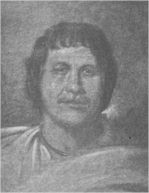
Wabokieshiek (‘The Light.’ or White Cloud’) A medicine-man also known as The Prophet, the friend and adviser of Black hawk. He was born about 1794, and presided over a village known as “prophet’s Village,” on Rock river, about 35 miles above its mouth, on the site of the present Prophetstown, Ill. Half Winnebago and half Sauk, he bad great influence with both tribes, and was noted for cruelty and his hostility toward Americans. When Black Hawk’s lieutenant, Neapope, went to Malden, Canada, to consult with the British authorities in regard to the right of the Indians to retain their lands on Rock river, he stopped on his return at the Prophet’s village, where he remained during the winter, and told Wabokieshiek of his mission. The Prophet, always ready for mischief and delighted at this opportunity to make trouble for the whites, is said to have performed some incantations, had several visions, and prophesied that if Black Hawk would move against the whites he would be joined by the “Great Spirit” and a large army which would enable him to overcome the whites and regain possession of his old village. These predictions, added to Neapope’s false reports from the British, induced Black Hawk to continue the war which bears his name. Keokuk is said to have blamed the Prophet for all the trouble. After the defeat of the Indians at Bad Axe in 1832, Black hawk and the Prophet made their escape, but were captured by Chaetar and One-Eyed Dekaury, two Winnebago Indians, in an attempt to reach Prairie La Crosse, where they expected to cross the Mississippi and be safe. They were delivered to Gen. Street on Aug.27,1832. Arriving at Jefferson Barracks, 10 miles below St Louis, they were put in irons, to their extreme mortification and of which they complained bitterly. In April of the following year they were taken to Washington, where they were permitted to see president Jackson, to whom Wabokieshiek appealed for their freedom; instead, they, were sent to Fortress Monroe, Va., where they remained until June 4, when they were released. Having lost his prestige as a prophet, Wabokieshiek lived in obscurity among the Sauk in Iowa until their removal to Kansas, and died among the Winnebago about 1841. He is described as being six ft tall, stout and athletic of figure, with a countenance in keeping with his militant disposition.
At variance with accounts of his depravity is a statement by Maj. Thomas Forsythe, for years the agent of the Sauk and Foxes, in which he says of Wabokieshiek: “Many a good meal has the Prophet given to the people traveling past his village, and very many stray horses has he recovered from the Indians and restored them to their rightful owners, without asking any recompense whatever.” It is also said that during the progress of the Black Hawk war, Col. Gratiot, agent for the Winnebago, who on account of his humane and honorable treatment of the Indians was considered most likely to influence them, was selected to visit the hostile camp and induce the Prophet to turn the British band back to its Iowa reservation. On reaching the Prophet’s village, Gratiot and his party were surrounded by the hostiles and made prisoners, despite their flag of truce, and he would have lost his life had not the Prophet come to his rescue. He was taken to Wabokieshiek’s house and allowed to explain the object of his mission, but could not dissuade the Indians from their purpose. Although the warriors clamored for Gratiot’s life, Wabokieshiek was determined to save him, and after keeping him for several days found an opportunity to allow him to escape.
While in Jefferson Barracks Wabokieshiek’s portrait was painted by Catlin, and is now in the National Museum; another portrait, by R. M. Sully, made while the Prophet was a prisoner at Fortress Monroe.
Consult:
- Fulton, Red Men of Iowa, 1882;
- Stevens, Black Hawk War, 1903;
- Wis. Hist. Soc. Coll., X, 1888.
Keokuk
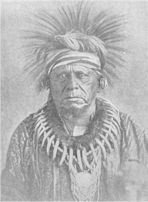
Keokuk (Kiyo`kaga, ‘one who moves about alert’ ). A Sauk leader, a member of the Fox clan, born on Rock river, Ill., about 1780. He was not a chief by birth, but rose to the command of his people through marked ability, force of character, and oratorical power. His mother is said to have been half French. At an early age he was a member of the Sauk council, which he graced, but at first played only a subordinate role there in. He stepped into prominence later on when he was made tribal guest-keeper. While holding this office he was supplied at tribal expense with all the means of rendering hospitality, and played the part of a genial host with such pleasing effect that his lodge became a center for all things social and political. Quick to see the possibilities of this office he made use of the opportunity to further his own ambitions.
Keokuk was well aware of the fact that the rigid social organization of his people offered a barrier to the realization of his cherished desire, which was to become the foremost man of his tribe. Contrary to the manner of men of his training, environment, and tradition, he had no scruples against doing away with a practice if thereby he might reap profit for himself; and he worked his will against custom, not in an open, aggressive way, but by veiled, diplomatic methods. He was continually involved in intrigue; standing always in the background, he secretly played one faction against another. In time he became the leading councilor in the Sauk assembly, and enjoyed great popularity among his people. But the situation assented a different aspect when the troubled period of the so called Black Hawk war arrived. The immediate cause of this conflict grew out of an agreement first entered into the Government and a small band of Sauk who, under their leader Kwaskwamia, were in winter camp near the trading post of St Louis. By this compact the Sauk were to give up the Rock River country. As soon as the agreement became noised abroad among all the Sauk there was strong opposition, particularly to the form in which it had been made. Throughout the affair Keokuk assumed so passive an attitude that he lost at once both social and political prestige. Those of the Sauk who favored an appeal to arms then turned to a man of the Thunder clan, Black-big-chest, known to the whites under the name of Black Hawk, who became their leader. Just at this critical period the feeble bond of political union between the Sauk and the Foxes was broken, this result being due largely to internal dissensions brought on by the intrigues of Keokuk, who, with a following of unpatriotic Sauk, sought and obtained protection from the Foxes under their chief, Paweshik. The fighting began before Black Hawk was ready, and he was forced to take the field with but a small number of those on whose support he had depended. With his depleted forces he could not successfully contend against the Illinois militia and their Indian allies.
Keokuk loomed up again during the final negotiations growing out of the war, and played so deftly into the hands of the Government officials that he was made chief of the Sauk. It is said that the announcement of his elevation to supreme power was made in open council, and that it so aroused the anger and contempt of Black Hawk that he whipped off his clout and slapped Keokuk across the face with it, The act of creating Keokuk chief of the Sauk has always been regarded with ridicule by both the Sank and the Foxes, for the reason that lie was not of the ruling clan. But the one great occasion for which both the Sauk and the Foxes honor Keokuk was when, in the city of Washington, in debate with the representatives of the Sioux and other tribes before Government officials, he established the claim of the Sauk and Foxes to the territory comprised in what is now the state of Iowa. He based this claim primarily on conquest.
On his death, in 1848, in Kansas, whither he had moved three years before, the chieftainship, with its unsavory associations, went to his son, Moses Keokuk (Wunagisäa, ‘he leaps up quickly from his lair’), who displayed many of the mental characteristics of the father. Those who knew them both maintain that the son was even the superior intellectually, and of higher ethics. He was fond of debate, being always cool, deliberate, and clear-headed. In argument he was more than a match for any Government officer with whom he ever came in contact at the agency. He bore an intense hatred for the Foxes, which was returned with more than full measure. Moses Keokuk was acknowledged the purest speaker of the Sauk dialect. The Sauk were never tired of his eloquence; it was always simple, clear, and pleasing. Late in life he embraced Christianity and was baptized a Baptist; but he never ceased to cherish a sincere regard for the old-time life and its fond associations. He succeeded in turning aside much of the odium that had early surrounded his office, and though he met with more political opposition during his whole life, yet when he died, near Horton, Kans., in August, 1903, his death was regarded by the Sauk as a tribal calamity.
In 1883 the remains of the elder Keokuk were removed front Kansas to Keokuk, Iowa, where they were reinterred in the city park and a monument erected over his grave by the citizens of the town. A bronze bust of Keokuk stands in the Capitol at Washington.
