
Sinkiuse Tribe, Sinkyone Tribe, Sinkiuse Indains, Sinkyone Indians. A former division of Salish, under Chief Moses, living on the East side of Columbia River from Ft. Okinakane to the neighborhood of Point Eaton, Washington. Hale classed them as a division of the Pisquows. Population 355 in 1905, 299 in 1908, 540 (with others?) in 1990.
In the summer of 1878,the citizens of the eastern portion of Washington Territory were alarmed by the excitement among the Indians, growing out of the outbreak of the Shoshones; and in some places measures for self-protection were deemed necessary. Chief Moses and his band, numbering about two hundred warriors, had refused to go upon any reservation; and they were suspected also of having been accomplices in the murder of Mr. Perkins and his wife, who met their death at the hands of a vagrant band of Columbia river Indians, instigated or influenced by that great mischief maker, Smoheller the “dreamer.” I that fall, Reverend J. H. Wilbur, Indian Agent in charge of the Yakima Reservation, was instructed to induce Moses and his people to go upon the Yakima Reservation.
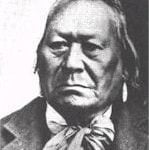
Moses was sent for, but declined to go, giving as his reason that the government had assured him that he should be assigned to a separate reservation. He not only denied all complicity in the Perkins murder, but offered guides to assist him in the arrest of the murderers, whom he alleged were located about forty miles from his camp. A party was organized, consisting of fifteen Yakima Reservation Indians and thirty white volunteers from Yakima City; and it was understood that Moses and his party should have one day’s start of the Yakima party, in order to make arrangements for crossing the Columbia river.
When Moses arrived at the appointed place, he found that the arresting party had proceeded to a point twelve miles below. This circumstance, together with the fact that he had been advised that the Whites had plotted to waylay and kill him on the way home, and also that the police and volunteers intended to arrest him and confine him in the Yakima jail, excited his suspicions. He declined to furnish the guides as he agreed; and he, with sixty armed men, defiantly confronted the volunteer party. After considerable talk, without collision, Moses returned to his camp.
Three days later he asserts he started with nine of his band to join the volunteer party, who were endeavoring to capture the murderers. Before over-taking them he camped for the night; and the volunteers who were in the vicinity, mistaking Moses’ camp-fires for those of the party of murderers they were seeking, surrounded the camp and took Moses and his nine men prisoners. All were disarmed, the other having killed himself to avoid arrest. Moses and the other four of his band were taken to Yakima City and confined in jail without formal examination. A week later Indian Agent J. H. Wilbur induced the citizens of Yakima to turn over to him Moses and his fellow Indian prisoners. Under a strong guard, to prevent the citizens form killing him, Moses and his four companions were taken to the agency, where they remained for three months, notwithstanding the persistent efforts of the citizens to have them returned to the jail.
On the 12th of February, 1879, the Commissioner of Indian affairs ordered Moses to Washington for a conference. This order was communicated to the authorities of Yakima County; and, upon their agreement that he should not be arrested, eh was allowed to return to his camp and make preparations for his journey to Washington. At the end of ten days he was sent for, and promised to meet the agent at Yakima ferry in four days. When the agent arrived at the ferry, the sheriff of Yakima county with a posse was guarding every crossing on the river within a distance of twenty miles, determined to take Moses dead or alive. Unable to accomplish anything, Agent Wilbur returned to Yakima City; and the next morning Chief Moses was brought in by the sheriff. The prosecution then asked for a continuance of the case for eight days.
Agent Wilbur then waived a preliminary examination, offered bail for Moses’ appearance at the next term of court, which was accepted and Moses went to Washington. After several conferences with him, on the 19th of April, 1870, a reservation was set apart for Moses and his people, called the Columbia Reservation, which adjoins the Colville Reservation on the west. The delegation returned to the general commanding the department with the special request to that officer, and a similar one to the governor of the territory, requesting that Moses and his party be forwarded to their reservation without arrest or further interference. The Perkins murderers were tried at the October, 1879, term of the Yakima court; and three of them were convicted of murder. The charge against Chief Moses was dismissed, the grand jury failing to find any indictment.
