
The Piros Tribe, formerly significant Pueblo Indians in New Mexico, occupied two main divisions during the early 17th century: the Rio Grande valley and an area east of the Rio Grande. The establishment of missions among the Piros began in 1626. Despite their initial number of around 9,000, the Piros suffered severe harassment from the Apache, reducing their population significantly. Today, most Piros pueblos are extinct, with only a small number of Piros individuals known to survive. Their history reveals a struggle for survival in a harsh desert environment and amidst constant intertribal conflict.
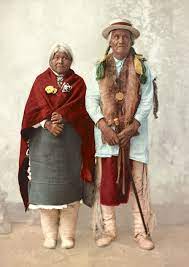
Piros Indians, Piro Tribe, Piro Indians. Formerly one of the principal Pueblo tribes of New Mexico, which in the early part of the 17th century comprised two divisions, one inhabiting the Rio Grande valley from the present town of San Marcial, Socorro County, northward to within about 50 miles of Albuquerque, where the Tigua settlements began; the other division, sometimes called Tompiros and Salineros, occupying an area east of the Rio Grande in the vicinity of the salt lagoons, or salinas, where they adjoined the eastern group of Tigua settlements on the south. The western or Rio Grande branch of the tribe was visited by members of Coronado’s expedition in 1540, by Chamuscado in 1580, by Espejo in 1583 (who found them in 10 villages along the river and in others near by), by Oraté in 1598, and by Benavides in 1621-30, the latter stating that they were in 14 pueblos along the river. Judging from the numerous villages of the province of Atripuy, mentioned by Oraté, which appears to have been the name applied to the range of the Rio Grande division of the Piros, Benavides’ number does not seem to be exaggerated. The establishment of missions among the Piros began in 1626. In that year the most southerly church and monastery in New Mexico were built at Senecú by Arteaga and Zuñiga (to whole are attributed the planting of the first vines and the manufacture of wine in this region), and during the same year missions at Sevilleta, Socorro, and probably also at Alamillo were founded. It is not improbable that the Piros of the Rio Grande, although said to number 6,000 in 1630, were already seriously harassed by the persistent hostility of the Apache, for Sevilleta had been depopulated and destroyed by fire “in consequence of intertribal wars” prior to the establishment of the missions, and was not resettled until about 1626. Moreover, the 14 villages along the Rio Grande occupied by the Piros in 1630 were reduced to 4 half a century later. “This was due not only to the efforts of the missionaries to gather their flock into larger pueblos,” says Bandelier, ” but also to the danger to which these Indians were exposed from the Apaches of the ‘Perrillo’ and the ‘Gila,’ as the southern bands of that restless tribe were called.”
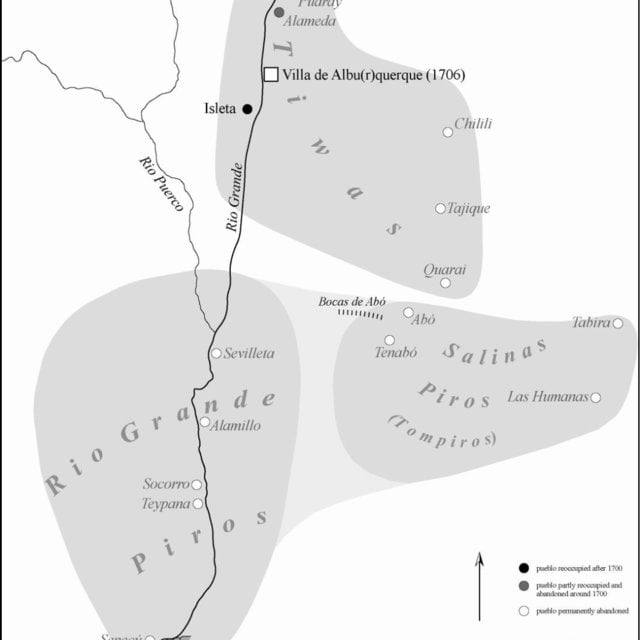
The area occupied by the Piros of the Salinas extended from the pueblo of Abo south east to and including the pueblo of Tabira, commonly but improperly called “Gran Quivira,” a distance of about 25 miles. The habitat of the eastern Piros was even more desert in character than that of the eastern Tigua, which bounded it on the north, for the Arroyo de Abo, on which Abo pueblo was situated, was the only perennial stream in the region, the inhabitants of Tabira and Tenabo depending entirely on the storage of rain water for their supply. In addition to the 3 pueblos named, it is not improbable that the now ruined villages known by the Spanish names Pueblo Blanco, Pueblo Colorado, and Pueblo de la Parida were among the 11 inhabited settlements of the Salinas seen by Chamuscado in 1580, but at least 3 of this number were occupied by the Tigua. Juan de Oñate, in 1598, also visited the pueblos of the Salinas, and to Fray Francisco de San Miguel, a chaplain of Oñate’s army, was assigned the Piros country as part of his mission district. The headquarters of this priest being at Pecos, it is not likely that much active mission work was done among the Piros during his incumbency, which covered only about 3 years. The first actual missions among the Piros pueblos of the Salinas were established in 1629 by Francisco de Acevedo at Abo and Tabira, and probably also at Tenabo, but before the massive-walled churches and monasteries were completed, the village dwellers of both the Salinas and the Rio Grande suffered so seriously from the depredations of the Apache, that Senecu on the Rio Grande, as well as every pueblo of the Salinas, was deserted before the Pueblo insurrection of 1680. Prior to the raid on Senecu by the Apache in 1675, 6 of the inhabitants of that village were executed for the massacre of the alcalde-mayor and 4 other Spaniards. Probably on account of the fear with which the Spaniards were known to be regarded by the Piros after this occurrence, they were not invited by the northern Pueblos to participate in the revolt against the Spaniards in 1680; consequently when Otermin, the governor, retreated from Santa Fé to El Paso in that year, he was joined by nearly all the inhabitants of Socorro, Sevilleta, and Alamillo. These, with the former occupants of Senecu, who, since the destruction of their village by the Apache had resided at Socorro, were afterward established in the new villages of Socorro, Texas, and Senecu del Sur in Chihuahua, on the Rio Grande below El Paso, where their remnants still survive. In attempting to reconquer New Mexico in the following year, Otermin caused Alamillo to be burned, because the few remaining inhabitants fled on his approach. Only 3 families remained at Sevilleta when the Spaniards retreated, but these had departed and the pueblo was almost in ruins on their return in 1681.
The entire Piros division of the Tanoan family probably numbered about 9,000 early in the 17th century. Of these, only about 60 individuals are known to survive.
Living with or near the Piros of the Salinas in the 16th and 17th centuries were a band of Jumano, a semi-nomadic tribe of which little is known. The proximity of these Indians to the Piros pueblos led to the error, on the part of cartographers of that period, of confounding the Jumano and Piros, hence the references on many early maps to the “Humanos de Tompiros,” etc.
Following is a list of Piros pueblos, so far as known, all of them being now extinct with the exception of Senecu del Sur, while Socorro has become “Mexicanized”:
- Abo
- Agua Nueva
- Alamillo
- Barrancas
- Qualacu
- San Felipe
- San Pascual
- Senecu
- Senecu del Sur (also Tigua)
- Sevilleta
- Socorro del Sur
- Socorro or Pilabo
- Tabira
- Tenabo
- Tenaquel
- Teypana
The following pueblos, now extinct, were probably also occupied by the Piros:
- Amo
- Aponitre
- Aquicabo
- Atepua
- Ayqui
- Calciati
- Canocan
- Cantensapue
- Cunquilipinoy
- Encaquiagualeaca
- Huertas
- Peixoloe
- Pencoana
- Penjeacu
- Pesquis
- Peytre
- Polooca
- Preguey
- Pueblo Blanco
- Pueblo Colorado
- Pueblo de la Parida
- Pueblo del Alto
- Queelquelu
- Quialpo
- Quiapo,
- Quiomaqui
- Quiubaco
- Tecahanqualahamo
- Teeytraan
- Tercao
- Texa
- Teyaxa
- Tohol
- Trelagu
- Trelaquepu
- Treyey
- Treypual
- Trula
- Tuzahe
- Vumahein
- Yancomo
- Zmnaque
The following pueblos, now also extinct, were inhabited either by the Piros or the Tigua:
- Acoli
- Aggey
- Alle
- Amaxa
- Apena
- Atnyalna
- Axauti
- Chein
- Cizentetpi
- Couna
- Dhiu
- Hohota
- Mejia
- Quanquiz
- Salineta
- San Francisco
- San Juan Bautista
- Xatoe
- Xiamela
- Yonalus

