
The following were chiefs or leaders of the Ottawa Indians.
Pontiac
An Ottawa chief, born about 1720, probably on Maumee river, Ohio, about the mouth of the Auglaize. Though his paternity is not positively established, it is most likely that his father was an Ottawa chief and his mother a Chippewa woman. J. Wimer 1 says that as early as 1746 he commanded the Indians, mostly Ottawa, who defended Detroit against the attack of the northern tribes. It is supposed he led the Ottawa and Chippewa warriors at Braddock’s defeat.
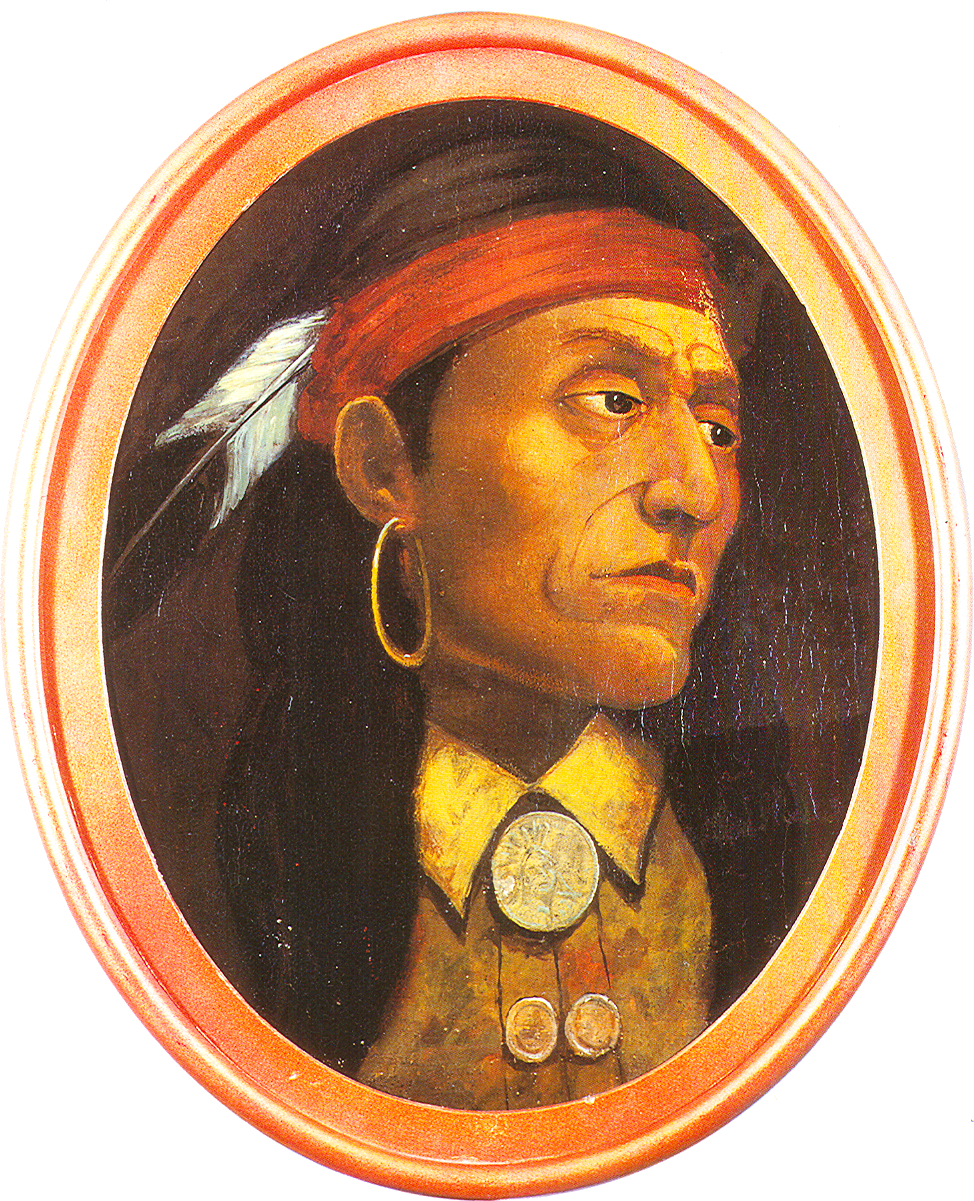
He first appears prominently in history at his meeting with Maj. Robert Rogers, in 1760, at the place where Cleveland, Ohio, now stands. This officer bad been dispatched to take possession of Detroit on behalf of the British. Pontiac objected to the further invasion of the territory, but, learning that the French had been defeated in Canada, consented to the surrender of Detroit to the British, and was the means of preventing an attack on the latter by a body of Indians at the mouth of the strait. That which gives him most prominence in history and forms the chief episode of his life is the plan he devised for a general uprising of the Indians and the destruction of the forts and settlements of the British.
He was for a time disposed to be on terms of friendship with the British and consented to acknowledge King George, but only as an “uncle,” not as a superior. Failing to receive the recognition he considered his due as a great sovereign, and being deceived by the rumor that the French were preparing for the reconquest of their American possessions, he resolved to put his scheme into operation. Having brought to his aid most of the tribes north west of the Ohio, his plan was to make a sudden attack on all the British posts on the lakes at once, at St Joseph, Ouiatenon, Michilimackinac, and Detroit, as well as on the Miami and Sandusky, and also attack the forts at Niagara, Presque Isle, Le Boeuf, Venango, and Pitt (Du Quesne). The taking of Detroit was to be his special task. The end of May 1763 was the appointed time when each tribe was to attack the nearest fort and, after killing the garrison, to fall on the adjacent settlements. It was not long before the posts at Sandusky, St Joseph, Miami (Ft Wayne), Ouiatenon, Michilimackinac, Presque Isle, Le Boeuf, and Venango were taken and the garrison in most cases massacred; but the main points, Detroit and Ft Pitt, were successfully defended and the Indians forced to raise the siege. This was a severe blow to Pontiac, but his hopes were finally crushed by the receipt of a letter from M. Neyon, commander of Ft. Chartrea advising him to desist from further warfare, as peace had been concluded between France and Great Britain. However, unwilling to abandon entirely his hope of driving back the British, he made an attempt to incite the tribes along the Mississippi to join in another effort.
Being unsuccessful in this attempt, he finally made peace at Detroit, Aug. 17, 1765. In 1769 he attended a drinking carousal at Cahokia, Illinois, where he was murdered by a Kaskaskia Indian. Pontiac, if not fully the equal of Tecumseh, stands closely second to him in strength of mind and breadth of comprehension.
Consult:
- Chronicles of America, Pontiac’s Conspiracy
- Parkman, Conspiracy of Pontiac
- Randall, Pontiac’s Conspiracy, in Ohio Archaeology and Historical Quarterly, Oct. 1903;
- Hough, Diary of the Siege of Detroit in the War with Pontiac, 1860.
Negwagon
A chief of the Ottawa of the Michilimackinac region of Michigan, commonly known as Little Wing, or Wing, and also called Ningweegon. Although the United State had declined the proffer of Indian services in the war with Great Britain in 1812, Negwagon espoused the American cause and lost a son in battle, whereupon he adopted Austin E. Wing. When the British took possession of Michilimackinac, Negwagon retired with his people to their hunting grounds, hoisting the American flag over his camp. Happening to be alone, he was visited by British soldiers, who ordered him to strike his flag. Obeying the command, he wound the emblem around his arm, and drawing his tomahawk, said to the officer, “Englishman, Negwagon is the friend of the Americans. He has but one flag and one heart; if you take one you shall take the other!” Then sounding a war cry he assembled his warriors and was allowed to remain in peace and to hoist the flag, again. After the close of the war he annually visited Detroit with his family in two large birch-bark canoes with an American flag flying front the stern of each. Lewis Cass, then stationed at Detroit, never failed to reward him on the occasion of these visits with two new flags. By treaty of Mar. 28, 1836, he was granted an annuity of $100, payable in money or goods. Negwagon is described as having been very large in stature. A county of Michigan was named in his honor, but the name was subsequently changed.
Consult:

- Events in Ind. Hist., 155, 1842[↩]
