
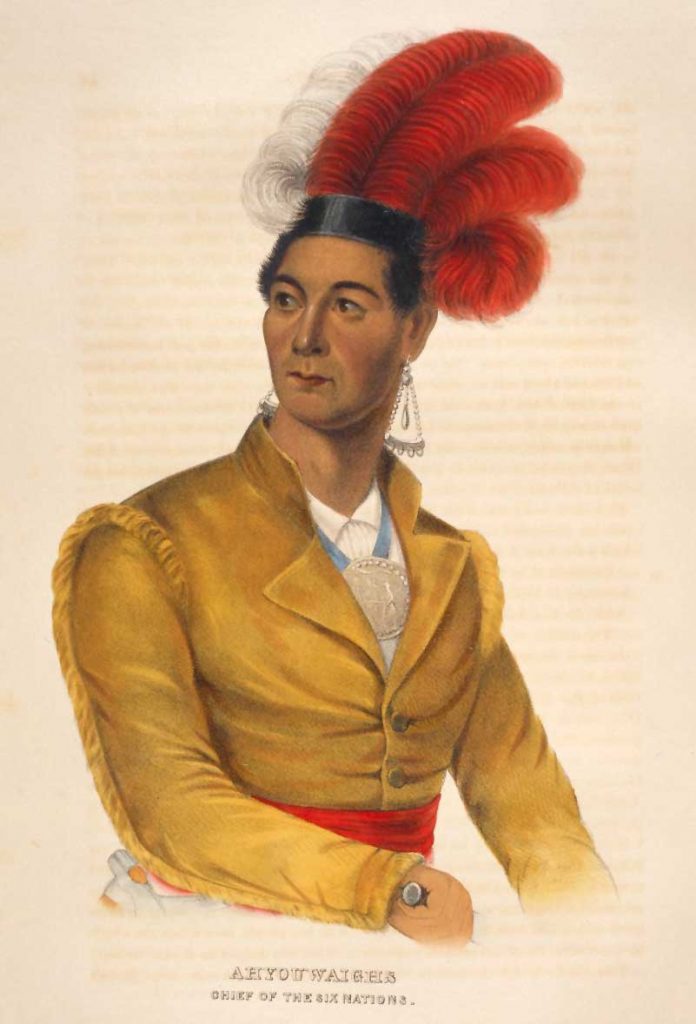
Caughnawaga Indians (Gă-hnă-wă-‘ge, ‘at the rapids’ ). An Iroquois settlement on the Sault St Louis on St Lawrence River, Quebec. When the hostility of the pagan Iroquois to the missions established in their territory frustrated the object of the French to attach the former to their interests, the Jesuits determined to draw their converts from the confederacy and to establish them in a new mission village near the French settlements on the St Lawrence, in accordance with which plan these Indians were finally induced to settle at La Prairie, near Montreal, in 1668. These converts were usually called “French Praying Indians” or “French Mohawks” by the English settlers, in contradistinction to the Iroquois who adhered to their own customs and to the English interests.
In 1676 they were removed from this place to Sault St Louis, where Caughnawaga and the Jesuit mission of St Francois du Sault were founded. The village has been removed several times within a limited area. The majority of the emigrants came from the Oneida and Mohawk, and the Mohawk tongue, somewhat modified, became the speech of the whole body of this village. The Iroquois made several unsuccessful efforts to induce the converts to return to the confederacy, and finally renounced them in 1684, from which time Caughnawaga became an important auxiliary of the French in their wars with the English and the Iroquois.
After the peace of Paris, in 1763, many of them left their village on the Sault St Louis and took up their residence in the valley of Ohio river, principally about Sandusky and Scioto Rivers, where they numbered 200 at the outbreak of the American Revolution. From their contact with the wilder tribes that region many of them relapsed into paganism, although they still retained their French allegiance and maintained connection with their brethren on the St Lawrence.
About 1755 a colony from Caughnawaga formed a new settlement at St. Regis, some distance farther up the St Lawrence. As the fur traders pushed their way westward from the great lakes they were accompanied by Caughnawaga hunters. As early as 1820 a considerable number of this tribe was incorporated with the Salish, while others found their way about the same period down to the mouth of Columbia River in Oregon, and north even as far as Peace River in Athabasca. In the west they are commonly known as Iroquois.
Some of the Indians from St Regis also undertook these distant wanderings. In 1884 Caughnawaga had a population of 1,485, while St Regis (in Canada and New York) had about 2,075, and there were besides a considerable number from the 2 towns who were scattered throughout the west. In 1902 there were 2,017 on the Caughnawaga Reservation and 1,386 at St Regis, besides 1,208 on the St Regis Reserve, New York.

