
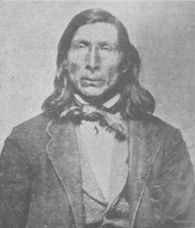
Montauk Indians (meaning uncertain). A term that has been used in different senses, sometimes limited to the particular hand or tribe known by this name, but in a broader sense including most of the tribes of Long Island, excepting those about the west end. It is occasionally used incorrectly as equivalent to Metoac. The Indians of Long Island were closely related to the Indians of Massachusetts and Connecticut. Tooker 1 says that the dialect of the Montauk was more nearly related to the Natick of Massachusetts than was the Narraganset.
The Montauk, in the limited sense, formerly occupied Easthampton township, Suffolk county, at the east end of Long Island, and controlled all the other tribes of the island, except those near the west end. That these so called tribes were but parts of one group or tribe, or the loosely connected elements of what had been an organized body, seems apparent. Ruttenber, speaking of the Montauk in the limited sense, says: “This chieftaincy was acknowledged both by the Indians and the Europeans as the ruling family of the island. They were indeed the head of the tribe of Montauk, the other divisions named being simply clans or groups, as in the case of other tribes. Wyandance, their sachem, was also the grand sachem of Paumanacke, or Sewanhackey, as the island was called. Nearly all the deeds for lands were confirmed by him. His younger brothers, Nowedonah and Poygratasuck [Poggatacut], were respectively sachems of the Shinnecock and the Manhasset.” The Rockaway and Cannarsee at the west end were probably not included. It is doubtful whether he is correct in including the west-end Indians in the confederacy.
The principal Montauk village, which probably bore the name of the tribe; was about Fort Pond, near Montauk Point. The Pequot made them and their subordinates tributary, and on the destruction of that tribe in 1637, the Narraganset began a series of attacks which finally, about 1659, forced the Montauk, who had lost the greater part of their number by pestilence, to retire for protection to the whites at Easthampton. Since 1641 they had been tributary to New England. When first known they were numerous, and even after the pestilence of 1658-59, were estimated at about 500. Then began a rapid decline, and a century later only 162 remained, most of whom joined the Brotherton Indians of New York, about 1788, so that in 1829 only about 30 were left on Long Island, and 40 years later these had dwindled to half a dozen individuals, who, with a few Shinnecock, were the last representatives of the Long Island tribes. They preserved a form of tribal organization into the 19th century and retained their hereditary chiefs until the death of their last “king,” David Pharaoh, about 1875. A few mixed bloods are still officially recognized by the state of New York as constituting a tribe under Wyandanch Pharaoh, son of David.

- Tooker, Cockenoe-deLong Island, 1596[↩]
My great grandmother who was born in Little Neck, New York. Was a relative of the late James B. Waters “Chief Wild Pigeon” who was from Little Neck, New York. I know he was a sachem chief of the montaukett tribe. He must be kin to the Waters family who were members of the matinecock tribe. I guess that’s how my great grandmother is a relative of the late James B. Waters. “Chief Wild Pigeon”
5