
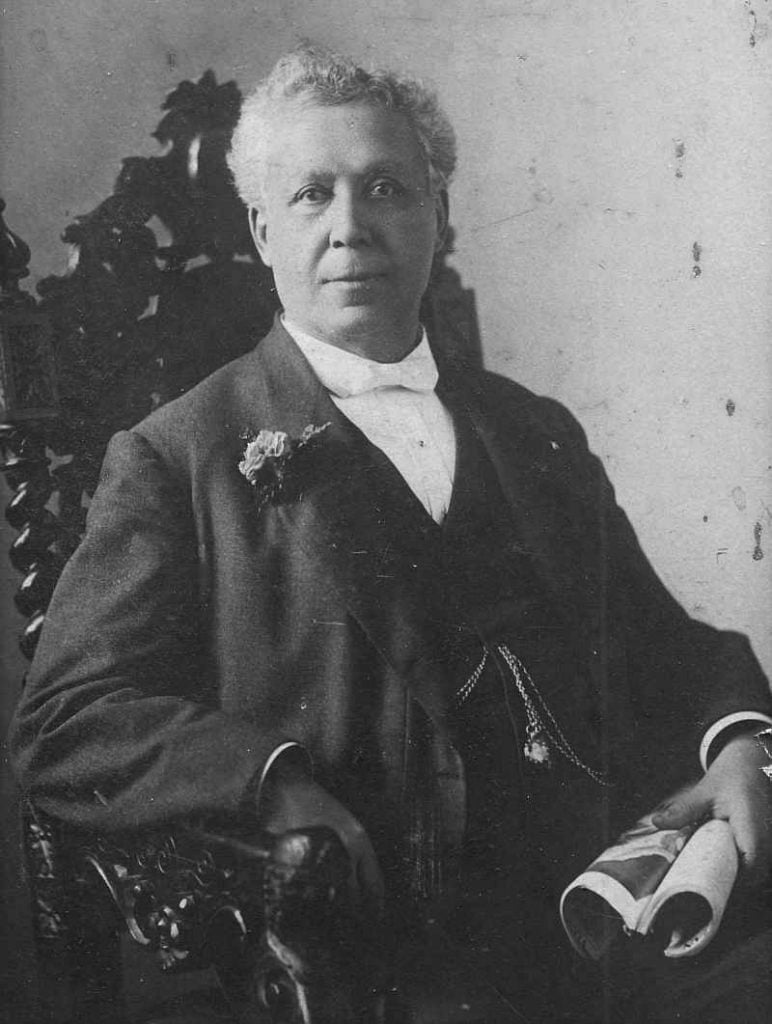
Onasakenrat, Joseph
Onasakenrat (‘White Feather’) , Joseph. A Mohawk chief, noted for his translations of religious works into his native language. He was born on his father’s farm, near Oka, Canada, Sept. 4, 1845; at 14 years of age he was sent to Montreal College to be educated for the priesthood, remaining there about 4 years. He was afterward converted to Protestantism and became an evangelical preacher. On June 15, 1877, the Catholic church of Oka was burned, and Chief Joseph was tried for the offense, but was not convicted. He died suddenly, Feb. 8, 1881, at Caughnawaga. Among his translations into the Mohawk dialect are the Gospels (1880) and a volume of hymns. At the time of his death he was engaged in translating the remainder of the Bible, having reached in the work the Epistles to the Hebrews.
Oronhyatekha
![Oronhyatekha ('It [is a] burning sky')](https://accessgenealogy.com/wp-content/uploads/2011/07/Oronhyatekha.jpg "Mohawk Indian Chiefs and Leaders 3")
Hiawatha
Hiawatha (Haio’n’hwe”tha’, ‘he makes rivers’). A name and a title of a chieftainship hereditary in the Tortoise clan of the Mohawk tribe; it is the second on the roll of federal chieftainships of the Iroquois confederation. The first known person to bear the name was a noted reformer, statesman, legislator, and magician, justly celebrated as one of the founders of the League of the Iroquois, the Confederation of Five Nations. Tradition makes him a prophet also. He probably flourished about 1570, A. D., and was the disciple and active coadjutor of Dekanawida. These two sought to bring about reforms which had for their object the ending of all strife, murder, and war, and the promotion of universal peace and well-being. Of these one was the regulation to abolish the wasting evils of intra-tribal blood-feud by fixing a more or less arbitrary price, 10 strings of wampum, a cubit in length, as the value of a human life. It was decreed that the murderer or his kin or family must offer to pay the bereaved family not only for the dead person, but also for the life of the murderer who by his sinister act had forfeited his life to them, and that therefore 20 strings of wampum should be the legal tender to the bereaved family for the settlement of the homicide of a co-tribesman. By birth Hiawatha was probably a Mohawk, but he began the work of reform among the Onondaga, where he encountered bitter opposition from one of their most crafty and remorseless tyrants, Wathatotarho (Atotarho) After three fruitless attempts to unfold his scheme of reform in council, being thwarted by the craft of his formidable antagonist (who for revenge destroyed his opponent’s daughters), Hiawatha left the Onondaga and, exiling himself, sought the aid of the Mohawk and other tribes. But, meeting with little success among the former, he continued his mission to the Oneida, who willingly assented to his plans on condition that the Mohawk should do the same. The Mohawk, the Cayuga, and the Oneida finally formed a tentative union for the purpose of persuading the Onondaga to adopt the plan of confederation, and the latter accepted it on condition that the Seneca should also be included. A portion of the Seneca finally joined the confederation, whereon the Onondaga, through Wathatotarho, accepted the proposed union. As the Onondaga chieftain was regarded as a great sorcerer, it was inferred that in this matter he had been overcome by superior magic power exercised by Hiawatha and Dekanawida, for they had brought Wathatotarho under the dominion of law and convention for the common welfare. Hence in time the character of Hiawatha became enveloped in mystery, and he was reputed to have done things which properly belong to some of the chief gods of the Iroquois. In this mystified form he became the central figure of a cycle of interrelated legends. Longfellow has made the name of Hiawatha everywhere familiar, but not so the character of the great reformer. Schoolcraft, in his Algic Researches, embodied a large number of legends relating to Chippewa gods and demigods, and, while compiling his Notes on the Iroquois, Gen. Clark communicated to him this cycle of mythic legends misapplied to Hiawatha. Charmed with the poetic setting of these tales, Schoolcraft confused Hiawatha with Manabozho, a Chippewa deity, and it is to these two collections of mythic and legendary lore that the English language owes the charming poem of Longfellow, in which there is not a single fact or fiction relating to the great Iroquoian reformer and statesman.
See Further:
- Hale, Iroquois Book of Rites.
- Hale, A Lawgiver of the Stone Age.
- Hewitt in American Anthropology, Apr. 1892.
Thayendanega – Joseph Brant
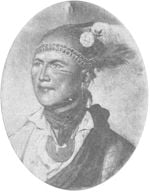
Thayendanega. (Thayĕndanē”kĕn’, ‘He sets or places together two bets,’ referring to the custom of fastening together the articles of approximate value placed as wagers by two phratries in tribal contests. The elements are t for te ‘two’; ha ‘he-it’; yenda’ ‘a wager’; -nē’kĕn’ ‘set side by side iteratively’). A celebrated Mohawk chief, popularly known as Joseph Brant, who took an active part against the white settlers in the border wars during the Resolution, and who first came into official notice as a so called “Pine-tree chief.” He as born on the Ohio in 1742 while his parents were on a hunting expedition to that section. The home of his family was at Canajoharie Castle in the Mohawk valley, N. Y. His father, Tehowaghwengaraghkwin, according to Stone, was a full-blood Mohawk of the Wolf gens, and his mother was also Indian or at least a half-blood. While Joseph was still young his father died, and the mother then married an Indian known among the whites as Brant: hence the name by which Brant is commonly known. ills sister Molly, the elder child, because the acknowledged wife, according to the Indian method, of Sir William Johnson. Thayendanegea’s career as a warrior began at the age of 13, when he joined the Indians under Sir William Johnson at the battle of Lake George in 1755. Johnson sent him to Dr Wheelock’s charity school at Lebanon, Conn., where he learned to speak and write English, and acquired some knowledge of general literature and history. He married the daughter of an Oneida chief about 1765, and settled at Canajoharie, where he joined the Episcopal Church and for a time led a peaceful life. His wife died in 1771, leaving a son and a daughter; in the year following he married his first wife’s half-sister. He was with Johnson in the Niagara expedition of 1759, and took part in the Pontiac war of 1763, fighting on the English side. Having visited England in 1775, he re-turned prepared to devote his energies to the British cause in the Revolution, then imminent. He was given a colonel’s commission by Gov. Carleton, and sullied his name by taking an active part in the massacre at Cherry valley and in the raid that desolated Minisink, Orange County, in 1779. He was conspicuous in the battle of Oriskany, Aug. 6, 1779, but was not present at the massacre of Wyoming in 1778, as has been charged. After the treaty of peace between Great Britain and the United States in 1783, still retaining his commission in the British service and drawing half pay, Brant was granted a tract of land, 6 miles wide, on each side of Grand River, Ontario, on which he settled with his Mohawk and other Iroquois followers, and continued to rule over them until his death, Nov. 24, 1807. He was thrice married; his second wife died childless, but by his third wife he had seven children. His youngest son, John (Ahyouwaighs) , became chief of the Mohawk tribe through his mother, who was the eldest daughter of the head chief of the Turtle gens. His daughter Elizabeth married William Johnson Kerr, grandson of Sir William Johnson. The last survivor of the Brant children was Catherine B. Johnson, who died in 1867. Thayendanegea was buried near the little church he had built on Grand River, 3 miles from Brantford, Ontario, and a monument placed over his grave bears the inscription, “This tomb is erected to the memory of Thayendanegea or Capt. Joseph Brant, principal chief and warrior of the Six Nations Indians, by his fellow subjects, admirers of his fidelity and attachment to the British Crown.” In 1879 the grave was desecrated and the bones were stolen by a physician and medical students, but most of them, including the skull, were recently restored to their former resting place. Consult Stone, Life of Brant, 1864., visit:
See Further:
- Thayendanegea, Captain Joseph Brant
- To see a more complete biography: Joseph Brant, Captain of the Six Nations

- New Indian, Stewart, Nev., Mar.1907.[↩]
