
The foundation of social organization, and hence of government, the tangible form of social organization, was originally the bond of real and, legal blood kinship. The recognition and perpetuation of the ties of blood kinship were the first important steps in the permanent social organization of society.
Among the North American Indians kinship is primarily the relation subsisting between two or more persons whose blood is derived from common ancestors through lawful marriage. Persons between who in kinship subsists are called kin or kindred. Kinship may be lineal or collateral. By birth through the natural order of descent kindred are divided into generations or categories, which represent lineally and collaterally relationships or degrees of kinship, which in turn are sometimes modified by the age and the sex of the persons so affected. In noting the degrees of kinship in the direct line all systems appear to agree in assigning one degree to a generation. Thus is developed a complex system of relationships. The extent and the complexity of the system in any case vary with the social organization of the people. These degrees of kinship may be called relationships, and they define more or less clearly the station, rights, and obligations of the several individuals of the kinship group specified. The distinction between relationship and kinship must not be confused, for there are persons who are related but who do not belong to the same kin.
In speaking of the entire body of a group of kindred it is necessary that reference he made to some person”, the propositus, as the starting point. In general every person belongs naturally to two distinct families (see Family) or kinship groups, namely, that of the father and that of the mother. These two groups of kindred, which before his birth were entirely distinct for the purposes of marriage and the inheritance of property and certain other rights, privileges, and obligations, unite in his person and thereafter form only subdivisions of his general group of kindred, and both these groups share with him the rights, privileges, and obligations of kindred.
There are two radically different methods of naming these relationships; the one is called the classificatory, the other the descriptive method. In the descriptive phrase the actual relationship becomes a matter of implication, that is, the relationship is made specific either by the primary terms of relationship or by a combination of them. Under the first, kindred are never described, but are classified into categories and the same term of relationship is applied to every person belonging to the same category. In the descriptive system of naming kinship degrees there is usually found a number of classificatory terms.
There has been prevalent hitherto among many ethnologists the opinion that the tracing of descent through the paternal line is in most cases a development from the system of tracing descent exclusively through females, and that, therefore, the latter system is antecedent and more primitive than the former. But it is not at all clear that there has been adduced in support of this contention any conclusive evidence that it is a fact or that either system has been transformed from the other; but it is evident that such an improbable procedure would have caused the disregard and rupture of a vast body of tabus-of tabus among the “lost sacred known, namely, the tabus of incest.
The kinship system in vogue among the Klamath Indians of California and Oregon is apparently typical of those tribes in which, like the Kiowa, both the clan and the gentile systems of kinship are wanting. This lack of either system, so far as known; is characteristic of nearly all the tribes of the plains, the Pacific slope, and the northwest coast. The Klamath system recognizes only two degrees in ascending above and only two in descending below the propositus in the direct line, and four collateral degrees of the paternal line, that of father’s brothers, that of father’s uncles, and then that of father’s sisters and that of father’s aunts; and four collateral degrees of the maternal line, that of mother’s sisters, that of mother’s aunts, that of mother’s brothers, and that of mother’s uncles, or eight collateral degrees in all. Hence in reckoning descent below himself in the direct line the offspring of propositus recognizes one degree of kinship below the lower of the two admitted by his father; but in the ascending direct line, the offspring of propositus does not recognize as a relation the higher of the two admitted by his father. So that in this system the circle of relationships shifts with the person selected as the starting point of the reckoning. The father recognizes relations which his child does not admit, and the child recognizes relations which the father does not admit.
Where the blood ties appear to be so limited and so disregarded in the social organization, the cohesion of the tribe is accomplished more or less satisfactorily through military, religious, or other societies, in North America those tribes among whom the clan system prevailed, with the tracing of descent through the female line, became the most important peoples of modern times. The Five Civilized Tribes of Oklahoma and the Iroquois peoples are examples of this.
Among the Omaha a man must not marry in his own gens. A law of membership requires that a child belong to its father’s gens. This is descent in the male line, but children of white or black persons (Negroes) belong to the gens of the mother, into which they are forbidden to marry. Moreover, a stranger can not belong to any gens of the tribe because there is no ceremony of adoption into a gens. A man is prohibited from marrying a woman of the gens of his father, as the women of this gens are his grandmothers, aunt, sisters, nieces, daughters, or granddaughters. For the same reason he can not marry a woman of the gens of his father’s mother, but he can marry a woman belonging to any other gens of his paternal grandmother’s phratry, as she would not be of his kindred.
Consanguineous or blood kinship embraces not only the gens of the father, but also that of the mother and grandmothers, and these kindred with reference to a man fall into fourteen groups, and with reference to a woman into fifteen groups.
Among the Omaha, within the phratry in which gentes exist, those who occupy the one side of the fire are not regarded as full kindred by those occupying the other side of the fire, and they are prohibited from intermarrying. But were it not for the institution of these gentes or quasi-kindred groups within the phratries, a male would be compelled to marry outside of his tribe, for the reason that all the women of the tribe would otherwise be his kindred through the previous intermarriages among the ten original “gentes” or phratries.
The Omaha kinship system may be taken as typical of the gentile organization, tracing descent through the male line. In this system the relationships are highly complex and the terms, or rather their approximate English equivalents, denotive of these relationships are employed with considerable latitude and in quite a different manner from their use in English. For example: If the propositus be a male or a female, he or she would call all men his or her ‘fathers’ whom his or her father would call ‘brothers’, or whom his or her mother would call her potential ‘husbands.’ he or she would call all women his or her ‘mothers’ whom his or her mother would call ‘sisters’, ‘aunts’, or ‘nieces’, or whom his or her father would call his potential ‘wives.’ Moreover, he or she would call all men ‘brothers’ who are the sons of such fathers or mothers, and their sisters would be his or her ‘sisters.’ he or she would call all men his or her ‘grandfathers’ who are the fathers or grandfathers of his or her fathers or mothers, or whom his or her fathers or mothers would call their mothers’ ‘brothers.’ he or she would also call all women his or her ‘grandmothers’ who are the real or potential wives of his or her grandfathers, or who are the mothers or grandmothers of his or her fathers or mothers, or whom his or her fathers would call their fathers ‘sisters.’
If the propositus be a male he would call all males his ‘sons’ who are the sons of his brothers or of his potential wives, and the sisters of these sons are his ‘daughters.’ If the propositus be a female person she would call all children of her sisters her ‘children’, because their father is or their fathers are her potential or actual husband or husbands; and site would call those males her ‘nephews’ who are the sons of her brothers, and the daughters of her brothers would be her `nieces.’
If the propositus be a male, he would call his sister’s son his ‘nephew’ and her daughter his ‘niece’; but whether male or female, the propositus would call all finale and female persons who are the children of his sons, daughters, nephews, or nieces,’ ‘grandchildren’; and, in like manner, he or she would call all men ‘uncles’ whom his or her mothers would call their ‘brothers’, and would call all female persons ‘aunts’ who are his or her father’s sisters as well as those who are the wives of his or her uncles. But the father’s sisters’ husbands of a male person are his brothers-in-law, because they are the actual or potential husbands of his sisters; and when the propositus is a female person they are her actual or potential husbands.
Any female person whom a man’s own wife calls ‘elder sister’ or ‘younger sister’, her father’s sister, or her brother’s daughter is his potential wife.
Any male person whom a man’s wife would call ‘elder brother’ or `younger brother’ is his brother-in-law; also any other male person who is the brother of his wife’s niece or of his brother’s wife. But his wife’s father’s brother is his grandfather, not his brother-in-law, although his sister is his potential wife. When his brother-in-law is the husband of his father’s sister or of his own sister, his sister is his grandchild, and not his potential wife. A male person is the brother-in-law of a man if he be the husband of the sister of the other’s father, since that man could marry his (the other’s own) sister, but his aunt’s husband is not his brother-in-law when he is his own uncle or his mother’s brother. Any male person is the brother-in-law of the man whose sister is his wife. But since his sister’s niece’s husband is his sister’s potential or actual husband, he is his son-in-law, because he is his daughter’s husband.
A male or female person would call any male person his or her ‘son-in-law’ who is the husband of his or her daughter, niece, or grandchild, and his father is his or her son-in-law. When a male person or a female person would call the father of his or her daughter-in-law his or her ‘grandfather,’ her brother is his or her grandson.
A male or female person would call any other female person who is the wife of his or her son, nephew, or grandson, his or her ‘daughter-in-law’; and the mother of his or her son-in-law is so called by him or her.
The father, mother’s brother, or grandfather of a man’s wife, of his potential wife, or of his daughter-in-law (the last being the wife of his son, nephew, or grandson) is the grandfather (or father-in-law) of that mail. Any female person who is the mother, mother’s sister, or grandmother of a man’s wife, of his potential wife, or of his daughter-in-law (a wife of his son, nephew, or of his grandson) is the grandmother (or mother-in-law) of that, man.
By the institution of either the clan or the gens system of determining and fixing degrees of relationship, kinship through males or through females acquired increased importance, because under either form of organization it signified ‘clan kin’ or ‘gentile kin’ in contradistinction to non-gentile kin. The members of either were all organized body of consanguinei bearing a common clan or gentile name, and were bound together by ties of blood and by the further bond of mutual rights, privileges, and obligations characteristic of the clan or the gens. In either case, ‘clan kin’ or ‘gentile kin’ became superior to other kin, because it invested its members with the rights, privileges, and obligations of the clan or gens.
Where a man calls his mother’s sister ‘mother’, and she in turn calls him her ‘son’, although she did not in fact give him birth, the relationship must in strictness he defined as a marriage relationship and not as a blood relationship. Under the clan or the gentile system of relationships kinship was traced equally through males and through females, but a broad distinction was made between the paternal and the maternal kindred, and the rights, privileges, and obligations of the members of the line through which descent was traced were far more real and extensive than were those of the other line. Among North American Indians kinship through males was recognized just as constantly as kinship through females. There were brothers and sisters, grandfathers and grandmothers, grandsons and granddaughters, traced through males as well as through females. While the mother of a child was readily ascertainable, the father was not, but because of this uncertainty, kinship through males was not therefore rejected, and probable fathers, probable brothers, and probable sons were placed in the category of real fathers, real brothers, and real sons.
In every Iroquois community the degree of security and of distinction which every member of the community enjoyed, depended chiefly on the number, the wealth, and the power of his kindred, hence the tie uniting the members of the kinship group was not lightly or arbitrarily broken.
It appears that where the clan organization is in vogue the adoption (q. v.) of alien persons was customary.
With descent in the female line a male person had in his clan grandfathers and grandmothers, mothers, brothers and sisters, uncles, rarely nephews and nieces, and grandsons and granddaughters, some lineal and some collateral; at the same time, with the exception of uncles, he had the same relationships outside of his clan, and fathers, aunts, sons and daughters, and cousins, in addition. A woman had the same relationships in the clan as a man, and in addition sons and daughters; and at the same time she had the same relationships outside of her clan as had the man.
In certain communities there are terms in use applied to polyandrous and polygynous marriage relations. For instance, in Klamath the terns p`tcekē’p’ denotes
(1) the relationship of the two or more wives of a man, and
(2) the relationship of two or more men (who may be brothers) who marry sisters or a single woman among them.
And in the Cree the term n’ t’ri âuim, employed by both men and women, signifies ‘my (sexual) partner’; for example, a wife will apply this terns to the cowife of the husband or husbands; and the terns nikusâk is applied by one man to another with whom he shares a wife or wives, or to whom he has loaned his own wife. This term is employed also as a term of friendship among men.
The distinction between one’s own father and mother and the other persons so called was sometimes marked by the use of an explanatory adjective, ‘real,’ ‘true,’ or the like; sometimes by calling all the others ‘little fathers’ or ‘little mothers.’
The following chart, which applies especially to the Haida, may be taken as typical of a two-clan system with female descent, self being male:
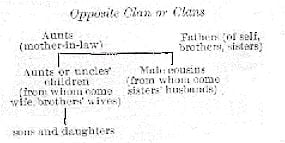
In paternal succession analogous series of terms of relationship develop.
The persons belonging to one’s own clan being accounted blood relations, marriage with any of them was not permitted, and where there were many clans this prohibition usually extended to the father’s clans also. After marriage, terms of affinity corresponding to ‘father-in-law,’ and ‘sister-in-law,’ were applied not only to persons who could be so designated in English, but to all members of the same clans of corresponding age and sex as well. Where there were but two clans the terms of affinity might be applied to those who had previously been known as uncles, aunts, uncles’ children, nephews, and nieces, is indicated in the above table.
Where clans did not exist blood relationship was recognized on both sides as far as the connection could be remembered, and marriage with any person within this circle was, generally speaking, less usual than with one entirely outside, though such marriages were not everywhere prohibited, and in some cases were actually preferred. There was the sauce custom, however, of extending the terms of relationship to groups of individuals, such as the brothers of one’s father, and the sisters of one’s mother. Among the Salish tribes of British Columbia, who appear to have had a special fondness for recording genealogies, the number of terms of relationship is very greatly increased. Thus four or even five generations back of that of the parents and below that of the children are marked by distinct terms, and there are distinguishing terms for the first, second, third, and youngest child, and for the uncle, aunt, etc., according as one’s father, mother, or other relative through whom the relationship exists is living or dead, and different terms for a living and a dead wife. There are thus 25 terms of relationship among the Lillooet, 28 among the Shuswap, and 31 among the Squawmish. By way of illustration, the kinship system of the last-mentioned tribe is subjoined (see Boas in Rep. on N. W. Tribes of Can., 136, 1890):
1. Direct relationship. Haakweyuk, great-great-great grandparent or great
great-great grandchild; tsopeyuk, great-great-grandparent or great-great-grandchild; stshamik, great-grandparent or great-grandchild; seel, grandfather, grandmother, great-uncle, or great-aunt; emats, grandchild, grandnephew, or grandniece; man, father; chisha, mother; men, child; seentl, eldest child; anontatsh, second child; menchechit, third child; saut, youngest child; kupkuopits, brothers, sisters, and cousins together; kuopits, elder brother or sister, or father’s or mother’s elder brother’s or sister’s child; skak, younger brother or sister, or father’s or mother’s younger brother’s or sister’s child snchoitl, cousin.
2. Indirect relationship.
(A) When the intermediate relative is alive: sisi, father’s or mother’s brother or sister; staeatl, brother’s or sister’s child; chemash, wife’s or husband’s cousin, brother, or sister; or cousin’s brother’s or sister’s wife or husband; saak, son-in-law, daughter-in-law, father-in-law, or mother-in-law; skuewas, any relative of a husband or wife.
(B) When the intermediate relative is dead: uotsaeqoitl, father’s or mother’s brother or sister; suinemaitl, brother’s or sister’s child; chaiae, wife’s or husband’s cousin, brother, or sister, or cousin’s brother’s or sister’s wife or husband; slikoaitl, son-in-law, daughter-in-law, father-in-law, or mother-in-law.
3. Indirect affinity Skseel, wife’s grandfather or grandmother, or stepfather’s, stepmother’s father or mother; skaman, aunt’s husband or stepfather; skechisha, uncle’s wife or stepmother; skemen, stepchild; skemats, grandson’s or granddaughter’s wife or husband; skesaak, wife’s or husband’s stepfather or stepmother, or stepchild’s husband or wife.
It will be noted that many of these are reciprocal terms, and such were very common in Indian kinship systems, used between persons of different generations, as above, or sometimes between persons of opposite, sex of the same generation, such as husband and wife. Out of 14 terms in Klamath and Modoc 11 are reciprocal. On the other hand, persons of different sexes will often indicate the same relative, such as a father or a mother, by entirely different terms, and different terms are applied to those of a person’s own phratry and to members of the opposite one, while the Iroquois use, the equivalent for ‘brother’ for persons inside and outside the tribe indiscriminately. In all tribes, no matter how organized, a distinction is made between the elder and the younger members of the generation of self, at least between older and younger members of the same sex.
The terms corresponding to ‘grandfather’ and `grandmother,’ except among a few peoples, like the Salish, were extended to all those of a generation older than that of the parents and sometimes even to persons of that generation, while the term for ‘grandchild’ was applied to very young people by old ones quite indiscriminately. There were also terms to indicate the potential relationship of husband and wife, applied by a man to his wife’s sisters, his aunt, or his niece, not because she was or had been, but because she might become, his wife, as usually happens to the wife’s sister after the wife’s death.
Besides the natural import of terms of kinship, they were employed metaphorically in a great number of ways, as to indicate respect, to avoid the use of a man’s personal name, to indicate tho clan or phratry to which a person belonged, or to indicate the possession of special privileges. Naturally enough, they often took the place of clan or even tribal designations, a fact which undoubtedly has led to serious errors in attempts to trace the history of Indian tribes. Again, they were applied to animals or supernatural beings, and with the Haida this use was intended to mark the fact that the being in question belonged to such and such a, phratry or that a representation of it was used as a crest in that phratry. As this classification of animals by phratries or clans is often traced back to the intermarriage of a human being and an animal, we have an extension of the idea of kinship quite beyond any civilized conceptions. See Clan and Gens, Family, Social Organization.
