According to Morgan 1 the Delaware have 3 clans (called by him gentes), or phratries, divided into 34 sub-clans, not including 2 sub-clans now extinct.
These clans, which are the same among the Munsee and Mahican, are:
- Took-seat (’round paw,’ ‘wolf’ ).
- Pokekooungo (‘crawling,’ ‘turtle’).
- Pullaook (‘non-chewing,’ ‘turkey’).

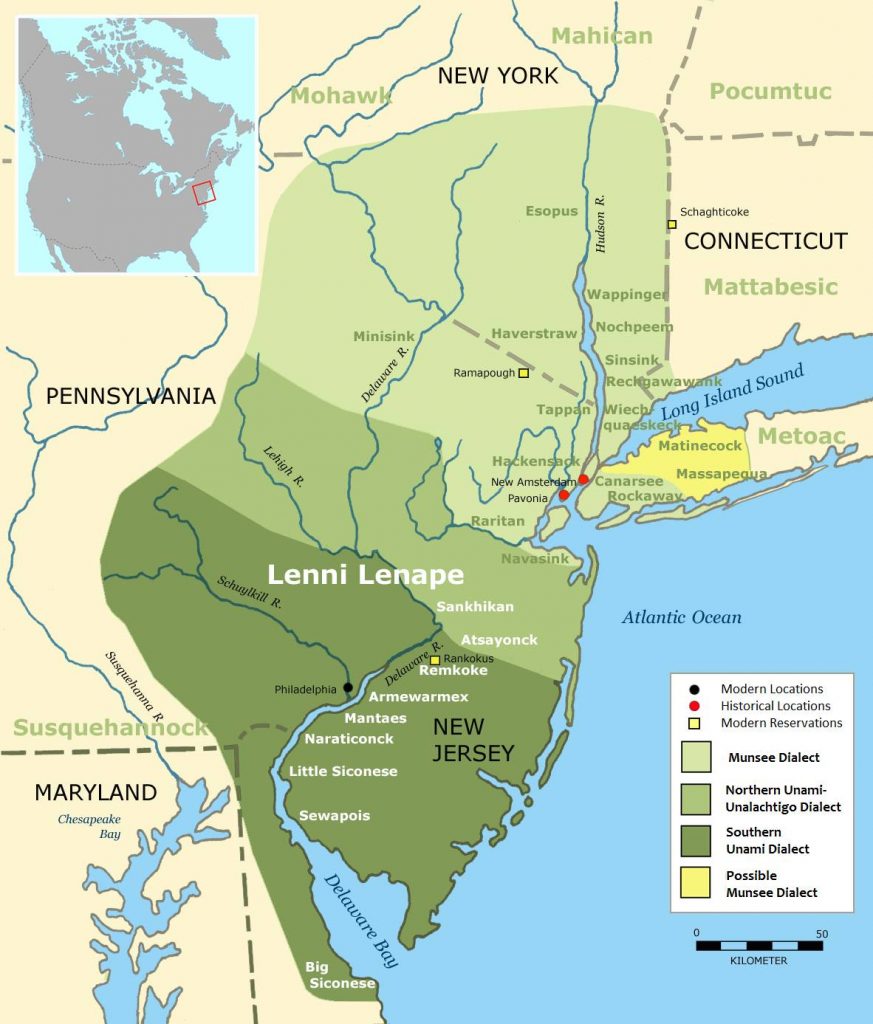
These clans – Wolf, Turtle, and Turkey – are commonly given as synonymous with Munsee, Unami, and Unalachtigo, the 3 divisions of the Delawares, exclusive of the New Jersey branch. According to Brinton 2 they are not clans, but mere totemic emblems of the 3 geographic divisions above named. Of these the Unami held the hereditary chieftainship. The New Jersey branch probably formed a fourth division, but those bands broke up at an early period and became incorporated with the others. Many of them had originally removed from the west bank of Delaware river to escape the inroads of the Conestoga. The 3 clans as given by Morgan are treated under the better known geographic names.
The Took-seat, or Wolf clan, has the following 12 subdivisions:
- Maangreet (big feet) ;
- Weesowhetko (yellow tree);
- Pasakunamon (pulling corn);
- Weyarnihkato (care enterer, i. e. cave enterer?);
- Tooshwarkana (across the river);
- Olumane (vermilion);
- Punaryou (dog standing by fireside) ;
- Kwineekcha (long body);
- Moonhartarne (digging);
- Nonharmin (pulling up stream);
- Longushharkarto (brush log);
- Mawsootoh (bringing along).
The Pokekooungo, or Turtle clan, has the following 10 subdivisions, 2 others being extinct:
- Okahoki (ruler);
- Takoongoto (high bank shore);
- Seeharongoto (drawing down hill);
- Oleharkarmekarto (elector);
- Maharolukti (brave);
- Tooshkipakwisi (green leaves) ;
- Tungulungsi (smallest turtle) ;
- Welunungsi (little turtle);
- Leekwinai (snapping turtle);
- Kwisaesekeesto (deer).
The Pullaook, or Turkey clan, has the following 12 subdivisions:
- Moharala (big bird) ;
- Lelewayou (bird’s cry) ;
- Mookwungwahoki (eye pain) ;
- Mooharmowikarnu (scratch the path);
- Opinghoki (opossum ground);
- Muhhowekaken (old shin);
- Tongonaoto (drift log);
- Noolamarlarmo (living in water) ;
- Muhkrentharne (root digger) ;
- Muhkarmhukse (red face);
- Koowahoke (pine region);
- Oochukham (ground scratcher).
The divisions of the Munsee, according to Ruttenber 3, were the:
- Minisink
- Waoranec
- Waranawonkong
- Mamekoting
- Wawarsink
- Catskill
He names among the Unami divisions the Navasink, Raritan, Hackensack, Aquackanonk, Tappan, and Haverstraw, all in north New Jersey, but there were others in Pennsylvania. Among the Unalachtigo divisions in Pennsylvania and Delaware were probably the Neshamini, Shackamaxon, Passayonk, Okahoki, Hickory Indians (?), and Nantuxets. The Gachwechnagechga, or Lehigh Indians, were probably of the Unami division. Among the New Jersey bands not classified are the Yacomanshaghking, Kahansuk, Konekotay, Meletecunk, Matanakons, Eriwonec, Asomoche, Pompton (probably a Munsee division), Rancocas, Tirans, Siconesses (Chiconessex), Sewapoo (perhaps in Delaware), Kechemeche, Mosilian, Axion, Calcefar, Assunpink, Naraticon, and Manta (perhaps a Munsee division). The Nyack band, or village, in Rockland co., N. Y., may have belonged to the Unami. The Papagonk band and the Wysox probably belonged to the Munsee.
Additional Delaware Indian Resources
- Delaware Indian History
- Delaware Indian Clans
- Delaware Indian Villages
- Delaware Indian Chiefs and Leaders
- Conoy Indian History
- Moravian Indian History
- Munsee Indian History
- Nantiocoke Indian History
- Unalachtigo Indian History
- Unami Indian History
- Wappinger Indian History
- Wappinger Indian Divisions

- Morgan, Lewis H. Ancient Society: Or, Researches in the Lines of Human Progress from Savagery Through Barbarism to Civilization. Calcutta: Bharati Library, n.d.. 171, 1877. https://www.marxists.org/reference/archive/morgan-lewis/ancient-society/[↩]
- Brinton, Daniel G. The Lenape and Their Legends: With the Complete Text and Symbols of the Walam Olum, a New Translation, and an Inquiry into Its Authenticity. Philadelphia: D. G. Brinton, 1885. https://accessgenealogy.com/books/fs4o [↩]
- Ruttenber, Edward M. History of the Indian Tribes of Hudson’s River: Their Origin, Manners and Customs, Tribal and Sub-Tribal Organizations, Wars, Treaties, Etc., Etc. Albany, N.Y: J. Munsell, 1872. https://accessgenealogy.com/books/j4fw.htm[↩]
