
Creek Indians. A confederacy forming the largest division of the Muskhogean family. They received their name form the English on account of the numerous streams in their country.
Where did the Creek Indian tribe live?
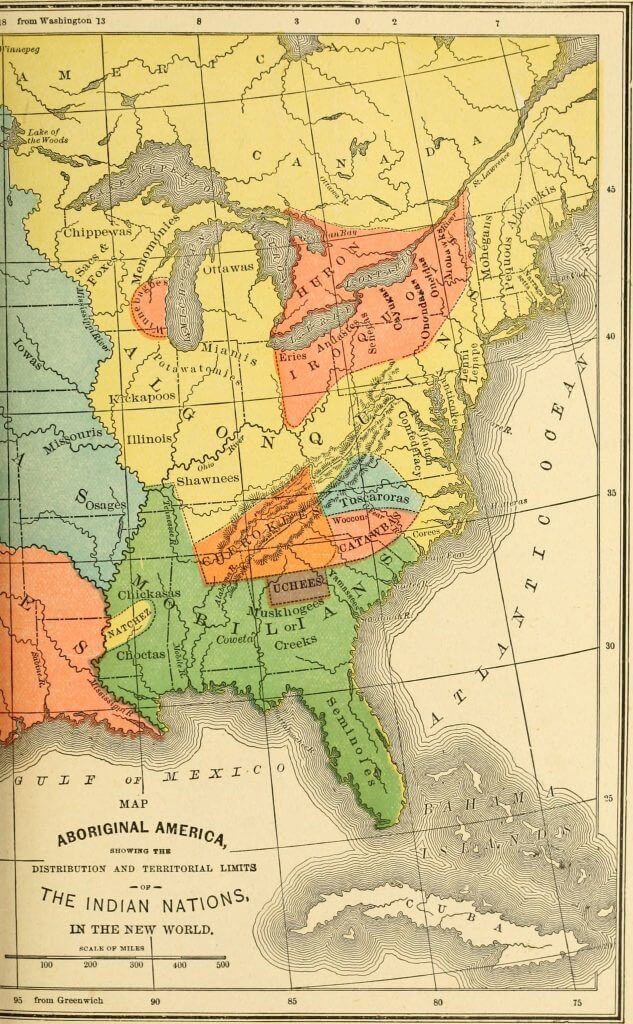
During early historic times the Creek occupied the greater portion of Alabama and Georgia, residing chiefly on Coosa and Tallapoosa rivers, the two largest tributaries of the Alabama river and on the Flint and Chattahoochee Rivers. They claimed the territory on the east from the Savannah to St. Johns river and all the islands, thence to Apalachee Bay, and from this line northward to the mountains. The south portion of this territory was held by dispossession of the earlier Florida tribes. They sold to Great Britain at an early date their territory between Savannah and Ogeechee rivers, all the coast to St Johns river, and all the islands up to tidewater, reserving for themselves St Catherine, Sapelo, and Ossabaw Ilands, and from Pipemakers Bluff to Savannah 1 Thus occupying a leading position among the Muskhogean tribes the Creeks were sufficiently numerous and powerful to resist attacks from the northern tribes, as the Catawba, Iroquois, Shawnee, and Cherokee, after they had united in a confederacy, which they did at an early day. The dominating tribes at the time of the confederation seem to have been the Abihka (or Kusa), Kasihta, Kawita, Oakfuskee, and some other tribe or tribes at the junction of Coosa and Tallapoosa rivers. Nothing certain can be said of their previous condition, or of the time when the confederacy was established, but it appears from the narratives of De Soto’s expedition that leagues among several of these towns existed in 1540, over which head chiefs presided.
For more than a century before their removal to the west, between 1836 and 1840, the people of the Creek confederacy occupied some 50 towns, in which were spoken 6 distinct languages, viz, Muscogee, Hittite, Koasati, Yuchi, Natchez, and Shawnee. The first three were of Muskhogean stock, the others were entirely alien incorporations. About half the confederacy spoke the Muscogee language, which thus constituted the ruling language and gave name to the confederacy. The meaning of the word is unknown. Although an attempt has been made to connect it with the Algonquian maskeg, ‘swamp,’ the probabilities seem to favor a southern origin. The people speaking the cognate Hitchiti and Koasati were contemptuously designated as “Stincards” by the dominant Muscogee. The Koasati seem to have included the ancient Alibamu of central Alabama, while the Hitchiti, on lower Chattahoochee river, appear to have been the remnant of the ancient people of southeast Georgia, and claimed to be of more ancient occupancy than the Muscogee. Geographically the towns were grouped as Upper Creek, on Coosa and Tallapoosa rivers, Alabama, and Lower Creek, on middle or lower Chattahoochee river, on the Alabama-Georgia border. While the Seminole (q. v.) were still a small body confined to the extreme north of Florida, they were frequently spoken of as Lower Creeks. To the Cherokee the Upper Creeks were known as Ani-Kusa use, from their ancient town of Kusa, or Coosa, while the Lower Creeks were called Ani-Kawita, from, their principal town Kawita, or Coweta. The earlier Seminole emigrants were chiefly from, the Lower Creek towns.
Creek Tribe History
The history of the Creeks begins with the appearance of De Soto’s array in their country in 1540. Tristan de Luna came in contact with part of the group in 1559, but the only important fact that can be drawn from the record is the deplorable condition into which the people of the sections penetrated by the Spaniards had been brought by their visit. Juan del Pardo passed through their country in 1567, but Juan de la Vandera, the chronicler of his expedition, has left little more than a list of unidentifiable names. The Creeks came prominently into history as allies of the English in the Apalachee wars of 1703-08, and from that period continue almost uniformly as treaty allies of the South Carolina and Georgia colonies, while hostile to the Spaniards of Florida. The only serious revolt of the Creeks against the Americans took place in 1813-14-the well-known Creek war, in which Gen. Jackson took a prominent part. This ended in the complete defeat of the Indians and the submission of Weatherford, their leader, followed by the cession of the greater part of their lands to the United States. The extended and bloody contest in Florida, which lasted from 1835 to 1843 and is known as the Seminole war, secured permanent peace with the southern tribes.
The removal of the larger part of the Creek and Seminole people and their Negro slaves to the lands assigned them in Indian Territory took place between 1836 and 1840.
The Creek woman was short in stature but well formed, while the warrior, according to Pickett 2 was “larger than the ordinary race of Europeans, often above 6 ft. in height, but was invariably well formed, erect in his carriage, and graceful in every movement. They were proud, haughty, and arrogant; brave and valiant in war.” As a people they were more than usually devoted to decoration and ornament; they were fond of music, and ball play was their most important game. Exogamy, or marriage outside the clan, was the rule; adultery by the wife was punished by the relatives of the husband; descent was in the female line. In government it was a general rule that where one or more clans occupied a town they constituted a tribe under an elected chief, or miko, who was advised by the council of the town in all important matters, while the council appointed the “great warrior” or tustenuggi-hlako. They usually buried their dead in a square pit under the bed where the deceased lay in his house. Certain towns were consecrated to peace ceremonies and were known as “white towns,” while others set apart for war ceremonials were designated as “red towns.” They had several orders of chiefly rank. Their great religious ceremony was the annual puskita (see Busk), of which the lighting of the new fire and the drinking of the black drink were important accompaniments.
The early statistics of Creek population are based on mere estimates. It is not known what numerical relation the mixed bloods hold to the full bloods and their former Negro slaves, nor the number of their towns (having a square for annual festivities) and villages (having no square). In the last quarter of the 18th century the Creek population may have been about 20,000, occupying from 40 to 60 towns. Knox in 1789 (Am. State Pap., r, 1832) estimates them at 6,000 warriors, or a total of 24,000 inhabitants in 100 towns; but these evidently included the Seminole of Florida. Bartram, about 1775, credits the whole confederacy, exclusive of the Seminole, with 11,000 in 55 towns. Hawkins, in 1785, gave them 5,40 men, representing a total of about 19,000. Estimates made after the removal to Indian Territory place the population between 15,000 and 20,000. In 1904 the “Creeks by blood” living in the Creek Nation, numbered 9,905, while Creek freedmen aggregated 5,473. The number of acres in their reserve in 1885 was: 3,215,395, of which only a portion was tillable, and 90,000 were actually cultivated.
Some of the more important earlier treaties of the United States with the Creek Indians are: Hopewell, S. C., Nov. 28, 1785; New York, Aug. 7, 1790; Coleraine, Ga., June 29, 1796; Ft Jackson, Ala., Aug. 9, 1814; Creek agency on Flint River, Jan. 22, 1818; Indian Spring, Creek Nation, Jan. 8, 1821; Washington, D. C., Jan. 24, 1826, and Mar. 24, 1832; Ft Gibson, Ind. Territory, Nov. 23, 1838.
At present (1905) the Creek Nation in Indian Territory is divided into 49 townships (“towns”), of which 3 are inhabited solely by Negroes. The capital is Okmulgee. Their legislature consists of a House of Kings (corresponding to the Senate) and a House of Warriors (similar to the National House of Representatives), with a head chief as executive. Several volumes of their laws have been published.
Creek Tribe Biographies
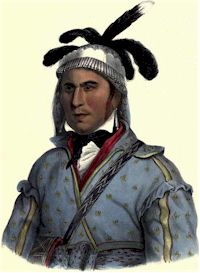
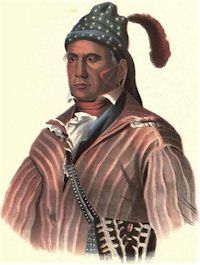
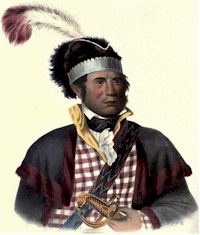
- Biography of General William Augustus Bowles
- Biography of General William Mcintosh
- Biography of General Alexander McGillivray
More Information on the Creek Tribe
- Creek Confederacy – Swanton
- Notes on the Creek Indians
- Early History of the Creek Indians and Their Neighbors
- History of the Muskogee Indians
- Migration Legend of the Creek Indians– Gatschet
- Creek Treaties
- Treaty of August 7, 1790
- Treaty of June 29, 1796
- Treaty of June 16, 1802
- Treaty of November 14, 1805
- Treaty of August 9, 1814
- Treaty of January 22, 1818
- Treaty of January 8, 1821
- Treaty of January 8, 1821 (2)
- Treaty of February 12, 1825
- Agreement of June 29 1825
- Treaty of January 24, 1826
- Treaty of November 15, 1827
- Treaty of March 24, 1832
- Treaty of February 14, 1833
- Treaty of August 24, 1835
- Treaty of November 23, 1838
- Treaty of January 4, 1845
- Supplemental Treaty of June 13, 1854
- Treaty of August 7, 1856
- Agreement of September 13, 1865
- Treaty of June 14, 1866
- Creek Towns
- Creek Indian Clans
- Creek Tribal Locations
- Georgia Indian Tribes – Swanton
- Oklahoma Indian Tribes – Swanton
- South Carolina Indian Tribes – Swanton
- Muskogee Indians – Swanton
- Index to Campbell’s Abstract of Creek Indian Census Cards
- 1832 Creek Census
- McIntosh, Creek Chief
- Alexander McGillivray, Last King of the Creeks
- Creek Indian Chiefs and Leaders
- Oklahoma Indian Tribal Schools
- Indian Missions of the Southern States
- Mailing Lists
- Tribe Specific
- Indians Mailing Lists by Location
- Indian Cemetery Mailing Lists
- Indian Roll Mailing Lists
- Papers of William Henry Lyttelton 1756-1760
- Creek Indian Wars
- Red Eagle and the Wars with the Creek Indians
- Green Corn Dance
- Enrollment of Five Civilized Tribes, 1896
- Index to Final Roll
- Native American Land Patents
- Indian Chiefs I have Known
- Indian Races of North and South America
- Creek Indian Research


My great grandmother was a short lady of Creek. I believe 1/2 because her last name was Story. Don’t know her family. But she had 5 girls(one was my grandmother), and married a white man, Bailey. You could see the Creek in her as she was almost black in the sun.
I have 3 boys and the middle is like that. He used to get black in the sun. My brother did too. How can I know how much we have? It
showed up in my Dad and his brothers and in me some now that I am older. Always wanted to know how much and how does it
work when some have it and others don’t in same family? I understand my brother said we have Cherokee also but Irish too!
Take a DNA test. It won’t tell you what Tribe, but it will tell you whether you have Native ancestry. Encourage other family members to take one as well, to get a clearer picture.
we are finally for some strange reason are living in a time when people want to believe that they have indian blood in their heritage.when in the 1800″s and early 1900″ when the goverment man (sensus taker)came around the farm and asked the husband about his wife and children the husband would say that his wife was white even though she would be full blooded or half blooded indian.i have heard my whole life about my great great grandmother who was half indian and was adopted by a family and raised as their own child.but even through research i could not find her heritage.i decided to get a dna test.(not looking for indian blood i just wanted to tell my mother and father where we came from).it turns out that my family is just about everything that their is.and it said that i had 2%american indian in my dna.but the strange thing is that the u.s. goverment will still not let you claim another heritage other that caucasion even with dna evidence.it seems kinda strange how life works,don’t you think?
Claim a heritage? The U.S. government has nothing to do with your heritage. Neither does a DNA test. That is your ancestry, not your heritage.
My family are descendants of Justine Greene married to Frank Greene of Savannah GA who’s mother was a Creek Indian from the Yamacraw tribe. I would love to find family who could tell me more about my family.
I am the grand daughter of Chief Squire Cloud and Mico Tussekiah. My grandmother was Fedora Cloud and my grandfather was Chief Boz Sheperd. I’m looking for info if anyone has anything to share.
Back in the early 80’s all the members of my mothers family including myself and my sister received some type of reparation money through the Creek Nation. Can anyone tell me what that was about.
It was actually 1972. MCN received just under $5 million for ceded lands in the southeast and Oklahoma. In 1972, they paid every citizen a dividend from that. I forget what the amount each person received, but I think it was just under $300. I was a minor at the time, so my Mom got all of our money. Somewhere online is a listing of everyone who received the payment. I’ve looked at it before and thought I had it downloaded somewhere, but can’t find it now. I’ll keep looking. This was the last time we received per capita payments.
I found the rolls. They can be found here under 1971 Creek Census:
There are several pages. This lists the amount at $276.00, but I think I was told at the time it was $112.00. Maybe I am misremembering. It was almost 50 years ago. The payments were sent in 1972.
Barb, I have removed the link referenced, since some of the data represented on that website was stolen from AccessGenealogy. Yes, stolen. 🙁
My Great Great Grandmother was 100% mixed Creek and Cherokee who married my great great grandfather by the last name of brown i wish i knew more bc i wanna find out more about her and my family.. I now live in Armuchee Where here in rome Ga they say it got its name from the creek and cherokee that where mixed and lived there bc from what ive heardcreek and cherokee mixed was kinda a bad thing so here in rome they kinda where all sent to armuchee anyone else knows more please do let me know
My people were the Brown’s also! If you can give me some names I may be able to answer your question!
I have been told that my family is Creek. I would like to know more about my ancestors and its heritage.
My family is Creek and African descendants.
My husband has been told his entire life that his great-great grandmother Leila Emma Stewart (smoak) of full blooded creek heritage. I have traced the family linage back to his Great x4 grand parents but don’t know how to find out if they were of creek heritage. Any advise?
Search for their Dawes Roll numbers
The Dawes Roll is not all inclusive! unfortunately!
Does he have family in the Alabama area? My family is from there…Creek natives.
Members of my family has web fingers and toes, i was told that this may come from native indians or caucasian people. Do you have information on this?
Cynthia, the medical term for two or more fingers or toes that are fused together or “webbed” is syndactyly (sin-dak-tuh-lee). This trait occurs in 1 out of every 1700-2000 births in North America. It is hereditary, but not isolated or more common to a Creek heritage, or any other specific tribe. While most instances are tied to autosomal DNA, there are some occurrences which happen solely on the X chromosome.