
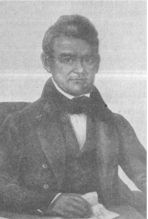
Yonaguska
(properly ‘The bear drowns him,’ whence his common name ‘Drowning-bear’). The adopted father of Col. William H. Thomas, and the most prominent chief in the history of the East Cherokee, although, singularly enough, his name does not occur in connection with any of the early wars or treaties. This is due partly to the fact that he was a peace chief and counselor rather than a war leader, and in part to the fact that the isolated position of the mountain Cherokee kept them aloof, in a great measure, from the tribal councils of those living to the west and south.
In person he was strikingly handsome, being 6 ft 3 in. in height and strongly built. In power of oratory he is said to have surpassed any other chief of his day. When the Cherokee lands on Tuckasegee River were sold by the treaty of 1819, Yonaguska continued to reside on a reservation of 640 acres in a bend of the river a short distance above the present Bryson City, North Carolina, on the site of the ancient Kituhwa. He afterward moved over to Oconaluftee, and finally, after the removal, gathered his people about him and settled with them on Soco Creek on lands purchased for them by Thomas. He was a prophet and reformer as well as a chief. When about 60 years of age he had a severe illness, terminating in a trance, during which his people mourned him as dead. At the end of 24 hours, however, he awoke to consciousness and announced that he had been to the spirit world, where he had talked with friends who had gone before, and with God, who had sent him back with a message to the Indians, promising to call him again at a later time. From that day until his death his words were listened to as those of one inspired. He had been somewhat addicted to liquor, but now, on the recommendation of Thomas, not only stopped drinking himself, but organized his tribe into a temperance society. To accomplish this he called his people together in council, and, after clearly pointing out to them the serious effect of intemperance, in an eloquent speech that moved some of his audience to tears, he declared that God had permitted him to return to earth especially that he might thus warn his people and banish whisky from among them. He then had Thomas write out a pledge, which was signed first by the chief and then by each one of the council, and from that time until after his death whisky was unknown among the East Cherokee. Although frequent pressure was brought to bear to induce him and his people to remove to the west, he firmly resisted every persuasion, declaring that the Indians were safer from aggression among their rocks and mountains than they could ever be in a land which the white man could find profitable, and that the Cherokee could be happy only in the country where nature had planted him. While counseling peace and friendship with the white man, he held always to his Indian faith and was extremely suspicious of missionaries. On one occasion, after the first Bible translation into the Cherokee language and alphabet, some one brought a copy of Matthew from New Echota, but Yonaguska would not allow it to he read to his people until it had first been read to himself. After listening to one or two chapters the old chief dryly remarked: “Well, it seems to be a good book, strange that the white people are not better, after having had it so long.” He died, aged about 80, in Apr. 1839, within a year after the removal. Shortly before the end he had himself carried into the townhouse on Soco Creek, of which he had supervised the building, where, extended on a couch, he made a last talk to his people, commending Thomas to them as their chief and again warning them earnestly against ever leaving their own country. Then wrapping his blanket around him, he quietly lay back and died. He was buried beside Soco, about a mile below the old Macedonia mission, with a rude mound of stones to mark the spot. He left two wives and considerable property, including an old Negro slave named Cudjo, who was devotedly attached to him. One of his daughters, Katalsta, still (1909) survives, and is the last conservator of the potter’s art among the East Cherokee.
John Ross
Ross, John. Chief of the Cherokee; Born in Rossville, Ga., Oct. 3, 1790; died in Washington, D. C., Aug. 1, 1866. He was the son of an immigrant from Scotland by a Cherokee wife who was herself three-quarters white. His boyhood name of Tsan-usdĭ, âLittle John,’ was exchanged when he reached man’s estate for that of Guwisguwi, or Cooweescoowee, by which was known a large white bird of uncommon occurrence, perhaps the egret or the swan. He went to school in Kingston, Tenn. In 1809 he was sent on a mission to the Cherokee in Arkansas by the Indian agent, and thence forward till the close of his life he remained in the public service of his nation.
At the battle of the Horseshoe, and in other operations of the Cherokee contingent against the Creeks in 1813-14, he was adjutant of the Cherokee regiment. He was chosen a member of the national committee of the Cherokee Council in 1817, and drafted the reply to the U. S. commissioners who were sent to negotiate the exchange of the Cherokee lands for others west of the Mississippi. In the contest against the removal his talents found play and recognition. As president of the national committee from 1819 till 1826 he was instrumental in the introduction of school and mechanical training, and led in the development of the civilized autonomous government embodied in the republican constitution adopted in 1827.
He was associate chief with William Hicks in that year, and president of the Cherokee constitutional convention. From 1828 till the removal to Indian Territory in 1839 he was principal chief of the Cherokee Nation, and headed the various national delegations that visited Washington to defend the right of the Cherokee to their national territory. After the arrival in Indian Territory, he was chosen chief of the united Cherokee Nation, and held that office until his death, although during the dissensions caused by the Civil War the Federal authorities temporarily deposed him. See Mooney, Myths of the Cherokee, 19th Rep. B. A. E., 122, 150, 224, 225, 1900.
Sequoya
Inventor of the Cherokee alphabet, born in the Cherokee town of Taskigi, Tenn., about 1760; died near San Fernando, Tamaulipas, Mexico, in Aug. 1843. He was the son of a white man and a Cherokee woman of mixed blood, daughter of a chief in Echota. Besides his native name of Sikwayi, or Sequoya, he was known as George Gist, otherwise spelled Guest or Guess, the patronymic of his father, generally believed to have been a German trader. He has also been claimed as the son of Nathaniel Gist of Revolutionary note.
Sequoya grew up in the tribe, quite unacquainted with English or civilized arts, becoming a hunter and trader in furs. He was also a craftsman in silverwork, an ingenious natural mechanic, and his inventive powers had scope for development in consequence of an accident that befell him in hunting and rendered him a cripple for life. The importance of the arts of writing and printing as instruments and weapons of civilization began to impress him in 1809, and he studied, undismayed by the discouragement and ridicule of his fellows, to elaborate a system of writing suitable to the Cherokee language.
In 1821 he submitted his syllabary to the chief men of the nation, and on their approval the Cherokee of all ages set about to learn it with such zeal that after a few months thousands were able to read and write their language. Sequoya, in 1822, visited Arkansas to introduce writing in the Western division of the Cherokee, among whom he took up his permanent abode in 1823. Parts of the Bible were printed in Cherokee in 1824, and in 1828 The Cherokee Phoenix, a weekly newspaper in Cherokee and English, began to appear.
Sequoya was sent to Washington in 1828 as an envoy of the Arkansas band, in whose affairs he bore a conspicuous part, and when the Eastern Cherokee joined the old settlers in the west his influence and counsel were potent in the organization of the reunited nation in Indian Territory. When, in his declining years, he withdrew from active political life, speculative ideals once again possessed his mind. He visited tribes of various stocks in a fruitless search for the elements of a common speech and grammar. He sought also to trace a lost band of the Cherokee that, according to tradition, had crossed the Mississippi before the Revolution and wandered to some mountains in the west, and while pursuing this quest in the Mexican sierras he met his death. See Mooney, Myths of the Cherokee, 19th Rep., B. A. E., 108 et seq., 147, 148, 1900, and the authorities therein cited.
Lowrey, George
A cousin of a href=”sequoyah.htm”>Sequoya and second chief of the Eastern Cherokee under John Ross, commonly known as Mayor Lowrey. His native name was Ag1 It (‘He is rising’), possibly a contraction of an old personal name, Agin’agi`ll (.’Rising-fawn’). He joined Ross in steadily opposing all attempts to force his people to move from their eastern lands, and later, after this had been accomplished, he was chief of council of the Eastern Cherokee at the meeting held in 1839 to fuse the eastern and western divisions into the present Cherokee Nation.
Consult further:
- Mooney, Myths of the Cherokee, in 19th Rep. B. A. E., 115, 135, 1900.
Lowrey, John
A Cherokee chief, commonly known as Colonel Lowrey. He commanded, the friendly Cherokee who helped Gen. Andrew Jackson in the war against the Creeks in 1813-14, and with Col. Gideon Morgan and 400 Cherokee surrounded and captured the town of Hillabi, Ala., Nov. 18, 1813. The two were conspicuous also in the battle of Horseshoe Bend, Mar. 27, 1814, for which they were commended. Lowrey was one of the signers of the treaties made at Washington, June 7, 1806, and Mar. 22, 1816.
Consult further:
- Mooney, Myths of the Cherokee, in 19th Rep. B. A. E.,90, 1900.

