

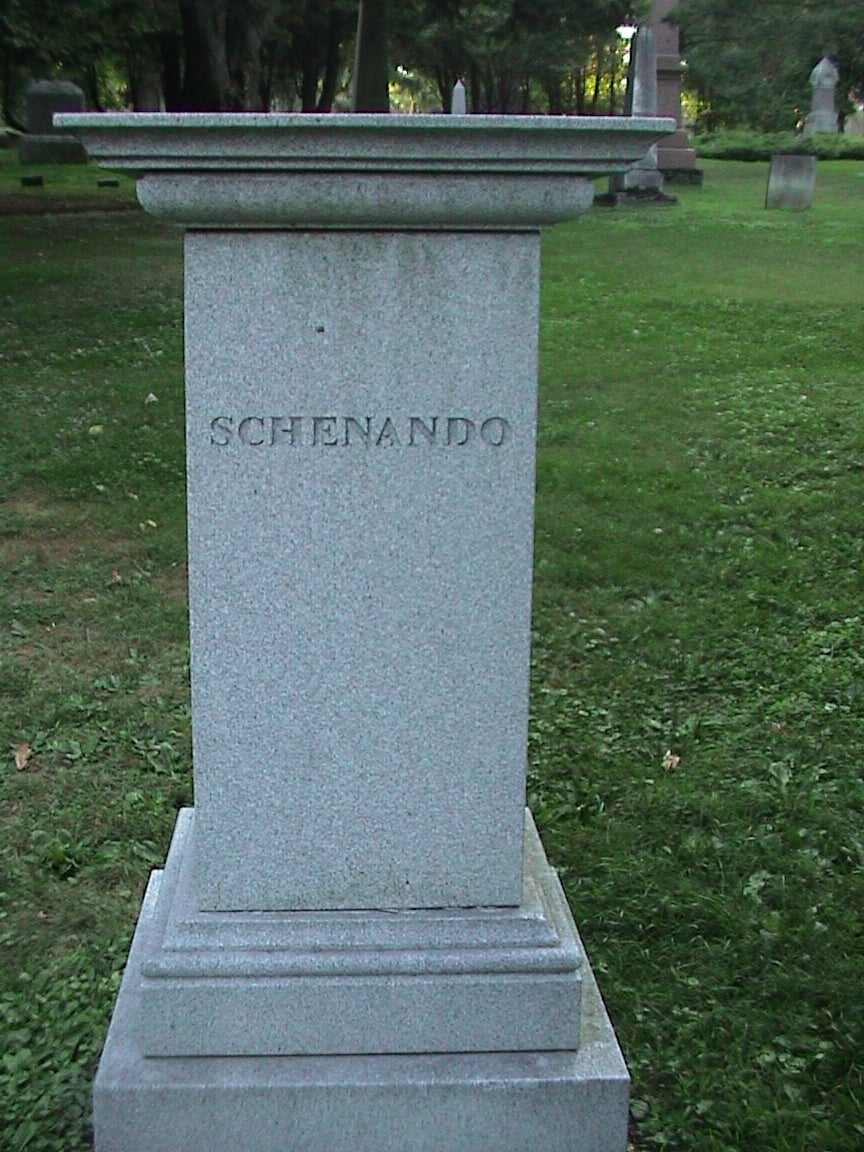
Heading southwest out of Utica, and still following the Central Trail of the Six Nations, the Akwesasne Warriors headed for Hamilton College near the little village, of Clinton It was here that the great Oneida Chief, Skenandoah, is buried, and the region that they were now in was the territory of the ancient Oneida nation, the land deeded to by the Great Spirit. In the Hamilton College Cemetery the warriors saw a large head-stone where the remains of Skenandoah were transferred in 1856 so that he might lie next to his white brother, Samuel Kirkland, the founder of the College. The monument over Skenandoah’s grave was erected by the Northern Missionary Society and was dedicated in 1873.
Skenandoah ‘The Deer’ was a famous Oneida Chief. Skenandoah was always the warm and unwavering friend of the Americans. He was described by those who knew him as a tall, intelligent appearing man of great physique. He was a man of great eloquence, and solid judgment. During the Revolutionary War he believed in the cause of the People of the United States and on more than one occasion warned his white neighbors of British invasions. It is known that he saved the People of German Flats by giving them warning. He and his warriors fought on the side of the Americans in all of their border wars along the Mohawk and surrounding territory. Trusty Oneida scouts were sent among the British in Canada and secured valuable information concerning the numbers, strength and movements of the British. Skenandoah and his warriors fought beside General Herkimer in the Battle of Oriskany. General George Washington commended his services. It was he and his Oneidas who saved Washington’s starving army at Valley Forge by bringing him several hundred bushels of corn. In 1775, while on an official visit to Albany on behalf of his people, he was given liquor by his so-called friends. He became drunk and the next morning found himself in the gutter along one of Albany’s streets. Everything of value had been taken from him including most of his clothes and his chieftainship regalia. He was so chagrined and humiliated that he resolved never again to become intoxicated, a determination from which nothing could ever move him. On one occasion he said to his people. “Drink no firewater of the white man. It makes you mice for the white men who are cats. Many a meal they have eaten of you.”
During old age he became blind and almost helpless. Just before his death he said to his people, “I am an aged hemlock. The winds of a hundred winters have whistled through my branches. I am dead at the top. The generation to which I have belonged has run away and left me. Why I live the Great Spirit only knows.” Skenandoah died at Oneida Castle March 11, 1816, reputed to be 110 years of age. In spite of all that the Oneidas had done for the cause of the Americans, British troops destroyed their villages, crops and orchards, and in spite of the fact that Congress applauded the Oneidas for their firmness and integrity, assuring them friendship and protection of their lands, after the war, their hunting and fishing grounds were invaded by the whites who sent up a clamor and an increasing cry for their removal to the west. The poor, tired Oneidas were not long to enjoy the settlement that they had worked so hard to keep. They were totally averse to moving and leaving their old homelands and the graves of their forefathers. Greedy land speculators, who coveted their lands, won out and it was in 1623 that their removal from New York was decided upon. Their trail to the west was wet by tears as the Oneidas left their beautiful homelands and the graves of their fathers. Old Skenandoah had fought and died in vain!
Leaving the grave of the old chief the warriors headed west over the ancient trail that led through the ancient Oneida Country. Just east of Oneida Castle on the north side of the highway they saw a large stone boulder with a bronze plaque marking the site of the last home of Skenandoah. The monument bore the following inscription:
This marks the site of the last home of Skenandoah, chief of the Oneidas and the white man’s friend. Here he entertained Gov. De Witt Clinton 1810, and many other distinguished guests, and here he died in 1816 aged 110. He was carried on the shoulders of his faithful Indians to his burial in the cemetery of Hamilton College, Clinton, N. Y. and laid to rest beside his beloved friend and teacher, Rev. Samuel Kirkland. “I am an aged hemlock. The winds of a hundred winters have whistled through my branches. I am dead at the top. The generation to which I belonged has run away and left me. Why I live the Great Spirit only knows.” Erected in 1912 by Skenandoah Chapter N. S. D. A. R., Oneida, N. Y.”
With a pleased feeling in all of their hearts because of the honour that this organization had given the great Iroquois chief, the warriors journeyed west, still traveling over the ancient trail of the Iroquois. Near Oneida Castle they visited a grove in what is called Castle Park. It was in this beautiful grove that the ancient Long House or Council House had stood while the Oneida People yet remained in their country. From the site of the Oneida Council House the Mohawks headed south about four miles. There they visited some Oneida Indians, grand children of those few Indians who had refused to leave their old home in 1823. Leaving their Oneida friends, they headed for a place called Nichols Pond. Near here they visited the site of an ancient Oneida village that Champlain attacked in 1615 and this was where the Oneidas defeated him. Here the Mohawks saw the Tribal Stone of 1615 and other spots of interest including ancient corn pits and the wall that enclosed the stockaded village. From this ancient village site the Mohawks headed south to beautiful Lake Cazenovia where another trail of the Iroquois passed. Tradition says that Hiawatha once traveled this trail to meet Deganahwida in the Mohawk Country. Together these two great men founded the Iroquois League, a league that was organized to do away with war and establish universal peace among all people. From this region the warriors again headed west to a small settlement called Pompey. There they visited an ancient Onondaga Indian burial ground near Indian Hill. This Onondaga Village site was occupied in 1655 and it had a large population. Leaving the old village site and burial ground the Mohawks headed north for the village of Manlius. Near here is a sacred spring of the Iroquois. This spring was called De-o-song-wa by the Indians and The Deep Spring by the white settlers. It was on the boundary line between the Onondaga and Oneida Country. This spring not only marked the boundary line between them, but it was a well known stopping place on the Great Central Trail of the Iroquois. Leaving the region of the Great Spring and heading toward the setting sun the young Mohawks soon were on the Onondaga Reservation. Near the Onondaga Long House they saw an impressive stone monument erected by the Six Nations to the great Prophet and Teacher, Handsome Lake or Kaniatario.
