
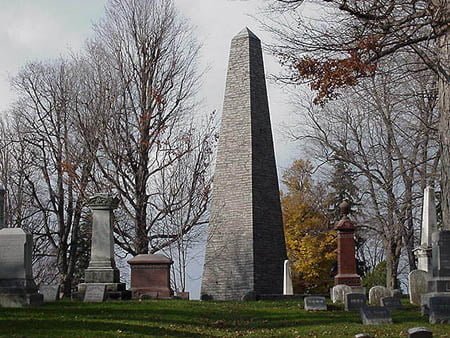
From Syracuse, and the Monument to Onondaga Indians, the Mohawks once more headed down the Great Central Trail of the Iroquois to the City of Auburn. There, in the Fort Hill Cemetery, Fort Street, Auburn, the warriors saw the remains of a huge Indian mound in the center of which was a gigantic stone shaft monument erected to a great Cayuga Chief named Logan.
Chief Logan, Tah-gah-jute christened Logan, 1725-1780, renowned Cayuga sachem, statesman, orator and warrior. He was born in the Indian village Wasco near here. His memory remains enshrined in the Finger Lakes Country as the friend of the white man. In 1852, almost three quarters of a century after his death, there rose in the ancient Indian fortress, now Fort Hill Cemetery, a great stone shaft in his memory – a monument of esteem reared with the free will gifts of Auburnians to an Indian of whom Judge William Brown, of Pennsylvania once said. “He was the best specimen of humanity I have ever met with either white or red.”
Knowing of the history of this great chief; the Mohawks were silent as they left the stone memorial and journeyed west. They knew that in a few days they would see another monument erected to this same Chief Logan, a monument erected in the State of Ohio. A short drive brought the warriors to the northern end of Cayuga Lake. Traveling down the old Cayuga Trail that followed the lake south, the warriors visited the site of Cayuga Castle, the ancient Capitol village of the Cayuga Nation. This ancient village site lies on the east side of Cayuga Lake.
From there the Mohawks turned north to the head of the lake. Following the road that once was an Indian trail down the west side of Cayuga Lake, they arrived at Canoga, the site of an ancient Indian village which Indian tradition says was the birthplace of the famous orator Red Jacket. Here on Canoga Creek once stood the village of Skannayutenate, birthplace of Sa-go-ye-wat-ha, the famous Seneca leader. On this ancient village site the warriors saw a monument erected to Red Jacket. The monument contained a picture of a wolf, the clan of Red Jacket and also a tomahawk and pipe. The inscription was as follows: “Red Jacket – Sa-go-ye-wat-ha ‘He Keeps Them Awake’ the orator of the Six Nations of Iroquois – a chief of the Wolf Clan-of the Senecas – born near this spot 1750 – died at Buffalo, N. Y. 1830- erected the by Waterloo Library and Historical Society.”
