
Leaving the monument of Pauline Johnson, the Mohawks headed for the nearby City of Brantford. There in one of the city parks they saw a gigantic monument, said to be the largest in Canada, erected to the Mohawk Chief, Thayendangea. The inscription on this monument was as follows:
“The last resting place of Tenh-wen-nyos ‘Awl Breaker’ Governor Blacksnake, born 1737-died 1859-One of the greatest War-Chiefs of the Seneca Nation, warmly espoused the American Cause in struggle of 1776-Devoted his later years to work among his people-Absolutely honest and truthful and enjoying entire confidence of Indian and Paleface, Erected by Seneca Nation of Indians and State of New York, 1930.”
Tenh-Wen-Nyos, A Seneca Chief
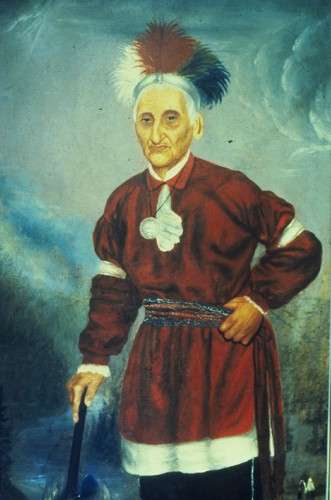
Tenh-wen-nyos, also known as Governor Blacksnake or Chainbreaker, was Cornplanter’s nephew. During the Revolutionary War Tenhwennyos was Cornplanter’s assistant and fought by his side. At the dose of the war the Six Nations held a treaty with the United States at “The Carrying Place” near Rome, N. Y. Tenhwennyos attended that treaty. At this treaty the Six Nations were told that the Congress of the United States and the King of England has made a separate treaty and that the King had made no provision for his Red allies, the Six Nations. They were told that the King had given up the lands of the Six Nations to the United States. The thought of losing their homes, the graves of their ancestors and everything they held dear or sacred was too much for the Iroquois and that night the war dance was started. War between the six Nations and the Americans would have been resumed but for some Mohawks who were camped near and who persuaded the Six Nations to wait until the end of the council. The Mohawks, with the help of Tenhwennyos and Cornplanter put forth their influence for peace and on the following day negotiations were resumed. By this treaty the Americans left the Six Nations in possession of most of their lands.
When Tenhwennyos and his Senecas saw that Washington did not intend to drive his people from their country or desert them as the King had done he pledged friendship and allegiance to Congress. From that time on, their interests and that of their people were bound up in the success of the new government. The devotion of Tenhwennyos to the United States was shown many times during the period following the Rome treaty when, on several occasions, English agents continued to foster discontent and incite the Indians against the Americans. English agents encouraged a great confederation of western Indians to fight for their country and drive the Americans back. England did not do this out of love for the Indians, but because she, herself, desired to control the land. The western Indians met two American armies on the field of battle and defeated them. Washington called the Iroquois chiefs to council at Philadelphia to ask their aid in securing peace with the western Indians. Tenhwennyos, Cornplanter, Fish Carrier, Farmer’s Brother, Red Jacket and Joseph Brant attended that council and pledged themselves to help the Americans. British opposition was so great that all but Tenhwennyos and Cornplanter turned back. Though they were threatened with their lives these two attended the great council and spoke strongly for peace. British agents did all in their power to remove the influence of these two Senecas but in vain. The name of the Six Nations was so great and far known that many distant Indians returned home after hearing a Seneca member of the Confederacy, speak for peace. On Their return from the council, the Senecas were rewarded at Pittsburg. Their canoes were loaded with goods and General Washington, himself, presented Tenhwennyos and Cornplanter with silver medals for services rendered. On their return home these two Indians lost their gifts which were taken from them by frontier settlers who stole their goods and tried to kill the Indians.
As a result of the faithful services of these two men of the Six Nations, the Iroquois, as a body, did not join the western Confederacy. Had they done so there can be no doubt that general Anthony Wayne would have been defeated. The western Indians were shown proof of the false friends when, at the hour of defeat, they were refused refuge in the English fort by the very ones who had encouraged them to fight the Americans.
In the War of 1812 that followed, the Americans and especially the State of New York were concerned about what course the Six Nations would take. As usual British agents were among the Iroquois attempting to persuade them to migrate to Canada and from there to fight against the Americans. They were promised everything, money, land, official positions and what not if they would take up arms against the United States. Tenhwennyos and Cornplanter reminded their people how England had left no provision for the Iroquois after the last war and had, in fact, given the Iroquois lands to the United States. They advised their people to remain neutral.
When the war started the aid of the Iroquois was asked by Congress. Tenhwennyos, Cornplanter, Farmer’s Brother and others were given commissions in the American Army. These leaders raised Indians Companies and their scouts and spies were among the best in the entire United States Army. They took part in every battle along the frontier. So active were these Seneca scouts that no marauding party succeeded in obtaining a foothold on United States soil. Dr. Arthur Parker ‘Gawasowaneh’, great Iroquois authority, says, “Six hundred and nine Indians of the Six Nations, including twelve women, fought for this country in the War of 1812. The Seneca Nation declared war on England in 1812 because British troops had invaded Grand Island, their territory. The Onondaga Nation also officially declared war on Great Britain. These original owners of the soil were defending their own territory and they fought as allies of the United States. It was General Boyd who said. ‘The bravery and humanity of the Indians were equally conspicuous.’
At the close of the war, the Iroquois soldiers were honorably mustered out. They received the thanks of the United States Government and high praise from the officers of the United States Army.
After this war, Tenhwennyos led a life of usefulness among his devoted people. His home near Tunesassa, on the Allegany Reservation, was always open to the needy of his people and to the white folks as well. All of his life he put his faith in the ancient religion of his people. At his death his funeral was conducted with the ancient ceremonies of the Iroquois. Large delegations from all of the Six Nations, United States as well as Canada, attended his funeral. He was born around the year 1786 and died Dec. 2, 1859.
Charles Aldrich, a man who knew Tenhwennyos, wrote of him as he appeared in 1836, “He was very tall, straight as an arrow, and his abundant hair was both white and long His figure was at once striking and venerable. He was always kind and agreeable, genial and pleasant to all who approached him. The people of his tribe, as the white people treated him with marked deference and respect. Governor Blacksnake, in addition to being a man of authority in his tribe, was an orator to whom his people always listened with profound attention. I shall never forget Him though I did not understand a word of his language. A little Indian mate had died; a day or two later our family attended his funeral near the river, the coffin was lowered into the grave; his father stepped briskly forward and dropped a bow and arrow by his side, at this moment, with grave and solemn mien, Governor Blacksnake stepped to the top of the mound of earth and began a half hour’s address to his Indian friends. He spoke slowly and with great deliberation. Some one who understood informed us that he spoke most kindly of the little boy who was gone, depicted the joys of the new existence on which he was to enter and urged his hearers to so order their lives as to be prepared for the better existence of the life to come. I do not remember-I was but a child myself-that I was ever more impressed by the appearance of an orator, except by Abraham Lincoln at his first inauguration. Blacksnake’s figure was tall and commanding, his delivery slow and distinct, his appearance graceful and dignified, his sympathy for the bereaved family evident and touching. They paid his words the tribute of fast-flowing tears.” ‘Information regarding Tenhwennyos secured from M. H. Deardorff or Has-squee-su-or of Warren, Pa.’
As a sign of respect for this great leader of the Senecas, the young Mohawks sang an ancient ceremonial song of the Mohawks over his grave. Then, heading south-east they entered the State of Pennsylvania. Traveling along the banks of the Allegany River they were soon on the little Cornplanter Reservation. On this Seneca reservation the Mohawks visited the ancient Indian village site which was the home of Handsome Lake, the Seneca Prophet. It was here in 1799 that the Messengers of the Creator appeared to Handsome Lake and instructed him in the wishes of the Creator. From two Seneca People the warriors found the very spot where this event happened and stood on the cabin site where the prophet lay ill for so many years. They visited the sacred spring near this place, and here they felt that they were standing on sacred ground.
From the sacred spring they journeyed on through the reservation and in an old Seneca cemetery they saw a monument erected over the grave of Chief Cornplanter.
