
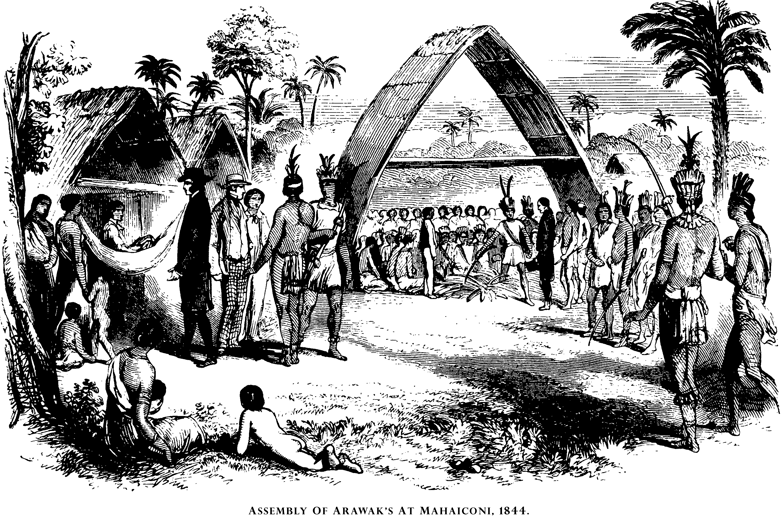
The tribes who inhabit the wilderness between the Amazon and the seacoast settlements at the north, upon the Caribbean Sea and the Atlantic, have been classified as belonging to the same family with the aboriginal inhabitants of Brazil. The race has been denominated the “Brasilio Guaarani,” and has been divided into the nations of Guarani, Caribs, Tupi, and Botocudos.
The Arawaks. First Seen By Columbus
In Guiana one of the most prominent tribes is that of the Arawaks. These people inhabit a great extent of country directly back of the narrow strip of cultivated seacoast. Nearly the whole of their territory is a savage wilderness, in which the traveler in vain seeks for any evidence of progress, or any tokens of former civilization and prosperity. A few rude figures, marked upon the rocks in certain localities, are the only records of the numberless generations, which have passed away, leaving their descendants precisely in the situation of those who preceded them, and as hopeless or careless of improvement. The Arawaks were the first natives seen by Columbus, upon the occasion of his discovery of the continent of South America, in the summer of 1498.
Entry Into The Gulf Of Paria
The first land made was the island of Trinidad, at the mouth of the great river Orinoco. No Indians were seen upon the island by a party sent on shore, although unmistakable tokens of a recent and hasty retreat were visible. As the vessels approached the Serpent s Mouth, (the southern entrance to the gulf of Paria,) twenty-five of the natives made their appearance in a canoe. To the astonishment of the admiral, who had expected, from the reports at Hispaniola, to find a race of Negroes in these southern latitudes, they were of lighter complexion than any with whom he had before held intercourse. Their figures were well proportioned and graceful; their only clothing was a sort of turban, and a waistband of colored cotton; and their arms were bows and arrows. “When an attempt was made to conciliate these wild voyagers by dancing and music, it was mistaken for a sign of hostility, and the sup posed war-dance was summarily stopped by a flight of arrows. The suspicions of the natives prevented the opening of any communication with them until after the entry of the ships into the gulf. Several of them were then taken by upsetting their canoe, and, after being kindly entreated and encouraged, were dismissed with the usual presents of trinkets and hawks-bells. When the fears of the inhabitants were dissipated by this procedure, they were eager to crowd about the vessels in their canoes. These latter were of excellent construction and large size; some of them were even furnished with a cabin.
The cacique of the county received the Spaniards at his house with the greatest respect and hospitality, and feasted them upon whatever luxuries the fruitful soil produced. “Nothing,” says Irving, “could exceed the kindness and amity of this people, heightened as it was by an intelligent demeanor and a martial frankness. They seemed worthy of the beautiful country they inhabited. It was a cause of great concern, both to them and to the Spaniards, that they could not understand each other s language.”
Raleigh’s Visit To The Orinoco
Sir Walter Raleigh entered the Orinoco in the year 1595, and brought home some account of the natives seen there. As recorded by Purchas: “The inhabitants on the northern branches are the Tiuitiuas, a goodly and valiant people, which have the most manly speech and most deliberate (saith Sir Walter) that ever I heard of whatever nation soever. In the summer they have houses on the ground, as in other places: in the winter they dwelt upon the trees where they built very artificial towns and villages; for between, May and September the river of Orinoco rises thirty feet upright, and then are those islands overflown twenty feet high, except in some few raised grounds in the middle. This watery store, when the clouds are so prodigal of more than the rivers storehouse can hold, whereby they became violent intruders and encroachers upon the land, and not the violence of cold, gives this time the title of winter. These Tiuitiuas never eat of any thing that is set or sown; Nature’s nurslings, that neither at home nor abroad, will be beholden to the art or labor of husbandry. They use the tops of palmettos for bread, and kill deer, fish, and pork, for the rest of their sustenance. They, which dwell upon the branches of the Orinoco, called Capuri and Macureo, are for the most part carpenters of canoes, which they sell into Guiana for gold, and into Trinidad for tobacco, in the excessive taking whereof, they exceed all nations. When a commander dies, they use great lamentation, and when they think the flesh of their bodies is putrefied and fallen from the bones, they take up the carcass again, and hang it up in the house, where he had dwelt, decking his skull with feathers of all colors, and hanging his gold-plates about the bones of his arms, thighs, and legs. The Arwacas, which dwell on the south of the Orinoco, beat the bones of their lords into powder, which their wives and friends drink.”
Early Wars Of The Arawaks
In early times the Arawaks were engaged in perpetual wars with the Caribs. Those of the latter race, who inhabited the nearest Caribbean islands, made continual descents upon the main, but are said, finally, to have been worsted. The Rev. W. H. Brett recounts some of the traditions still handed down among the Arawaks of these wars. “They have,” says he, “an indistinct idea of cruelties perpetrated by the Spaniards. Tradition has preserved the remembrance of white men clothed with “seperari” or iron, who drove their fathers before them, and, as some say, hunted them with dogs through the forest. But by far the greater number of their traditions relate to engagements between themselves and the Caribs on the main land.” With peculiar exultation they detail the particulars of a victory obtained over a great body of these invaders by means of a judicious ambush. The Arawaks had fled from their approach to the low marshy country upon the Waini, and laid their ambuscade upon either side of the narrow channel through which the enemy were expected to pass. “The Caribs are said to have had a great number of canoes of large size, which followed each other, in line, through the mazy channels of the Savannah. As they rounded a certain island, their painted warriors in the first canoe were transfixed by a shower of arrows from an unseen enemy on both sides of them, and totally disabled. Those in the second canoe shared the same fate; the others, who could not see what had happened, hurried forward to ascertain the cause of the cries, but each canoe, as it reached the fatal spot, was saluted by a deadly shower of arrows. The Arawaks then rushed forward, and fought till the victory was completed. It is said that only two Caribs survived, and they were dismissed by the Arawak chieftain, on promise of a ransom to be paid in cotton hammocks, for the manufacture of which their nation is noted.”
After the settlement of difficulties between the European colonists of Guiana and the neighboring Indian tribes, the introduction of Negro slaves by the former proved a terrible scourge to the natives. Great numbers of the Africans escaped from their masters, into the wilderness, and there forming predatory bands, were long a terror to both whites and Indians. “The accounts which the Arawaks have received from their ancestors, represent these Negroes as equally ferocious with the Caribs, and more to be dreaded on account of their superior bodily strength.”
The Arawaks of the present day are, like their forefathers, a more mild and peaceable race than many of their neighbors. In their domestic relations and general manner of life, they do not differ materially from the generality of the North American savages. Together with the rude clubs, bows and arrows, &c., so universal among barbarous nations, they have the more efficient weapons of the European. The Indian is everywhere quick to perceive the advantage of fire-arms, and apt in acquiring their use. Christian missionaries have devoted themselves with great zeal and perseverance to the instruction and improvement of this tribe, and the natural kindly disposition of the race seems to favor the undertaking.
Other Tribes Of The Interior
Besides the Caribs and Arawaks, the principal Indian tribes of Guiana are the Waraus, and the Wacawoios; in addition to these are the minor nations of the Arecunas, Zaparas, Soerikongs, Woyawais, Pianoghottos, &c., &c. Most of these are barbarous tribes, not sufficiently variant “from each other to render a distinct consideration valuable or interesting.
The vast wilderness, which they inhabit, is little visited by whites. From the coast settlements the only available routes into the interior are by means of the numerous rivers, upon whose banks missionary enterprise has here and there established a little settlement as a nucleus for future operations among the natives at large. From Mr. Brett s narrative of his own observation and experience in these wilds, we quote the following items of general description:
General Description
“The appearance of the Indian in his natural state is not unpleasing when the eye has become accustomed to his scanty attire. He is smaller in size than either the European or the Negro, nor does he possess the bodily strength of either of these. Few of his race exceed five feet five inches in height, and the greater number are much shorter. They are generally well made; many are rather stout in proportion to their height, and it is very rare to see a deformed person among them.”
In respect to dress, which, both for men and women, is of the most scanty proportions, (consisting only of a band age about the loins, with perhaps a few ornamental articles of feather-work for state occasions,) the efforts of the missionaries have effected some change in those brought under their influence. In a burning tropical clime, the propriety or policy of such fancied improvement is very questionable. If no immodesty is connected with naked ness in the eyes of the unsophisticated natives, it would seem hardly worthwhile to enlighten them upon such a subject, for the purpose of establishing a conformity to European customs.
Our author continues: “Their color is a copper tint, pleasing to the eye, and the skin, where constantly covered from the sun, is little darker than that of the natives of Southern Europe. Their hair is straight and coarse, and continues perfectly black till an advanced period of life. The general expression of the face is pleasing, though it varies with the tribe and the disposition of each person. Their eyes are black and piercing, and generally slant upwards a little towards the temple, which would give an unpleasant expression to the face, were it not relieved by the sweet expression of the mouth. The forehead generally recedes, though in a less degree than in the African; there is, however, much difference in this respect, and in some individuals it is well formed and prominent.”
The usual division of labor among savage nations is observed in Guiana. The daily drudgery of the household belongs to the women, who also cultivate the small fields in which the yuca, (the root from which they make their bread,) and the other cultivated crops are raised. The men pursue their hunting and fishing, and undertake the more severe labors attendant upon the building their huts, the clearing of new ground, &c.
The native dwelling is generally little more than a roof of palm-leaf thatch supported upon posts, between which hang the cotton hammocks in which the occupants sleep. Some few implements of ironware, and articles of pottery of a more substantial and practical form than that manufactured by themselves, are generally procured by trade with the coast, but these are all of the simplest description. Maize, with cassava, yams, potatoes, and other roots, constitutes their principal vegetable food. The cassava is prepared by grating, or scraping, and subsequent pressure in a receptacle of basketwork. This strainer is constructed in the form of a “long tube, open at the top and closed at the bottom, to which a strong loop is attached. The pulpy mass of cassava is placed in this, and it is suspended from a beam. One end of a large staff is then placed through the loop at the bottom, the woman sits upon the center of the staff, or attaches a heavy stone to the end, and the weight stretches the elastic tube, which presses the cassava inside, causing the juice to flow through the interstices of the plaited material of which it is made. This liquor is carefully collected in a vessel placed beneath. It is a most deadly poison; but after being boiled, it becomes perfectly wholesome, and is the nutritious sauce, called casareep, which forms the principal ingredient in the pepper-pot, a favorite dish of the country.”
