

Who constructed this five sided landmark and why?
Mankind has lived a long time in the beautiful Nacoochee Valley of the Northeast Georgia Mountains; at least 10,000 years. Even after 200 years of being farmed by European settlers, at least a dozen Native American mounds have been identified. In fact, the gateway to the valley is marked by a Creek Indian mound with a nineteenth century gazebo on top.
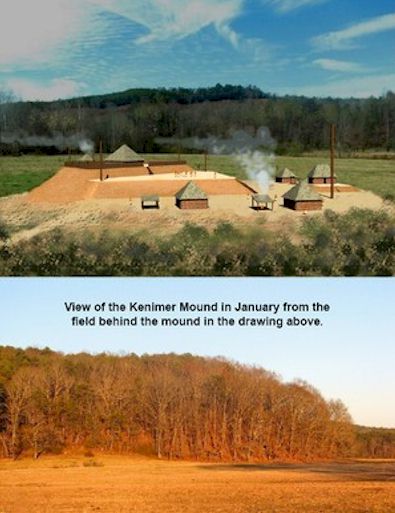
Near the village of Sautee in the Nacoochee Valley is a large five sided hill. Early European settlers noted that the Cherokees had held rituals on this hill during their brief occupation of northern Georgia. However, the hill was considered part of the valleys natural landscape until satellite photography became generally available to the public in the 1970s. Archaeologists realized that the five sided hill was symmetrical like the fived sided mounds built in the region. An archaeology professor briefly walked around the hill during the 1970s. He recorded in his notes that the site was probably a very large Indian mound of unknown age, but no one in the community had any clue that the hill was a mound.
In 1999 an archaeological team from the LAMAR Institute spent two days walking over the mound and digging test post holes in the mound. They discovered a much smaller mound at the foot of the large mound. Their work was superficial, but provided puzzling evidence to the archaeologists. Within the surface soil of the site was found pottery shards dating from the period 900-1000 AD. There was little evidence of soil color bands in the large mound, which are typical of the construction phases of most Indian mounds. On the other hand the small mound did have the bands of different colored soils and clays.
The archaeologists interpreted the evidence from the two day to mean that the larger mound was actually a hill that had been sculpted to look like a mound. They estimated that the mound dated from at least 900 AD. They suspected that a village had once been located in the flat riverine bottomland to the south of the mound. However, they did not have permission from the bottomlands owner to dig postholes for locating a village site. Again, the general public continued to be unaware that a massive Indian mound (or hill) stood just east of Sautee.
In January of 2009 this examiner thoroughly studied color and infrared satellite maps of the Nacoochee Valley to identify any geometric relationships between Native American sites. He then visited the Kenimer Mound with the permission of the owner, but did not disturb the soil. The mound is heavily forested now. A layman would probably never guess that it was an Indian mound from walking its surface. All the five facets of the mound revealed by satellite images are visible at ground level.
The Kenimer Mound may or may not be a sculpted hill. The archaeologists only dug about two feet deep postholes at a few spots. The final layer of construction may be much deeper than two feet. Also, the earthwork may be so old that the fill clay may look like naturally deposited clay. Without a much more extensive analysis of the site, most interpretations of this Native American site would be speculative.
It is the apparent age of the Kenimer Mound and its geometric relationship to other five sided mounds that is most intriguing. The Kenimer Mound is probably the oldest five-sided mound in Georgia. It may date to a time period older than 900 AD. This site is on the same longitudinal line as Ocmulgee National Monument, about 112 miles to the south and the Peachtree Mound near Murphy, NC. The pottery found on the surface of the Kenimer Mound is the same age as the earliest pottery at Ocmulgee National Monument. However, it is a different style pottery than made by the founders of Ocmulgee. Some suburban villages of Ocmulgee did make this style pottery, which has been labeled Napier Stamped Ceramics.
During the period between 1150 AD and 1375 AD the ancestors of the Creek Indians built a series of large, pentagonal mounds in Georgia, western North Carolina and along the eastern edge of Alabama. Five-side mounds are almost non-existent in other parts of the United States. The mounds and their accompanying towns were perfectly arranged on the apexes of a triangular matrix, stretching for several hundred miles. One leg of the isosceles triangles was true north-south. Another leg was true east-west. The hypotenuse was the angle of the solar azimuth at sunset on the Winter Solstice. How the accurate surveying of such long distances was accomplished by the indigenous peoples of the region has never been explained. The question itself implies that the indigenous people of the Southeastern United States were once far more advanced technologically than is typically understood by our society today.
It is likely that the construction of large five-side earthen pyramids was more than an architectural fad. The five side mound is always the dominant mound in the town. The Kenimer Mound faces the sunset of the Spring & Fall Equinox. Later five sided mounds were almost always oriented to the sunset on the Winter Solstice. During that period of time, the Muskogean New Year probably began on December 21st, whereas it now begins on June 21, the Summer Solstice. Although five-sided earthen terraces were constructed by the Olmecs in Mexico, they are rare in North America, except in Georgia and western North Carolina. Unfortunately, the modern-day Creek Indians have no tradition that would explain the significance of the pentagonal shape.
It is possible that a heretofore unknown people from an unknown location built the Kenimer Mound and that it was later utilized by the ancestors of the Creek Indians for their ceremonies. Whereas the pentagonal mounds built 2-300 years after the Kenimer Mound can clearly be associated with the ancestors of the Creek Indians. The Kenimer Mounds builders remain an enigma.
The Nacoochee Valley is located about 75 miles north of Atlanta, GA and is near the resort of Helen, GA, Highway 76 passes through the valley and Helen. It was also the location of the United States first gold rush and a probable site of Spanish gold-mining colony. Much of the bottomland of the valley is either in a Historical District or a Conservation District. Although the public may not climb any of the mounds in the valley, most are visible from paved roads. Sautee has become a charming artist colony and tourist shop community. Nearby Helen, GA has been re-constructed as an Alpine village.
