
Ours are the only mounds making up a distinct mound-region on Canadian soil. This comes to us as a part of the large inheritance which we who have migrated to Manitoba receive. No longer cribbed, cabined, and confined, we have in this our “greater Canada” a far wider range of study than in the fringe along the Canadian lakes. Think of a thousand miles of prairie! The enthusiastic Scotsman was wont to despise our level Ontario, because it had no Grampians, but the mountains of Scotland all piled together would reach but to the foot hills of our Rockies. The Ontario geologist can only study the rocks in garden plots, while the Nor’wester revels in the age of reptiles in his hundreds of miles of Cretaceous rocks, with the largest coal and iron area on the continent. As with our topography so with history. The career of the Hudson’s Bay Company, which is in fact the history of Rupert’s Land, began 120 years before the history of Ontario, and there were forts of the two rival Fur Companies on the Saskatchewan and throughout the country, before the first U. E. Loyalist felled a forest tree in Upper Canada. We are especially fortunate in being the possessors also of a field for archaeological study in the portion of the area occupied by the mound builders-the lost race, whose fate has a strange fascination for all who enquire into the condition of Ancient America.
The Indian guide points out these mounds to the student of history with a feeling of awe; he says he knows nothing of them; his fathers have told him that the builders of the mounds were of a different race from them-that the mounds are memorials of a vanished people-the “Ke-te-anish-i-na-be,” or “very ancient men.” The oldest Hudson’s Bay officer, and the most intelligent of the native people, born in the country, can only give some vague story of their connection with a race who perished with small-pox, but who, or whence, or of what degree of civilization they were, no clue is left.
It must be said moreover that a perusal of the works written about the mounds, especially of the very large contributions to the subject found in the Smithsonian Institution publications, leaves the mind of the reader in a state of thorough confusion and uncertainty. Indeed, the facts relating to the Mound Builders are as perplexing a problem as the purpose of the Pyramids, or the story of King Arthur.
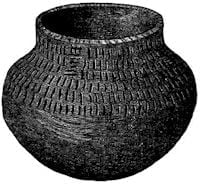
Is it any wonder that we hover about the dark mystery, and find in our researches room for absorbing study, even though we cannot reach absolute certainty? Could you have seen the excitement which prevailed among the half-dozen settlers, I had employed in digging the mound on Rainy River, in August last, when the perfect pottery cup figured below was found, and the wild enthusiasm with which they prosecuted their further work, you would have said it requires no previous training, but simply a successful discovery or two to make any one a zealous mound explorer.
A Mound Described
A mound of the kind found in our region is a very much flattened cone, or round-topped hillock of earth. It is built usually, if not invariably where the soil is soft and easily dug, and it is generally possible to trace in its neighborhood the depression whence the mound material has been taken. The mounds are as a rule found in the midst of a fertile section of country, and it is pretty certain from this that the mound builders were agriculturists, and chose their dwelling places with their occupation in view, where the mounds are found. The mounds are found accordingly on the banks of the Rainy River and Red River, and their affluents in the Northwest, in other words upon our best land stretches, but not so far as observed around the Lake of the Woods, or in barren regions. Near fishing grounds they greatly abound. What seem to have been strategic points upon the river were selected for their sites. The promontory giving a view and so commanding a considerable stretch of river, the point at the junction of two rivers, or the debouchure of a river into a lake or vice versa is a favorite spot. At the Long Sault on Rainy River there are three or four mounds grouped together along a ridge. Here some persons of strong imagination profess to see remains of an ancient fortification, but to my mind this is mere fancy. Mounds in our region vary from 6 to 50 feet in height, and from 60 to 130 feet in diameter. Some are circular at the base, others are elliptical.
Mound Regions
The mounds have long been known as occurring in Central America, in Mexico, and along the whole extent of the Mississippi valley from the Gulf of Mexico to the great lakes. Our Northwest has, however, been neglected in the accounts of the mound-bearing region. Along our Red River I can count some six or eight mounds that have been noted in late years, and from the banks having been peopled and cultivated I have little doubt that others have been obliterated. One formerly stood on the site of the new unfinished Canadian Pacific Hotel in this city. The larger number of those known are in the neighborhood of the rapids, 16 or 18 miles below Winnipeg where the fishing is good. In 1879 the Historical Society opened one of these, and obtained a considerable quantity of remains. It is reported that there are mounds also on Nettley Creek, a tributary of the lower Red River, also on Lake Manitoba and some of its affluents. During the past summer it was my good fortune to visit the Rainy River, which lies some half way of the distance from Winnipeg to Lake Superior. In that delightful stretch of country, extending for 90 miles along the river there are no less than 21 mounds. These I identify with the mounds of Red River. The communication between Red and Rainy River is effected by ascending the Red Lake River, and coming by portage to a river running from the south into Rainy River. Both Red and Rainy River easily connect with the head waters of the Mississippi. Our region then may be regarded as a self-contained district including the most northerly settlements of the strange race who built the mounds. I shall try to connect them with other branches of the same stock, lying further to the east and south. For convenience I shall speak of the extinct people who inhabited our special region as the Takawgamis, or farthest north mound builders.
