
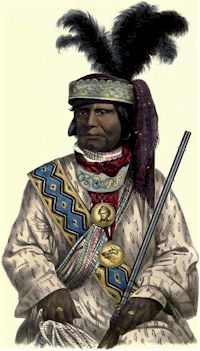
Watervliet Arsenal, near Troy, New York, is one of the places where Uncle Sam keeps his guns and powder, and as I was an ordnance officer, that is, an officer whose duty it is especially to look after the things to shoot with, I was on duty at that post when word came to me from Washington that the Indian chief, Billy Bowlegs, had broken out from the Everglades of Florida to go on the war-path, and that Uncle Sam wanted me to stop looking after guns in Watervliet, and to look after them in the South. Little John McCarty, the son of our housekeeper, brought the news in a big envelope to the stone house where we lived, and although it was not long before Christmas, 1856, I had to leave the family, including a little thick-necked, long-maned, hard-bitted Morgan pony, of which we all were very fond, for he had taken us up and down many a long hill. Saying good-by to my little boy, I told his mother, his grandmother, and my brother, Charles to be sure and remind Santa Claus not to forget him on December 25th, and started for the South.
It took eight days by train to reach Savannah, Georgia, seven days by boat to Pilatka, and two days and nights in an old-fashioned stage-coach through palmetto roots and over sandy roads to Tampa Bay, Florida, where Fort Brooke, one of Uncle Sams Army posts, was situated near the sea-shore. Here I was told that I must go farther, for General Harney was down the coast at Fort Meyers and he wanted to see me. Some soldiers rowed me out to a steamer, which was lazily swinging back and forth at anchor on the surface of the beautiful bay. It was freezing cold weather when I left Watervliet, but here the air was mild and pleasant, like our summer in the North. By the next morning the steamer was lying off the mouth of the broad Caloosahatchee River, which empties into the sea. The name of this river is half Indian and half Spanish. In English it means the Charles River, and its current is so strong that, although we had eight trained oarsmen to row us, yet it took nearly all day to go the twenty-five miles from the mouth of the river to Fort Meyers, where General Harney was staying. Fort Meyers, like many of Uncle Sams forts, is an army post with no fortifications at all. The barracks where the soldiers lived, and the officers houses, were built of logs, and so strong that it was thought they could be defended against all the Indians of Florida
Here I met my general and learned something of the fierce Indian leader Billy Bowlegs, who kept a large part of Florida in a state of alarm for over a year.
You remember the old chief of the Seminole Indians, Micanopy, and how Osceola sent him to waylay and fight Major Dade and our soldiers in the first real battle of that Seminole War? Micanopy had with him at that time his young grandson, who was about twelve years of age. This boy rode a small Florida pony on that eventful day, and when the battle began he led his pony behind a clump of earth and grass, called a hummock, and stretching the lariat, a slender hair rope, on the ground, the pony understood that he was meant to stand still. Then the boy took his bow and, stringing an arrow ready for use, lay down in the tall, thick prairie-grass near Micanopy. I suppose this boys real name was Micanopito for that means the grandson of Micanopy in Spanish but he began when he was so very young to ride astride big horses, and on top of such large bundles, that it made his legs crooked, and his father, who knew a very little Spanish, nicknamed him Piernas Corvas, meaning bowlegs. When he grew up, Natto Jo, a man who was part Indian and part negro, called him Guillermito a las piernas corvas, meaning to say little William Bowlegs; but when Natto Jo came into our camp, and spoke of him by that name, the soldiers asked what it meant and turned it for themselves into Billy Bowlegs. This chief was thirty-two years old when he first led his warriors into battle. About 350 Seminoles refused to go West when most of the Creek Indians went to live in Indian Territory after Osceola died, and it was these who followed Billy Bowlegs. He was a full-blooded Seminole, a perfect marksman, and his powers of endurance were as remarkable as his ability to appear and disappear in the most unexpected manner. This was possible because he was so well acquainted with the Everglades, and never went very far from that region. The Everglades is the name given to a large, shallow lake in Florida about 160 miles long by sixty miles wide. It contains many islands, some large and some small, but all covered with trees. The whole is very marshy and full of the intertwined roots of tree-trunks. Long streamers of moss hang from the trees, and while the Indians in their light canoes could push among the vines and thickets so that no trace or sign of them could be seen by a white man, it was impossible for the soldiers to follow them on horseback or on foot, for the water was up to a mans waist. The Indians hid their women and children in these Everglades, and scouts sent to hunt found no trace of them during a search of weeks and even months.
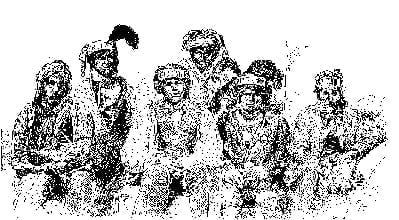
As I listened to so much about Billy Bowlegs, I became very impatient to see him, and it seemed to me that the only thing that Uncle Sam could hope to do was to make peace with him and his warriors. The few Indians I saw seemed shabby enough in their tattered garments, for although each had been given a good blanket, they were untidy savages and always turned their eyes away. I asked sometimes, “Is Billy Bowlegs here?” But he was always somewhere else. In this last Indian war in Florida, Bowlegs had more warriors than horses, but in spite of his short, crooked legs he could go on foot through weeds and swamps faster than any other Indian. Once he took about 100 of his men on foot from the Everglades sixty miles to Lake Kissimmee to attack one of Uncle Sams stockades, which was in charge of Captain Clarke. This stockade was made of small logs planted close to each other, deep in the ground, so as to form a fence. Square holes, or “loopholes,” were left in this stockade so that the soldiers could push their rifles through.
Once in the early morning, while it was still dark, Captain Clarke thought he heard a noise outside of the stockade. He waked the soldiers at once, but although they looked very carefully, they could not see anybody outside and there was no more noise, but when the sun came up and it was light they saw the Indians all around. It was Billy Bowlegs and his followers. They gave a great war-whoop and rushed upon the stockade from every direction. The soldiers fired through the loopholes in the stockade and after a while the Indians, taking those who had been wounded with them, went about a mile away, where they hid in a large hummock. The soldiers followed and tried for a long time to drive the Indians from the hummock, but at last they gave it up and went back to the stockade. When General Harney heard of this he sent a hundred mounted soldiers to help those in the stockade, but by the time they arrived Billy Bowlegs and his warriors had left the hummock and were safe in the Everglades once more. About this time General Harney left Florida and Uncle Sam sent Colonel Loomis to try to overcome Billy Bowlegs. The first thing this officer did was to send many companies of soldiers in different directions toward the Everglades. One party came upon some Indians moving from hummock to hummock. There were men, women and children, and Billy Bowlegs was leading them. The mounted soldiers rushed upon these Indians and fired, killing some and capturing others, but their leader, Billy Bowlegs, made his escape. When Colonel Loomis heard that some of the children had been wounded, he felt so badly that he made up his mind to try another way to overcome Billy Bowlegs. He sent for me and told me to go into the Indian country and try to have a talk with the chief. Two companies of soldiers went with me and also an Indian woman called Minnie, to guide us. She took her child along. Natto Jo, the half-breed, went too, to speak for us to the Indians in their own language.
Through forests and over prairie lands we went. One day, when we came to a beautiful open glade I rode with Lieutenant S. D. Lee some distance ahead of the main body of soldiers. As we were riding I turned to see the soldiers, but they were out of sight. I looked around to speak to my companion and to my astonishment saw the whole company, men, wagons, and horses, marching along in the sky above the horizon to my right. We hastened on expecting soon to come to them, but just as we supposed we had reached them they disappeared. Such a wonderful picture is called a mirage, but so real did it seem that we could hardly believe it was only a reflection of the company, which was still far behind. The entire journey the Indian woman had been so dirty that we thought her most unpleasing and savage; but when we stopped near Lake Okechobee she began to sing cheerily. She washed her face and hands, combed her hair, and dressed herself and her child in respectable and clean clothing, which she had carried in a bundle, adding many beads and some wild flowers. We could hardly believe her the same person, but when I spoke to Natto Jo of this wonderful change he said in his usual funny English: “Hell fool you and Natto Jo mañana (to-morrow).”
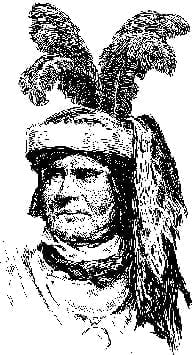
But we had to trust her, so we sent her with messages to Billy Bowlegs and she promised to come back soon with an answer. For a few days we waited near the lake, but she never came and at last we went back as we had come. Yet I am sure that her visit did good and that she gave my messages to the chief, for while the Indians came out after this from the Everglades to seize supplies, as they could raise no grain during the war in their hiding-places and needed food, and while they attacked small numbers of our soldiers now and then, still, when Johnny Jumper, the son of Osceolas old lieutenant, finally came on a visit from the Indian Territory with some other Indians, he learned from a warrior who had been wounded and captured at Lake Kissimmee, that Billy Bowlegs would like to come and talk about peace, but he did not dare to do so. He was afraid that the white people would pay no attention to his flag of truce and might shoot him. Johnny Jumper was a friend to the white man, and when he heard this he took “Polly,” a niece of Billy Bowlegs, with him and went straight into the Everglades to see the chief. They succeeded, and the result was that Colonel Loomis sent out a proclamation, saying that the Florida war was ended, and Billy Bowlegs, with 165 other Indians, went with one of Uncle Sams army officers to “The Indian Territory” to live. Nearly all the Indians that were left followed the next year.
Except for the chief, Sam Jones, who was too old to go, and a few of his followers, the Everglades was now empty; but Billy Bowlegs, firm and determined to the last, left his country and passed beyond the Mississippi to join his brother Seminoles in other lands. Yet his soul, undaunted, could not brook this change from the wild and free life of the Everglades, which lie had always known, and in less than a year after his arrival in the new land he died, honored and praised, as always, by his own people.
