
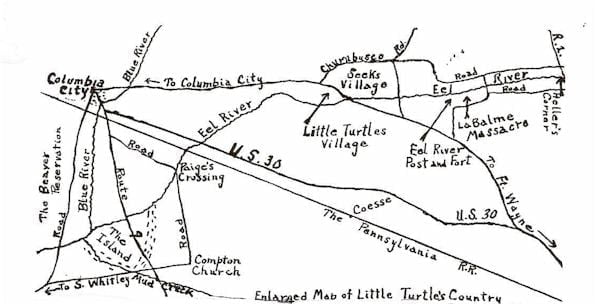
The Ke-na-po-co-mo-co: Many people never heard of this word before. Few can pronounce it after they hear it. Fewer still can spell it. Even this form of the word is not quite so difficult as the original, which was Kenapekwamakwah. But to simplify it in spelling and pronunciation the above form, Ke-na-po-co-mo-co, is used with accents on the first, third and fifth syllables. But what does the word mean? It is the Miami Indian word for snakefish, and is translated into English as Eel, or snake-like fish. This name was given to that important tributary of the Wabash River, because in early days its water abounded with eels. So Eel River, the Kenapocomoco. Would it not have been a bit more poetical and musical had. we kept the more beautiful Indian name as we have done with Mississinewa, Salamonie, Tippecanoe and others.
The Home of Little Turtle
- The Eel River Trail and Portage
- Heller’s Corner
- La Balme’s Massacre
- The More Farm the Eel River Post
- Little Turtle and the Eel River Post
- Seek’s Village
- Little Turtle’s Village
- Aquenackque
- The Early Life of Little Turtle
- Little Turtle and George Washington
- Little Turtle and General Wayne
- Little Turtle at the Treaty of Greenville
- Little Turtle and Works of Peace
- Little Turtle as a Traveler
- Little Turtle’s Last Years
- Little Turtle’s Family
- Captain William Wells
- A Characterization of Little Turtle
- The Blue River Village
- The Passing of Turtle Village and Eel River Post
- The Island
- The Beaver Reservation
- Down the Kenapocomoco
- Indian Settlements on the Kenapocomoco
- KE-NA-PE-COM-A-QUA
- Later History of Kenapecomaqua
- Logansport, the Mouth of Eel River
- Eel River, the KE NA PO CO MO CO
