

1884 To 1904 – Favored Youthful Choctaw Freedmen
“And Hannah took Samuel to the Temple of the Lord and said to Eli, the priest; I have lent him to the Lord as long as he liveth.”
The object of this chapter is to note the names and careers of a number of the young people that during the early days were sent or encouraged to attend other educational institutions. As early as 1884, two years before Miss Hartford came to Oak Hill, Rev. Alexander Reid, of Atoka took the lead in arranging for two young men to go to Biddle University, Charlotte, North Carolina, and five young ladies to Scotia Seminary, at Concord, North Carolina. Later the teachers at Oak Hill aided and encouraged others to attend these and other Christian institutions of learning established elsewhere by our Freedmen’s Board. The present is an opportune time for noting the results, in the way of increased happiness and added usefulness to these young people by one or more years of special training in youth.
In 1884 Richard D. Colbert of the Beaver Dam Church was sent to the preparatory school at Biddle University and remained till June 1887. After his return he taught school eleven years. He was then licensed by the Presbytery, and has been preaching the gospel ever since that time.
In 1884 Henry Williams of Doaksville, (Fort Towson) was sent to Biddle University and remained three years. On his return he became a teacher of public school and in 1892 married Annie Ball.
In 1884 Celestine Hodges a daughter of Samuel and Charlotte Hodges, Wheelock, was sent to Scotia Seminary and remained four years. On her return in 1888, she became a teacher and has been teaching most of the time since, serving the first two years as an assistant at Oak Hill.
She became custodian of the buildings, after the departure of Miss Hartford, and was teaching the Oak Hill school, when Mr. McBride arrived a month or so after its opening. Two years later she founded a school and Sunday school along Sandy Branch, that a few years later developed into the Church, that bears that name. She is now located upon and improving her own farm southwest of Antlers.
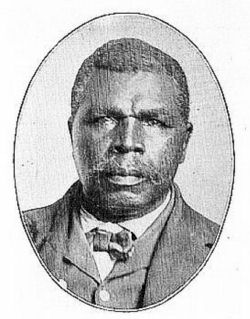
In 1884 Susan Homer, daughter of Wiley Homer, Grant, was sent to Scotia Seminary and remained two years. On her return she served as a teacher until she married Albert Brown. She is now a widow, occupying and improving her own farm, near Grant.
In 1884 Marie Jones and her sister Fannie Jones, daughters of the late Caroline Prince (1911), and Virginia Shoals, daughter of J. Ross and Harriet Shoals, all from the Oak Hill Church, were sent to Scotia Seminary.
Marie Jones after spending some time at school engaged in teaching and later became the wife of Mr. Sands, a Methodist minister, now located at Kingston, New York.
Fannie Jones remained at Concord, going to school and working in the city until 1898, when she located at St. Louis, where she became the wife of Mr. McNair, and taught school a number of years. She is now occupying the old home near Oak Hill.
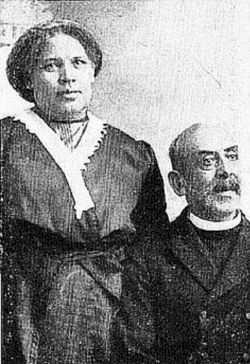
Virginia Shoals, now Mrs. Perry, returned in 1901. She has taught school several years and is now living on her own allotment of land near Red River, where she has founded and is endeavoring to maintain a Christian home.
Mary Homer (B. 1873) a daughter of Wiley Homer, Grant, after completing a course at Oak Hill attended a Choctaw government school, 1890 to 1894. She engaged in teaching until her marriage to Martin Shoals. She is now improving her own farm and educating her children at Oak Hill.
Hattie Homer (B. 1876), a sister of Mary, after attending a Choctaw government school at Grant 1890 to 1894 and completing a course at Oak Hill, taught school until she became the wife of Nick Colbert, an elder of the Beaver Dam Church, after his decease she married Bud Lewis and is now occupying and improving her own farm.
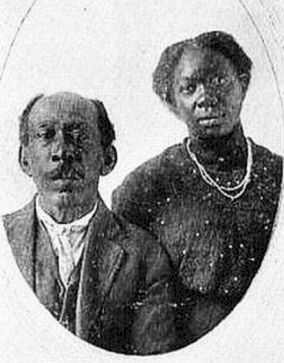
Harriet Stewart (B. 1873), and Fidelia Perkins, daughter and step-daughter of Parson Stewart, in 1892 were taken by Mrs. Emma F. McBride, matron, to the Mary Allen Seminary at Crockett, Texas. They remained until Harriet was promoted to the senior and Fidelia to the junior class. Both of them engaged in teaching.
Harriet Stewart after teaching a few years in 1898 became the wife of Rev. Pugh A. Edwards, a minister of the A. M. E. Church and is now occupying and improving her own farm near Hugo.
Fidelia in 1900 married Thomas H. Murchison, and located at Garvin, where she and her husband have taken a very active part in promoting the work of the Presbyterian Church. She served as one of the first superintendents of the Sunday school and he as an elder. She is now serving her sixth year as teacher of the public school at Millerton. She is a good penman, an acceptable teacher and is making a record of commendable usefulness.
Martha Jones, a daughter of Caroline Prince, and Nannie Harris a daughter of Charles B. Harris, in 1893, were sent to Crockett, Texas.
Nannie Harris contracted consumption and died the next year after returning from the school, and Martha Jones going with one of her teachers, located at Frankfort, Kentucky.
Johnson Shoals, son of J. Ross and Hattie, was an early pupil at Oak Hill, and an assistant teacher at that institution during the last term, 1912-1913. He has enjoyed a four years’ course of study at Tuskeegee, and four years at the Iowa State Agricultural College, Ames, Iowa. During the last four years he has been working on the old home farm during the summer and teaching school during the winter, which is an ideal plan for the average young man to pursue in early life.
Malinda A. Hall in 1900, after completing the grammar course at Oak Hill Academy, was sent by Mrs. Edward G. Haymaker to Ingleside Seminary at Burkeville, Virginia, where she graduated in 1904. She has taught public school one or more years. Commencing in February 1905 she rendered five years of faithful and efficient service as teacher of domestic science and superintendent of the Christian Endeavor society at Oak Hill Academy. In 1911 she became the wife of William Stewart and they are now improving their own new farm home south of Valliant.

Edward D. Jones, a class mate of Malinda Hall and native of Bluff, Okla., after completing the grammar course in 1900, graduated from Jackson college, Jackson, Miss., five years later, and in 1909 from the Medical school at Raleigh, N. C. He has since been engaged in the practice of medicine in his native state and is now located at Nowata, where he has acquired an extensive and lucrative patronage.
In 1903 when Carrie E. Crowe returned to Mary Holmes Seminary at West Point, Miss., she was instrumental in having Lizzie Watt and Iserina Folsom, both Oak Hill pupils, follow her to that institution.
Lizzie Watt was from Arkansas. Going with her mistress to spend some time at Winona Lake, Ind., she there met Mrs. M. E. Crowe, matron at Oak Hill. So great was the interest awakened she became a pupil at Oak Hill that fall, and remained until she was encouraged to go to the Mary Holmes Seminary. When last heard from, through the head of that institution, she was teaching and doing well.
Iserina Folsom, daughter of Moses and Martha Folsom, after her return from West Point in 1905, married Amos Ward, a farmer, and lives at Grant.
Samuel A. Folsom of the Forest Church, and early pupil at Oak Hill, in 1903-5 spent two years at Biddle University. On his return he taught one year at Oak Hill Academy, aided in the erection of the temporary Boys’ Hall after the fire of Nov. 8, 1908; and, serving as foreman of the carpenters, made it possible for the superintendent to erect Elliott Hall in 1910, by employing only the labor of students and patrons of the academy. On becoming a member and elder of the Oak Hill Church, he enjoyed the privilege of representing the Presbytery in the General Assembly at Denver in May, 1909. Returning later in search of health he died there at 29, Jan. 11, 1912.
George Shoals, in 1903-05, spent two years at Biddle University. Since his return he married Redonia Grier and they are now improving their own farm near Grant.
George Stewart, 1903-5 spent two years at Tuskegee. In 1910 he married Ara Brown, an Oak Hill student, and they are now industriously and successfully improving their own farm near the academy at Valliant.
In 1904, when the Pittsburgh Mission at Atoka was closed, Mrs. O. D. Spade, one of the teachers, took Lucretia C. Brown, a pupil of eight years, to her home at Bellefontaine, Ohio, and enabled her to graduate from the Grammar and High schools of that city in 1910. In 1912, after rendering one year of earnest and faithful service as assistant matron at Oak Hill Academy, she became the wife of Everett Richards, one of the older students at Oak Hill that year; and they are now improving and enjoying their own farm home near Lukfata. When their home was gladdened by the birth of their first born on Christmas night, 1913, they named it, Lucian Elliott, in honor of Mrs. Spade, her youthful benefactress.
Samuel S. Bibbs and Henry D. Prince in 1904 went to Biddle University and remained one year. Henry, after supporting his venerable mother until her decease in 1911, is now industriously engaged in improving his own farm near the academy. S. S. Bibbs in 1912 married Fannie McElvene, and is now located at Broken Bow, where he is making a good record in a new section of the country.
On March 4, 1906, James Stewart and Mary Garland, two previously promising Oak Hill students, were married at the academy. They are now industriously and earnestly developing a comfortable home on their own farm.
These incidents relating to the special education of the first young people among the Choctaw Freedmen are quite suggestive and interesting.
These young people may be said to represent buds of promise found in the wilderness, where the wild flowers bloom that are cared for only by a Heavenly Father’s eye. They are transplanted for a time, where they may receive Bible instruction, industrial training and a foretaste of the privileges of an enlightened Christian civilization. They are then returned to the wilderness with the Bible in hand, like the Huguenots and Pilgrim Fathers, when they first came to America, to become the standard bearers of truth, purity and industry, founders of prosperous Christian homes, and intelligent promoters of the best interests of their people.
Their education and training was the first intelligent effort to provide a supply of competent native teachers and preachers for the colored people in the south part of the Choctaw Nation. However humble their station and limited their attainment, they represent the first generation of native teachers.
It was also an effort to introduce into the homes of the people on their return, correct ideals of an intelligent Christian civilization. It was the day of small things and of humble beginnings.
It is encouraging to note that in all instances where they remained long enough in school to make sufficient progress, they became teachers and Sunday school superintendents on their return to their own neighborhoods. Some of them are still teaching and one after teaching eleven years has made a good record as a faithful minister of the gospel.
Those that have married have in most instances become the founders of prosperous Christian homes, and the most influential leaders in their several communities. By their industry, frugality and piety, they are proving themselves, in a very commendable way, to be “the salt of the earth and the light of the world,” among their own people.
Several of them died soon after their return from school. This is a disappointment that is more deeply felt in Mission work than elsewhere. The proportion of short lives in this list is perhaps no greater than would be found in similar lists taken from other sections of the country. Good health and the disposition to take good care of it are very important assets, on the part of those who are encouraged to take special courses of training in missionary educational institutions.
These incidents were not without their influence on the mind of Alexander Reid in leading him to approve the plan of establishing a boarding school for the Freedmen in Indian Territory and Oak Hill as the most needy and favorable location for it. The Board was maintaining missions at Muskogee and Atoka, but those locations were not then attractive. One of his last acts in 1885, his last year, was the purchase of the Old Log House from Robin Clark for the use of the school.
The fact this emigration to distant schools continued, after the establishment of Oak Hill as a boarding school, awakens a little surprise. Only a very limited number of them in later years remained at Oak Hill to complete the Grammar course. The good old rule of local prosperity “Patronize Home Industries,” or institutions, seemed to have been forgotten. The sentiment began to prevail that any school abroad was better than one at home. The general prevalence of this sentiment tended to put a slight check upon the successful development of the work at Oak Hill. It was bereft of the presence and cooperation of its older and best trained pupils, just when their example of self control and habits of study were beginning to exert a good influence over the new ones.
