
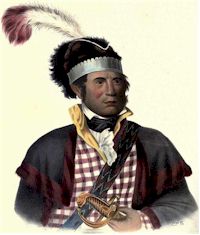
Creek Chief
The Coweta were the second great Muskogee tribe among the Lower Creeks, and they headed the war side as Kasihta headed the peace side. Their honorary title in the confederacy was Kawita ma’ma’yi, “tall Coweta.” Although as a definitely identified tribe they appear later in history and in the migration legends which have been preserved to us the Kasihta are given precedence, the Coweta were and still are commonly accounted the leaders of the Lower Creeks and often of the entire nation. By many early writers all of the Lower Creeks are called Coweta, and the Spaniards and French both speak of the Coweta chief as ”emperor” of the Creeks. An anonymous French writer of the eighteenth century draws the following picture of his power at the time of the Yamasee uprising:
The nation of the Caoüita is governed by an emperor, who in 1714 [1715] caused to be killed all the English there were, not only in his nation, but also among the Abeca, Talapouches, Alibamons, and Cheraqui. Not content with that he went to commit depredations as far as the gates of Carolina. The English were excited and wanted to destroy them by making them drag pieces of ordinance loaded with grape-shot, by tying two ropes to the collar of the tube, on each one of which they put sixty savages, whom they killed in the midst of their labors by putting fire to the cannon; but as they saw they would take vengeance with interest, they made very great presents to the emperor to regain his friendship and that of his nation. The French do the same thing, and also the Spaniards, which makes him very rich, for the French who go to visit him are served in a silver dish. He is a man of a good appearance and good character. He has numbers of slaves who are busy night and day cooking food for those going and coming to visit him. He seldom goes on foot, always [riding on) well harnessed horses, and followed by many of his village. He is absolute in his nation. He has a quantity of cattle and kills them sometimes to feast his friends. No one has ever been able to make him take sides with one of the three European nations who know him, he alleging that he wishes to see everyone, to be neutral, and not to espouse any of the quarrels which the French, English, and Spaniards have with one another. 1
Traditionally the name is supposed to have had some connection with the eastward migration of this tribe, and it is associated with the word ayeta, to go. No reliance can be placed upon this, however, any more than on Gatschet’s derivation from the Yuchi word meaning “man.” 2
As the principal body of Muskogee in Georgia, aside from the Kasihta, it is possible that these are the Chisi, Ichisi, or Achese of the De Soto chroniclers, 3 since Ochisi (Otc?´si) is a name applied to the Muskogee by Hitchiti-speaking peoples. 4 Spanish dealings with them in the seventeenth century have already been recounted. 5 In the period between 1670 and 1700 we find them placed on maps, along with the Kasihta, about the headwaters of the Chattahoochee and Coosa, but when they are first clearly localized they are on the upper course of the Ocmulgee not far from Indian Springs, Butts County, Georgia. On French maps the Altamaha and Ocmulgee together are often called ”Riviére des Caouitas.” After the general westward movement, which took place after the Yamasee war, they settled on the west bank of the Chattahoochee River between the Yuchi on the south and a town known as Chattahoochee.
This last-mentioned place was the first Muskogee settlement on Chattahoochee River and is said to have been established to enable its occupants to open trade with the Spaniards. Bartram says that the people of this town spoke the true Muskogee language, and it is probable that it branched off from the Coweta, though it may have been made up from several settlements. It was in Troup or Heard Counties, Georgia, and was abandoned before Hawkins’s time, 1798-99.
The first Coweta settlement on the Chattahoochee was probably at a place afterwards called Coweta Tallahassee, though at the period last mentioned it was occupied by people from Likatcka, itself a branch of Coweta. 6 D. I. Bushnell, Jr., has published parts of a journal kept by a member of General Oglethorpe’s expedition to the Creek towns in 1740, in which he gives some account of the people of Coweta. 7 In 1761 they had 130 hunters and their trader was George Galpin. 8 In 1797 Hawkins gives the names of five traders, Thomas Marshall, John Tarvin, James Darouzeaux, Hardy Read, and Christian Russel, the last a Silesian. 9 Adair enumerates Coweta as one of the six principal towns of the Muskogee confederacy but does not mention Kasihta. 10 Hawkins furnishes the following accounts of Coweta, Coweta Tallahassee, and a branch of the latter known as Wetumpka, as they appeared in 1799:
Cow-e-tuh, on the right bank of Chat-to-ho-che, three miles below the falls, on a flat extending back one mile. The land is fine for corn; the settlements extend up the river for two miles on the river flats. These are bordered with broken pine land; the fields of the settlers who reside in the town, are on a point of land formed by a bend of the river, a part of them adjoining the point, are low, then a rise of fifteen feet, spreading back for half a mile, then another rise of fifteen feet, and flat a half mile to a swamp adjoining the highlands; the fields are below the town.
The river is one hundred and twenty yards wide, with a deep steady current from the fall; these are over a rough coarse rock, forming some islands of rock, which force the water into two narrow channels, in time of low water. One is on each side of the river, in the whole about ninety feet wide; that on the right is sixty feet wide, with a perpendicular fall of twelve feet; the other of thirty feet wide, is a long sloping curve very rapid, the fall fifteen feet in one hundred and fifty feet; fish may ascend in this channel, but it is too swift and strong for boats; here are two fisheries; one on the right belongs to this town; that on the left, to the Cussetuhs; they are at the termination of the falls; and the fish are taken with scoop nets; the fish taken are the hickory shad, rock, trout, perch, catfish, and suckers; there is sturgeon in the river, but no white shad or herring; during spring and summer, they catch the perch and rock with hooks. As soon as the fish make their appearance, the chiefs send out the women, and make them fish for the square. This expression includes all the chiefs and warriors of the town.
The land on the right bank of the river at the falls is a poor pine barren, to the water’s edge; the pines are small; the falls continue three or four miles nearly of the same width, about one hundred and twenty yards; the river then expands to thrice that width, the bottom being gravelly, shoal and rocky. There are several small islands within this scope; one at the part where the expansion commences is rich and some part of it under cultivation; it is half a mile in length, but narrow; here the river is fordable; enter the left bank one hundred yards above the upper end of the island and cross over to it, and down to the fields, thence across the other channel; at the termination of the falls, a creek twenty feet wide, (0-cow-ocuh-hat-che, falls creek), joins the right side of the river. Just below this creek, and above the last reef of rocks, is another ford. The current is rapid, and the bottom even.
On the left bank of the river at the falls, the land is level; and in approaching them one is surprised to find them where there is no alteration in the trees or unevenness of land. This level continues back one mile to the poor pine barren, and is fine for corn or cotton; the timber is red oak, hickory, and pine; the banks of the river on this side below the falls are fifty feet high, and continue so, down below the town house; the flat of good land continues still lower to Hat-che thluc-co (big creek).
Ascending the river on this bank, above the falls, the following stages are noted in miles:
2½ miles, the flat land terminates; thence 3½ miles, to Chis-se Hul-cuh running to the left: thence 4 miles, to Chusse thluc-co twenty feet wide, a rocky bottom.
5 miles to Ke-tā-le, thirty feet wide, a bold, shoally rocky creek, abounding in moss. Four miles up this creek there is a village of ten families at Hat-che Uxau (head of a creek). The land is broken with hickory, pine, and chestnut; there is cane on the borders of the creek and reed on the branches; there are some settlements of Cowetuh people made on these creeks; all who have settled out from the town have fenced their fields and begin to be attentive to their stock.
The town has a temporary fence of three poles, the first on forks, the other two on stakes, good against cattle only; the town fields are fenced in like manner; a few of the neighboring fields, detached from the town, have good fences; the temporary, three pole fences of the town are made every spring, or repaired in a slovenly manner.
Cow-e-tuh Tal-lau-has-see; from Cow-e-tuh, Tal-lo-fau, a town, and hasse, old. It is two and a half miles below Cowetuh, on the right bank of the river. In going down the path between the two towns, in half a mile cross Kotes-ke-le-jau, ten feet wide, running to the left is a fine little creek sufficiently large for a mill, in all but the dry seasons. On the right bank enter the flat lands between the towns. These are good, with oak, hard-shelled hickory and pine: they extend two miles to Che-luc-in-ti-ge-tuh, a small creek five feet wide, bordering on the town. The town is half a mile from the river, on the right bank of the creek; it is on a high flat, bordered on the east by the flats of the river, and west by high broken hills; they have but a few settlers in the town; the fields are on a point of land three-quarters of a mile below the town, which is very rich and has been long under cultivation; they have no fence around their fields.
Here is the public establishment for the Lower Creeks, and here the agent resides. He has a garden well cultivated and planted, with a great variety of vegetables, fruits, and vines, and an orchard of peach trees. Arrangements have been made to fence two hundred acres of land fit for cultivation, and to introduce a regular husbandry to serve as a model and stimulus, for the neighborhood towns who crowd the public shops here, at all seasons, when the hunters are not in the woods.
The agent entertains doubts, already, of succeeding here in establishing a regular husbandry, from the difficulty of changing the old habits of indolence, and sitting daily in the squares, which seem peculiarly attractive to the residenters of the towns. In the event of not succeeding, he intends to move the establishment out from the town, and aid the villagers where success seems to be infallible.
They estimate their number of gun men at one hundred; but the agent has ascertained, by actual enumeration, that they have but sixty -six, including all who reside here, and in the villages belonging to the town.
They have a fine body of land below, and adjoining the town, nearly two thousand acres, all well timbered; and including the whole above and below, they have more than is sufficient for the accommodation of the whole town; they have one village belonging to the town, We-tumcau.
We-tum-cau; from We-wau, water; and tum-cau, rumbling. It is on the main branch of U-chee creek and is twelve miles northwest from the town. These people have a small town house on a poor pine ridge on the left bank of the creek below the falls; the settlers extend up the creek for three miles, and they cultivate the rich bends in the creek; there is cane on the creek and fine reed on its branches; the land higher up the creek, and on its branches is waving, with pine, oak, and hickory, fine for cultivation, on the flats and out from the branches; the range is good for stock, and some of the settlers have cattle and hogs, and begin to be attentive to them; they have been advised to spread out their settlements on the waters of this creek, and to increase their attention to stock of every kind. 11
The trader in 1797 was James Lovet. 12 Wetumpka is probably the Wituncara of the Popple map (pl. 4).
The census of 1832 enumerated five bands of Coweta Indians, as follows: Koochkalecha town, 276 besides 12 slaves; on Toosilkstorkoo Hatchee, 85 and 15 slaves; on Warkooche Hatchee, 30; on Halle-wokke Yoaxarhatchee, 191; at Cho-lose-parp Kar, or Kotchar, Tus-tun-nuckee’s town, 275 and 24 slaves; total 857 Indians and 51 slaves. 13 Chiefs’ families are not included.
The inferiority of this town in numbers to Kasihta was perhaps due to the fact that it had given off another settlement which afterwards constituted an independent town with its own busk ground. This was Likatcka, or “Broken Arrow” as the name has been rudely translated into English. It is said to have been founded by some families who went off by themselves to a place where they could break reeds with which to make arrows. According to William Berryhill, an old Coweta, however, it was not so much on account of the place where they had settled as because they considered themselves to have “broken away” from the parent band in much the same manner as a reed is broken. This town is said to have been situated on a trail and ford 12 miles below Kasihta. It appears to be noted first by Swan (1791). 14 Hawkins in his Sketch of the Creek Country does not speak of it, but in a journal dated 1797 says that the people of Coweta Tallahassee had come from it. 6 In the American State Papers 15 he mentions it as having been destroyed in 1814, but it was soon restored, for it was represented at the treaty of November 15, 1827, 16 and in the census of 1832. In this latter five settlements belonging to the town are enumerated, but it is probable that only the first two of these are correctly designated. One of these latter was on Uchee Creek; the situation of the other is not specified. Together they numbered 418 inhabitants, not counting slaves and free negroes. 17
Coweta and its chief, McIntosh, played a conspicuous part in the removal of the Creek Indians to the west. McIntosh was the leader of that party which favored removal and was killed by the conservative element in consequence. After the emigration Coweta and its branches settled in the northern part of the new country on the Arkansas, where most of their descendants still live. Their square ground was first located about 2 miles west of the present town of Coweta. After that site was fenced in and plowed up they moved it to some low-lying land close to Coweta, and later busks of a rather irregular character were held in other places, but the observance soon died out. Nevertheless the busk medicines are, or until recently were, still taken in an informal manner by the Coweta men four times a year, corresponding to the times of the three “stomp” dances and the busk. According to one informant, shortly before the Civil War, Coweta, Kasihta, Tukabahchee, and Yuchi planned to come together in one big town, but the war put an end to the project. In late times the Coweta and Chiaha were such close friends that it is said “a man of one town would not whip a dog belonging to the other.” This friendship also extended to the Osochi.

- MS in Ayer Coll., Newberry Lib. The story about slaughtering Indians who were pulling a cannon crops up in connection with the Popham colony (see Coll. Mass. Hist. Soc., 1st ser.. I, p. 252).[↩]
- Gatschet, Creek Mig. Leg., I, p. 19.[↩]
- Bourne, Narr. of De Soto, I, p. 10; II, p. 54.[↩]
- Hence the name “Ocheese River” (p. 215). See Hawkins in Ga. Hist. Soc. Colls., IX, p. 200; and p. 148.[↩]
- See pp. 220-222.[↩]
- Ga. Hist. Soc. Colls., IX, p. 63.[↩][↩]
- Amer. Anthrop., n.s.,vol. x, pp. 572-574, 1908.[↩]
- Ga. Col. Docs., VIII, p. 522.[↩]
- Ga. Hist. Soc. Colls., IX, pp. 170-171.[↩]
- Adair, Hist. Am. Inds., p. 257.[↩]
- Ga. Hist. Soc. Colls., III, pp. 52-67.[↩]
- Ibid., IX, p. 03.[↩]
- Senate Doc. 512, 23d Cong., 1st sess., IV, pp. 379-386. A mistake in addition has been made on one sheet, which I have rectified.[↩]
- Schoolcraft, Ind. Tribes, V, p. 262.[↩]
- Am. State Papers, Ind. Affairs, I, 858, 1832.[↩]
- Indian Treaties, 1826, pp. 561-564.[↩]
- Senate Doc. 512, 23d Cong., 1st sess., IV, pp. 386-394.[↩]