
Early the summer of 1877 troubles arose in regard to the occupancy of the Wallowa valley by white settlers, it having been withdrawn in 1875 as a reservation under treaty of 1873, because of the failure, of the Indians to permanently occupy it. An Indian belonging to a band of non-treaty Indians under Chief Joseph was killed by some settlers; then the Indians insisted upon the removal of the settlers and the restitution of the valley to them. Upon the refusal of the government to do this, and after further efforts to compel all the non-treaty Indians to come into the reservation at Lapwai, an outbreak occurred, under the leadership of Joseph, which resulted in a number of pitched battles, with great loss. He was compelled to retreat, the forces under General Howard pursuing him eastwardly across the headwaters of the Snake River and through the Yellowstone national park, where the pursuit was taken up by the threes under General Terry, resulting finally in the capture of Joseph and his band.
On the morning or September 30, 1877, Chief Joseph and his Nez Perces were met and surrounded by Colonel Nelson A. Miles and his command in the valley of Snake creek, northern Montana. On the 4th of October 1877, they surrendered. The length of this raid, the march of the troops, and the tact displayed by Joseph form one of the most extraordinary chapters in the history of Indian outbreaks, Eighty-seven warriors, 184 squaws, and 117 children surrendered. They were sent under guard to Fort Abraham Lincoln, North Dakota, thence to Fort Leavenworth, and afterward located in the Indian Territory, and finally at the Ponca agency, Oakland. In 1885 they returned to Idaho. They were located at Colville agency, where they now reside in peace, and in 1890 numbered 148.
Little, if any, change has token place in the Indian tribes living within Idaho, except the gathering of them upon reservations.
Coeur d’Alene reservation is under the charge of the Colville agency, Washington.
The country now called Idaho at its discovery by Europeans contained but few Indians except those in the north, the Sahaptin, Nez Percé; in the south were a few Shoshones, Bannocks, Snakes, and Utes, all, of Shoshonean stock.
Total Indian Population as of June 1, 1880 (A)
Total 1, 223
Reservation Indians, not taxed (not counted in the general census) 4,223
Indians in prisons, not otherwise, enumerated 2
Indians on reservations, self-supporting and taxed (counted in the general census) 159
(a) The self-supporting Indian taxed are included in the general census. The results of the special Indian census, to he added to the general census, are:
Total 4,103
Reservation Indians, not taxed 4,002
Indians in prisons not otherwise enumerated 2
Other parsons with in Indians, not otherwise enumerated 90
Indian Population of Reservations
| Agencies and Reservations | Tribe | Total | Males | Females | Ration Indians |
| Total | 4,002 | 1,997 | 2,005 | 400 | |
| Fort Hall agency | 1,403 | 750 | 741 | 374 | |
| Lemhi valley | 432 | 212 | 220 | 35 | |
| Nez Percé agency | 1,710 | 820 | 886 | ||
| Colville agency | 422 | 206 | 216 | ||
| Fort Hall agency | |||||
| Fort Hall reservation | Bannock and Shoshone 1 | 1,492 | 750 | 743 | 374 |
| Lemhi agency | |||||
| Lemhi reservation | Bannock, Shoshone, nod Sheepeater 2 | 432 | 212 | 220 | 35 |
| Nez Percé agency | |||||
| Lapwai reservation agency | Nez Percé | 1,715 | 820 | 886 | |
| Colville agency 3 | |||||
| Coeur d’Alene reservation | Coeur d’Alene | 422 | 206 | 216 |
The civilized (self-supporting) Indians of Idaho counted in the general census, number 159, 72 males and 87 females, and are distributed as follows: Bingham County, 23; Boise County, 19; Cassia County, 13; Idaho County, 81; Kootenai County, 19; Nez Perces County,19; other counties with 11 or less in each, 35.
The Indians not on reservations form but a small fraction of the Indian population, and they have no characteristics not indicated in the descriptions of other Indians.
Tribe, Stock, and Location of the Indians in Idaho
| Tribes | Stock | Reservation | Agency |
| Bannock | Shoshonean | Lemhi | Lemhi |
| Bannock (Boise) | Shoshonean | Forth Hall | Forth Hall |
| Bannak (Brunean) | Shoshonean | Forth Hall | Forth Hall |
| Coeur d’Alene | Salishan | Coeur d’Alene | Colville, Washington |
| Nez Percé | Shahaptian | Lapwai | Nez Percé |
| Sheepeater | Shoshonean | Lemhi | Lemhi |
| Shoshone | Shoshonean | Lemhi | Lemhi |
| Shoshone | Shoshonean | Forth Hall | Forth Hall |
Fort Hall Agency
The first arrival of Indians at the Fort Hall agency under an agent was on April 15, 1869. The report of the agent, August 30,1869, gives the following statistics of population: Bannocks, 600; Boise Shoshone, 200; Bruncan Shoshones, 100; Western Shoshones, 200; total, 1,100.
The former or aboriginal home of the Bannocks was in this immediate vicinity, the Boise Shoshones were in the western portion of the state, near Boise city, the Bruncan Shoshones ill the southwestern corner of the state, and the Western Shoshones came from the country now northern Utah Mid northeastern Nevada. There are at present no separate bands of Shoshones on this reservation; all are classed as one tribe. The Bannocks’ proper are an entirely separate tribe with a different language; but after twenty odd years of intermarriage it is almost impossible, to distinguish between them. Nearly all Bannocks can speak the Shoshone tongue, while but few Shoshones can speak the Bannock,-Station Fisher, United States Indian agent.
Lemhi Agency
The Indians at Lemhi agency are Shoshones, Bannocks, and Sheepeaters, but all are now considered as one tribe. They have ranged in eastern Idaho and Westen Montana since the white man has had any knowledge of them. The Lemhi valley has always been their headquarters, and they have been on the Lemhi reservation since its establishment in 1872. The Shoshones and Sheepeaters are one tribe. The Bannocks are a, separate tribe; but the few on the reservation have married and intermarried with the Shoshones. These Indians are on the increase. The Shoshones, or Snakes, are divided into 4 bands: the Western Shoshones, in northern Nevada, on Duck Valley reservation; the Shoshones on Lemhi reservation, known as Tendoy’s band; the Shoshones on Fort Hall reservation, Idaho; the Shoshones at Fort Washakie, Wyoming. These arc all one tribe. Egbert Nasholds, United States Indian agent.
Nez Percé Agency
The Nez Percé, since becoming reservation Indians, have always been on the Lapwai reservation. This tribe has no mixture of other tribes in it. The reservation is part of their old roaming grounds. The Nez Percé occupied this region at the time the reservation extended as far west as Walla Walla, Wash., over 100 miles west of its present boundary line, The reservation is now in the state of Idaho. There are none but Nez Percé Indians on this reservation.
Joseph’s band of Nespilems, which is now located on a reservation, the Coeur d’Alene, under charge of Colville agency, Washington, is credited in part as being of the Indians of this reservation. This band is composed of Nez Percé Indians. They were deported to Indian territory at the close of the Nez Percé war in 1877 and located at Ponca agency, and were returned to Idaho and. removed to Colville agency in June 1885.-Warren D. Robbins, United States Indian agent.
Coeur d’Alene Reservation
(Attached to Colville, Agency Washington) Coeur d’Alene reservation, in northern Idaho, is occupied by the Coeur d’Alene Indians, who have always been in the country about the reservation. They are farmers, entirely self-supporting, wear citizens’ dress, and are considered good Indians.
Fort Hall Agency
Report of Special Agent H. M. Austin on the Indians of Fort Hall reservation, Fort Hall agency, Oneida County, Idaho, October 1890. Names of Indian tribes or parts of tribes occupying said reservation 4 Boise and Brunan Bannack (Pauaiti) and Shoshoni.
The unallotted area of this reservation is 864,270 acres, or 1,360.5 square miles. The outboundaries have been surveyed. It was established, altered, or changed by treaty of July 3, 1868 (15 U.S. Stats., p. 673); executive orders June 14, 1867, and July 30, 1869; agreement with Indians made Judy 18, 1881, and approved by Congress July 3, 1882 (22 U. S. Stats,, p. 148); act of Congress February 23, 1889 (25 U. S. Struts, p. 687).
Indian population 1890, 1,493, Bannocks, 514; Shoshones, 979; practically one people by intermarriage.
Fort Hall Reservation
Origin Of The Shoshones
The tradition among the We-he-nite-to (knife people or tribe), now known as the Shoshones or Snakes (Togoi), is that they came from the far east.
The story of the Shoshones coming from the east is evidently true; a party of Shoshones on meeting the Comanches several years ago while in Washington, D. C., were able to converse with them, many of their words being identical, while others were very similar in sound.
Origin of the Bannocks
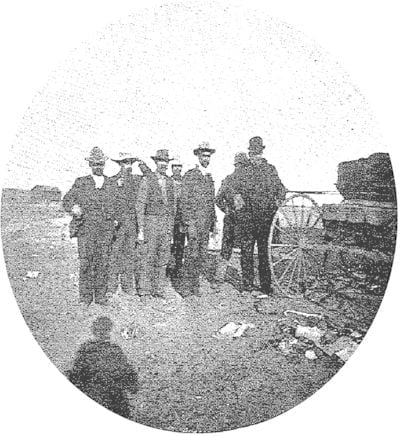
The language, of the Bannocks and that of the Piutes are virtually the same. The two tribes intermingle, as formerly what they termed their countries joined. The Piutes claim that the Bannocks are the descendants of a portion of their tribe, who, headed by an ambitious and rebellious chief, a great many years ago left the main tribe and traveled to the northeast and made a home in the mountains, where they gained it living almost exclusively by hunting the buffalo, elk, deer, bighorn, and antelope. Long ago the Bannocks, before they came in possession of horses, were very expert with bow and arrow. One of their modes of killing large game was, to secrete themselves by making an excavation in the loose rocks near the month of a narrow canyon or some spring where game frequently passed. This excavation would be about 4 feet in diameter and 3 or 4 feet deep, according to the height of the hunter. Around the rim of this little fort would be placed upright willows, or brush of some kind which corresponded with that in the immediate vicinity, so as not to excite the suspicion of the game, whose trail passed within 15 or 20 feet of the wily native’s unobservable shelter. With the wind in his favor he had almost a certainty of killing the first animal that passed the fatal spot. In most cases the large game was shot through the entrails, which, while not killing at once, would make the animal so sick that it would lie down before going far, if not disturbed, to die within 24 hours without getting on its feet again. The Indian would find his game by following the tracks. If the Indian can get a close standing shot he may take the chance of making a heart shot, notwithstanding he knows that there is a two-to-one chance that he will strike a rib, which will stop his light flint-point arrow.
The Bannocks are tall and straight, with a lighter complexion than the Shoshones, and are much more warlike and bloodthirsty. Work with them is an everlasting disgrace, and few except the old and broken down among them can be induced to do any kind of manual labor. They are very averse to schools and civilized pursuits. They regard themselves as the salt of the earth, and with them any one who does not speak the language of the Bannock and imitate his ways is ignorant. They are not very brave in war, but heartless and cruel. They have often been known to kill their aged parents after they became a burden.
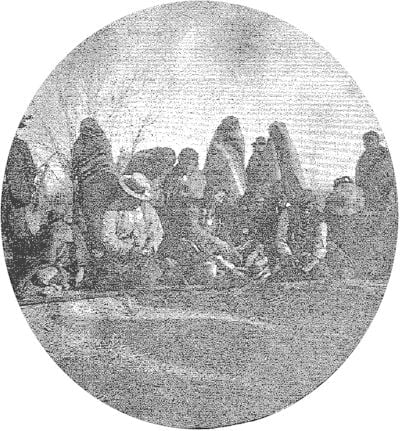
Prior to the advent of the white people the Shoshones lived principally upon fish roots, seeds, and berries. The fish were mostly salmon, taken with spears from the waters of the Salmon River and its tributaries and the Snake River below Salmon falls. The roots gathered consisted of camas and yamps (pah-se-go and ot-se-go). The camas, which is the larger and more plentiful, has a sickening sweet taste and a blackish appearance inside and out. It is liked by Indians, and will fatten hogs, making very fine flavored meats, but it is not palatable to the white man. The yamp is not larger than the common peanut, pointed at each end. When boiled it has very mach the taste of the sweet potato, but it is usually eaten raw, after being dried in the sun; it has a pleasant taste. Haws, chokecherries, wild sunflower seeds, and seeds from different grasses and weeds, as well as grasshoppers and a large species of the cricket, when plentiful, also formed a part of their diet. All descriptions of food were ground together between stones. Sometimes they laid the mixture on hot rocks and at other times it was boiled in willow baskets, which were thoroughly covered inside and out with pine pitch and clay. The boiling was accomplished by placing hot stones (held by bent willows) in the willow vessel.
All manual labor was performed by the female members of the family; the men speared the fish and did the hunting. In taking fish a long slender pole was used, at the end of which was attached a bone about 3 inches long, fastened in the, center by .a string or thong, and so arranged that in spearing the fish the bone head would turn crosswise in the fish. This was done by holding the bone head in place by means of a loop passed around the upper end of the bone and pole in penetrating the salmon the loop was driven off from the bone, which, owing to its slanting shape, caused the head to turn crosswise either in the fish or on the opposite side of it, In either case there was no chance of escape. Since the white people came among them they use iron or steel in place of the bone heads.
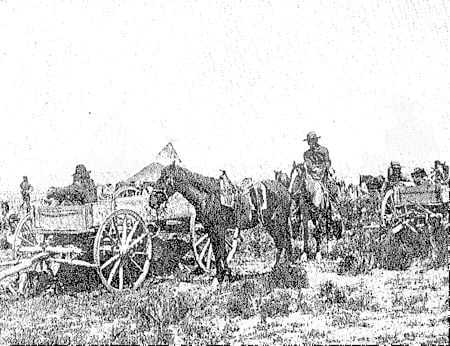
The Shoshones, before they became greatly mixed by intermarriage with the Bannocks, were a low, heavy built race, with small hands and feet, but with very largo chests and shoulders. They formerly dressed in furs and skins sewed together with sinews or thread spun by hand from wild hemp (smartweed). A warm and durable blanket was worn, mostly by old women and children, which was made from the fur of rabbits, used as filling, with the handspun wild hemp for warp.
At Fort Bridger, Utah, on July 3, 1868, there was a treaty entered into between the United States and the Shoshone (eastern band) and Bannocks tribes, in which they were promised a reservation which was, to embrace a reasonable portion of the Port Neuf valley and Kansas prairie, but the facts are that the Indians understood that they were to have the Port Neuf country and Camas prairie. There is not and never has been any place in this section known as Kansas prairie. It is quite evident that those representing the government at this treaty wore not familiar with the geographical lay of the country, and supposed that the two sections mentioned were adjacent, when in fact they are separated by more than 100 miles. Be this as it may, this little misunderstanding or blunder was a bone of contention on the part of the Indians who visited Camas prairie about the 1st of June each year, remaining there for a month or more, during which time the squaws gathered and dried a supply of roots for winter use, while the men gambled, raced horses, and traded with the Umatillas, Nez Perces, Piutes, Sheepeaters, and other tribes and bands of Indians that were wont to meet there each season for the same purpose.
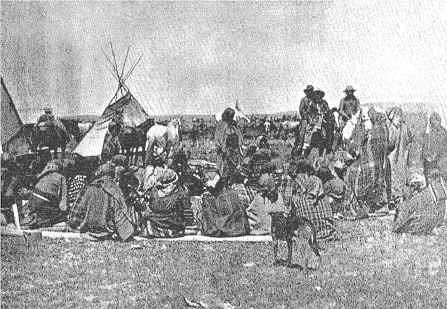
As the country became more thickly settled by white people the prairie proved not only an excellent field for stock grazing, but also a fine place for hogs, which would thrive and fatten on the roots that from time immemorial had formed a good part of the Indian’s winter food. Bad blood sprang up between the stock and hog men and the Indians, which culminated, in the summer of 1878, in the massacre of the white settlers, the Indians regarding them as intruders. The question of ownership then received an arbitrary settlement by the government in favor of the white people. The soil is now the home of thousands of farmers, The Camas stick has been superseded by the self-binder. This appears to the Indians as a great injustice.
The loss of their root harvest in the west was no greater privation to them than the loss of their meat harvest in the northeast, for after returning from their fields they, at least the Bannocks, only remained long enough at the agency to draw their annuity goods and rest their horses a little; they then went to what they termed the buffalo country along the Yellowstone and Musselshell Rivers in Montana, where the buffalo and other large game were found in abundance. They returned in the spring to their reservation with every extra horse loaded down with buffalo robes and dried meat.
Probably one-third of the Indians on this reservation are mixed bloods between Bannocks and Shoshones, and in classifying them the question as to their parents’ blood is settled by noting with which band they associate, they wear plenty of beads, brass trinkets; feathers, and gaudy blankets, and positively refuse to work, they are put down as Bannocks; but if, on the other hand, they take kindly to labor and try to dress and live like the white people they go on the records as Shoshones. On this reservation the latter out number the former almost 2 to 1.

These Indians are controlled to a great extent by time medicine men. They use the sweathouse to some extent, and it is no doubt beneficial in certain cases. The place selected to build the sweathouse is close to some stream or pond of water. It can be constructed in a few minutes, by simply bending a few willows in a half circle, inserting both ends in the ground and covering them with blankets or robes. It is made just high enough to admit its occupant in a sitting position. Water poured on hot stones produces steam and soon starts the perspiration from the bather. After a thorough sweating the bather comes forth naked, and plunges into the cold water. The result is not always satisfactory, in eases of flesh wounds or painful swellings they sometimes apply poultices made from pulverized roots or leaves of different weeds or herbs, but they rarely give medicine internally. Of late years they consult the agency physician in cases of broken bones, but their call on him for other ailments is usually for the purpose of getting an order for a little rice, sugar, or coffee.
The agency doctor labors under many disadvantages. For instance, he may visit a person in his lodge or shanty, sometimes 10 or more miles from the agency headquarters. He finds his patient lying on the ground, with scarcely any bedding and with no interpreter at hand it is impossible for them to understand each other. There being no glass or spoon about the place, he may be obliged to give the sick person his doses from an old oyster or tomato can. He can only tell him how often to take the medicine by motions, and points at the relative place of the sun for the time when the dose should be taken. This is but one of the many deplorable predicaments incident to the physician’s duties at the agency. The first thing that an enlightened man would suggest would be a hospital near the agency, but this would be an expensive luxury, from the fact that it would require a new hospital quite often, The first death in it would terminate its use as a hospital, for nothing could persuade another Indian to enter it; it would be bad medicine for him to do so. When a death occurs in a lodge or shanty it is promptly burned along with its contents. There are but few exceptions to this rule, even with the most enlightened Indians. An agency gristmill that cost the government several thousand dollars was burned by the Indians some years ago the first night after an Indian boy had been crushed to death in its machinery.
Among the Indians nothing is accounted for by natural ceases, and their superstitions are carefully guarded and increased by the medicine men, who are credited with supernatural power. One great belief with them is a coming resurrection of all the dead Indians, Every few years this belief is revived. It is always to take place in the spring or early summer. This past summer was the latest period fixed for this great event. The doctrine is not confined to this reservation alone, but is almost universally believed by all the tribes west of the Rocky Mountains.
Free riding on the railroads, a custom of general application, gives the medicine men the advantage of visiting the different reservations. This agency was visited quite recently by representatives from no less than 8 or 9 reservations, some from as far east as the Pine Ridge agency, Dakota, all on the same errand, looking for the messiah. As previously stated, a medicine man may not claim the power to heal the sick. His power may consist in bringing the dead to life, causing the grass to grow in the spring, making high waters just when the snow is melting in the mountains, or making medicine that will bring good luck to himself or friends in stealing horses. Not one of their medicine men has ever favored schools or civilization.
The Bannock and Shoshone Indians holier in the future life is simply that the braves, those who have taken scalps from an enemy or are successful horse thieves, will go to a land ruled by a big Indian god who will be most gorgeously decorated with beautiful feathers and wear the full robes of a great chief, and, riding a very fast horse, will lead them all in the buffalo chase. Game, and fish of all kinds will be in abundance and easily captured. The quiet, honest fellows my possibly be admitted, but will not be allowed to take part in any of the royal sports. They believe they will have their horses in and usually a horse is killed at the grave for immediate use in the other world, formerly their squaws shared the same fete.
This reservation was established 21 years ago. Two years later it was assigned to the charge of the Catholics. During the year following the, arrival of the Catholics the agency was visited quite often by a French Catholic priest, who christened a, great many of the young children and tried to teach the older ones religion and its duties, all of which has long since been forgotten. Since that time there have been occasional sermons preached and interpreted to them by ministers of the several creeds, but they do not take to the white mans doctrine very readily.
The Fort Hall reservation embraces 804,270 5 acres of land: one-tenth is wild hay land, two-tenths rocky, mountainous land, upon which grows considerable scrubby pine as well as cedar, The land designated farming land requires irrigation, and nothing can grow without it except wild hay on the low bottom lands along Snake river.
As the land is close to an extensive mining region, crops of all kinds bring a better price than they do in the middle or eastern states.
Gold dust is known to exist in paying quantities on the southwest portion of the reservation along the banks of Snake River. It is known as Snake River “flue dust”. Much of time mining ground close to the, reservation has been worked with rockers, using copper plates and quicksilver, the millers making from $2 to $10 per day.
This is a good stock country, and cattle killed for the Indians from the range are nearly as fat as stall-fed cattle. The greatest revenue of these Indians is from the sale of hay. They, have this season, with their own: teams and machines, put up at least 2,500 tons, which is being sold to stock men at $5 per ton in the stack. Indians wile raise stock sometimes reserve a little hay for their own use, but usually sell it all and then take the chances for their own .stock, The result last Winter was that they lost at least 20 per cent of their ponies and cattle.
About 2 years ago the government gave these Indians some 200 head of cattle. All of the Bannock and some of the Shoshones killed and ate theirs the first winter. Some 40 or 50 head were saved by the most enterprising Indians, and from their natural increase they have now about 400 head. They have altogether about 3,000 head of horses, which are mostly small, weighing from 600 to 900 pounds each.
About one-fourth of the Indians on this reservation are prosperous Unassisted they have built quite comfortable log cabins, stables, corrals, and fences. They dress like white men, and try to imitate their ways, and send their children to school. They are strictly honest, and always get credit at the trader’s store. There is another class, say about one-fourth, that do moderately well. They have not quite force or energy enough to make a success of life. They mean to be honest, but will buy on credit with little prospect of money with which to pay their debts, but when they fail to pay their debts it does not worry them much. They seem whimsical and improvident to a white man. Another one-forth are what may be termed worthless. They hang around the towns and beg what they eat, while their women do some scrubbing and washing for the whites, and sonic of the older men saw wood and do chores for cold bits when they are hungry, and wear castoff clothes. They beg all they can from the agent and never look a day ahead, except to be always on hand on issue days, ready to catch up all the entrails, heads, feet, and offal from the slaughtered beeves. The other and last one-fourth are gamblers and thieves, they will not work. They are mostly young bloods from 10 to 30 years of age, Bannock dudes in dress, and are shrewd gamblers in their way, ever ready to steal a horse or anything else of value, and are ready to kill a white man if they think they will not be detected. They believe it elevating to get drunk occasionally, and claim to be warriors and threaten to go on the warpath when pressed by hunger. They will go from one lodge to another begging or demanding food until some old woman, either through fear or kindheartedness, will feed them. They are constantly running after young girls or some other mans squaw. They land in the agency jail quite often, and are ready to repeat their lawlessness again as soon as they are at liberty.
It is impossible to state with any degree of accuracy whether they are increasing or decreasing in number. The present agent, who has lived a great portion of his life at or near this agency, is of opinion that during the 21 years past there has been a slight increase among the Shoshones, more particularly with the farming class. He believes that the Bannocks, the wild classes, are on the decrease, which is due to the fact that, being very loose in their morals, they have contracted more venereal disease than the Shoshones, or farmers, and hereditary syphilis in many cases is killing off their children.
There are quite a number of young men and women who attended school here 10 or 15 years ago. What little they learned then has been forgotten, and some of them are now found among the most degraded and worthless. Girls that were taught to read and write fairly well are now around each with a papoose on her back, and it’ is doubtful whether they have looked inside a book or written a line since leaving school. In some particulars the Indian children are as quick to learn as white children. Writing and geography has the greatest attraction for them. They also learn music very readily, but not mathematics.
The Indians of this agency had placed to their credit last July $6,000, which was the second installment of money under the treaty entered into with the United States in 1880 (ratified in 1888) by which they relinquished their right to some 350,000 acres of the southern portion of their reservation. This treaty gives them $6,000 a year for 20 years. They also made a treaty in 1887 granting for the Pocatello town site some 3 sections of land.
The Fort Hall reservation is in fine condition.
Lemhi Agency
Report of Special Agent H. M. Austin on the Indians of Letitia. reservation, Lemhi agency, Lemhi County, Idaho, October, 1890, Names of Indian tribes or parts of tribes occupying said reservation; 6 Bannak (Panaiti), Sheepeater, and Shoshoni.
The unallotted area of this reservation is 64,000 acres, or 100 square miles. The outboundaries have been surveyed. It was established, altered, or changed by unratified treaty of September 21, 1868, and executive order, February 12, 1875.
Indian population 1890; 432; Bannocks, 75; Shoshones, 240; Sheepeaters, 108.
Lemhi Reservation
The Indians at this reservation are the same, with the same history, customs, and habits, as are to be found at Fort hail among the Shoshones and Bannocks. They have intermarried and associated together so long that they are virtually one tribe.
The school at this agency has only been running some 7 or 8 months. The children learn quite readily, Most of the pupils can read, write, spell, add, subtract, and as few can multiply.
The minds of the Indian children here cam be cultivated and developed readily, Many of them are fluent talkers, can make themselves well understood, and have a, very good knowledge of things in generals There are some that want to go along in their old ways. As at Fort Hall, some of the heads of families are very much opposed to sending then, children to school. They say they do not want them to learn the ways of the white men. They think their ways the best. In the school some learn to sing ballads, and most of the children can sing sacred tunes, Both old and young possess in a marked degree the faculty of imitation. Their deity is the Great Spirit, or their Great Father, as they term it. They have faith in future punishment and a happy hunting ground. They believe that bad Indians in their travels from this land to the happy bunting ground have to climb steep, rugged mountains, over sharp gravel and rocks that tear and cut their feet, cross deep, wide rivers difficult to get over, also swamps and marshes. On this journey they do not find any food to eat, and nearly starve. Finally they see the promised land, but after they come in sight of it, it takes them days to reach it. So after serious trials and tribulations they get to the happy hunting ground and become part of God’s chosen people. On the other hand, when the good radian dies, when the spirit leaves the body, he immediately mounts a fine horse, takes his gun and ammunition, and travels through a beautiful country with an abundance of game of all kinds on either side of the trail. His journey is one of pleasure. The happy hunting ground is a beautiful place or country where the buffalo, elk, deer, and antelope are so plentiful and tame that the Indian can sit in his lodge, raise the flap, and shoot such game as he wants. His squaw will then bring it in.
These Indians are reasonably healthy. The males compare in size with the white man. They are generally straight and erect, their height ranging from 5 feet 8 to 0 feet 2 inches. They weigh from 14.0 to 200 pounds, and are well developed. They are never known to be bald. Their hair is thick, black, and straight. Their teeth are perfect, and they rarely have the toothaches They have keen black eyes, and the sight is not impaired until they are very old, although they have eye troubles on account of syphilitic poison in the system, which has caused a few to become nearly blind. In build the females are rather short and heavy, nature having provided them with great strength and endurance. They have to perform all the manual labor and drudgery about the camp. The male is too dignified to turn his hand to anything like work; therefore the squaw is generally the most healthy and hardy. They do not bear many children; generally 3 to 4 are born to them from 2.5 to 3 years apart. The children are always lashed on the squaw’s back until they are old enough to walk, and are usually healthy, except when there is an epidemic among them, such as scarlet fever, whooping cough, and measles, which are generally fatal.
The household management of these Indians is slovenly, one might say filth. Most of them live in lodges made of skins or cloth. They often bake their bread in the coals or ashes, and when in a hurry for their meat they throw a piece on the coals, let it cook a little, and eat it. They have no regular meals, but eat when hungry. There are a few exceptions to the living in lodges. Some of the Indians on this reservation reside to small houses that they have built with the assistance of the agency carpenter, there being 13 of these with a family in each. They live in them in winter, but when summer comes they move into the lodge, as they say the lodge is much cooler. As fast as the Indians build houses the government furnishes them with cooking stoves, which they use. The houses are built of pine logs that they get from the mountains, and are quite comfortable. If one of a family dies in the house they leave the place, and either burn the house or tear it down and move it to another place and rebuild it, When an Indian died the custom, until the agent put a stop to it, was to burn the lodge and its contents and kill horses over the grave, They would do it yet if not watched by the agent. It is very hard to get them to abandon these superstitions.
The male costume is a shirt, breechcloth, leggings, and a blanket of fancy colors. Their heads are decorated with feathers, and they wear strings of beads and shells around their necks, The hair is generally braided on the sides of the head, with the back hair hanging down the back and over the shoulders. They paint their faces different colors and with great care, so as to make them look as hideous as possible. Most of them are good horsemen, and look well when mounted. Many of them are rather good looking; some are of a jolly disposition, and others look sullen or grim. Nearly every one has his glass to use in making his toilet. The females or squaws, to some extent, wear dresses of calico, using from 4 to 5 yards in a dress. They also wear leggings and moccasins; with a shawl or blanket. They wear their hair long. A few of them part and braid the hair, but the majority wear it loose, hanging down over their faces and backs. The squaws do not wear as much jewelry as the men. They are not very bold, rather modest or timid, and speak in very low tones.
Their progress in civilization has been slow; but of late years their advancement has been encouraging. There are about 40 little farms on this reservation, and some are worked with quite good results. Some are engaged, in raising stock, horses principally, and others still stick to their fishing and hunting. Some begin to see the advantages of education and industrial training. They see that what little grain they raise is quite a help to them, and find a ready market for all they can raise. They are apt, and soon learn how to hold the plow, to cradle grain, and to mow grass, with the scythe. They take care of hay and straw and other final products. There are quite a number of the farmers wearing citizen’s clothes, which change their appearance very much; but when they wont to dress up they put on the blanket and paint.
The male Indian when about his camp is lazy and indolent, as the squaw does all the camp work. He does the hunting; but since the government is teaching these Indians to farm they are becoming more industrious. Quite a number on this reservation have abandoned their Indian habits to a great extent and only take a fall hunt. The rest of the time they work on their little farms, cultivating the land, building fences, sheds, and houses, and doing general farm work. Those who are engaged in farming pursuits are the older men. The young ride fast horses, run horse races, gamble, and do anything but work.
The squaw has all kinds of work to do, She cooks, makes clothes, moccasins, gloves, packs the horses, takes down the lodge when they move and puts it up when they camp, and. gathers the wood for fires. She tans the skins, such as deer, antelope, elk, moose, bear, and beaver. This is all done by hand with soap and the brains of the animals. They all like to dance, old and young, male and female. The war, sun and scalp dances are strictly prohibited by the government, and all dancing is fast being broken up by the agents; still some simple, innocent dances are permitted. In these dances they usually build two great fires, then join hands, form a circle, a hundred together, and swing, chant, and dance around the fire until all are tired out.
These Indians as a rule are inveterate gamblers. They will gamble away their money, their property, and their clothes, almost to the last shirt. Their wealth consists chiefly or horses. The tribe owns about 3,000, which are valued at about $15 per head. They have but few cattle. The fishermen and hunters own horses, guns, fishing tackle, and lodges. The farmers own farms and farming implements. The implements, clothing, bedding, and a greater portion or their subsistence is furnished by the government. Most of them always have a little money, and some work for white men for wages. The police get their salary from the government. Some haul the government supplies from the railroad station, 70 miles distant, for which, the government pays them; others make money by selling furs and skins of different kinds.
They are surely decreasing in numbers, They now, number 432; a few yours ago they numbered from 700 to 800.
The reservation is located in Lemhi County, Idaho, about the middle of the Lemhi valley, which is 10 miles wide and about 21 miles long. It is a fair grazing country, and has about 5,000 acres or tillable land, with an abundance of good water for all purposes. The water courses run near the farming lands, and with ditches could be utilized for the irrigation or all the valley lauds. All the land is avid, and irrigation is necessary for the production of crops.
There is a quartz mine on the reservation, but its extent has not been determined, as the government does not allow any prospecting, It also has an abundance of timber of fir, pine, spruce, and mountain cedar on the mountain slopes and sides. The indigenous grasses get moisture from the melting snow in the spring. There is occasionally a little rain in the spring, but after the 1st of June it is continually dry until snow falls again in the autumn.
The Lemhi agency is located about 1 mile from the south line, of the reservation, midway from the ends. It is beautifully situated on Hayden creek, a tributary of the Lemhi River, which makes its confluence about one-third of a mile from the agency.
The agency buildings are as follows: the office, the agent’s and physician’s houses, the girls’ dormitory, the day school, and a barn and ice houses They are all frame buildings, The carpenter shop, blacksmith shop, storehouse, laundry, clerk’s house, and boarding school building’s are built of logs. The implement building is of slabs. The value of those buildings is about $6,000, although they cost much more.
In the past the buildings were in a bad condition, but the present agent has repaired and repainted them, so they look clean and are comfortable. Hayden creek flows within a few steps of the agency building and affords an abundance of clear, pure cool water for the school, the agency, and. or other purposes.
As stated before, these Indians are a mixed tribe (it is impossible to separate them), consisting of Shoshone, Bannocks, and Sheepeaters, and have married and intermarried for generations. Their head chief is Tondoy, who has always been friendly toward the whites. He is 56 years of age, has great influence over his tribe, and is a full-blooded Shoshone.
Nez Percé Agency
Report of Special Agent Henry Heth on the Indians of Lapwai reservation, Nez Percé agency, Idaho County, Idaho, October 1890. Name of Indian tribe occupying said reservation: 7 Nez Percé.
The unallotted area of this reservation is 746,651 acres, or 1,167 square miles. The outboundaries have beau surveyed and some and subdivided.
It was established by treaty of June 11, 1863, 14 U. S. Stats, p. 647.
Indian population 1890; 1,716.
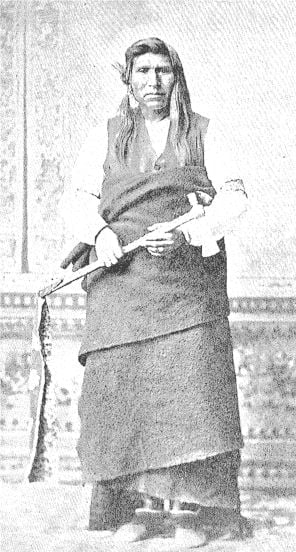
The Nez Percé agency is located at the mouth of Lapwai creek where it empties into the Clearwater, 10 miles from Luonton. Further on the Clearwater empties into Snake River.
The census or these Indians shows a population of 1,115.
Most of the Nez Perces belong to the Presbyterian church, and, owing measurably to the efforts of two pious missionaries, they have made considerable progress in religion. There are said to be about 100 Catholics among the Nez Percé, There are 4 churches on this reservation, 3 Presbyterian and 1 Catholic, and the Indians are very attentive, to their church duties, These Indians are self-sustaining; still, issues of agricultural implements and wagons to a limited number are annually made by the government. They subsist by farming and raising cattle.
Their lands are now being allotted to them. The reservation contains 746,651 acres. The number of acres under cultivation is estimated to be 6,000; under fence, estimated, 10,000. The fences are indifferently constructed. Some of the Nez Percé are good farmers, and several own large herds of cattle and horses. The intruding whites hold as many cattle on this reservation as the Indians, and possibly a larger number. The grass is all eaten of by the cattle of the whites by winter, the Indians losing such of their stock by starvation. The only remedy for this state of affairs is to station a detachment of United States cavalry on the reservation in the early spring drive off the cattle of the whites, and should they permit them to return or bring them back, impound the cattle and make, the offenders pay a fine.
The present value of the government buildings is estimated at $24,000, which includes the estimated value of 2 mills, one a steam gristmill and the other a grist and saw mill; also a school and boarding house, which probably cost $10,000. Two-thirds of the Nez Percé live in houses and one-third in tepees. Their houses are generally indifferent and not clean. About two-thirds dress as whites, the rest partly like the whites. The morals of the Christian Nez Percé are tolerably good, of the pagan Nez Percé bad.
A court of Indian judges settles their disputes and punishes offenses. In common with all Indians, they are much addicted to gambling, and there is more or less drunkenness among them.
There are 6 white employees at this agency, at a cost of $5,680, and 8 Indian employees, at $1,980, making a total cost to the government of $7,660 per annum for salaries and compensation. This does not include the cost of maintaining the Indian industrial and training school, a bonded school, located 4 miles from the agency.
Nez Perce School At Fort Lapwai
This school is located at old Fort Lapwai, which was abandoned by the military and turned over to the Indian department for school purposes. It is a government industrial and training school. In its management it is separated entirely from the agency. The average attendance during the fiscal year ended June 30, 1890, was 99; males 56, females 43. There are 10 buildings, with a capacity for 150 children. Six hundred and forty acres of the old military reservation are now a part of the school grounds. There are 87 acres of this under cultivation. The school is well supplied with vegetables from the school garden, cultivated by the boys under the direction of the industrial teacher. The usual diet of the children is beef and vegetables. There were 3 deaths among the pupils during the past year. The locality is considered very healthy, and the small death rate would indicate it. This school October 18, 1890, had only 35 pupils. The Indians were still in the mountains hunting and collecting berries and roots. When the snow falls they are driven to their homes, and then the children are sent to school. Carpenter, blacksmith, and shoemaker shops are to be built. The boys will be taught these trades and farm work. The girls are now taught sewing, washing, cooking, and general housework, in addition to a. fairly good English educations.
Colville Agency
Report of Special Agent Henry Heth on the Indians of Coeur d’Alene reservation, Kootenai County, Idaho (under jurisdiction of Colville agency, Washington), October 1890.
Names of Indian tribes or parts of tribes occupying said reservation 8 Coeur d’Alene, Kootenay, Pend d’Oreille, and Spokane.
The unallotted area of this reservation is 598,500 acres, or 935 square miles. The outboundaries have been surveyed and some have subdivided. It wee established, altered, or changed by executive orders, Jane 19, 1867, and November 8, 1873.
Indian population 1890: 422.
Coeur d’Alene Reservation
The Occur d’Alene reservation is in Idaho, and consists of 598,500 acres. The agency is at Colville, Washington. The number of Indians by the special census just taken is 422, males 206, females 216; number of children of school age, 54; number of mixed bloods, 39. Number of white employees, 2; salaries amounting to $2,100. No Indians employed. Deaths during the year, 28; births, 29. Their religion is Catholic. They have one church on the reservation. These Indians: generally attend church, and are self-sustaining; the only issues made by the government are garden seeds. They nearly all live in frame houses, which are painted and tolerably well furnished, and generally they dress like the whites. The number of acres under cultivation is 7,500; under fence, 20,000. Number who can speak English, 39. The morals of these Indians are fairly good.
Coeur d’Alene School
This school is situated on the Coeur d’Alene reservation, 8 miles from the town of Farmington, and on the railroad from Spokane Falls to Huntington. It is under the auspices of the Catholic Church, and is a contract school. The buildings were erected at the expense of the Catholic church, Their cost, including stables and outhouses, was $30,000, which is about the present value. The capacity of the school is 225, with separate apartments for the boys and girls. The pupils are from the Coeur d’Alene, Nez Percé, and Umatilla reservations. The trades taught the boys are shoemaking and carpentering. There are 640 acres of fertile land belonging to the school, and all necessary supplies are raised in the greatest abundance. Ten thousand bushels of grain, 2,000 bushels of potatoes, and all the vegetables used by the pupils were raised during the past year. The diet of the pupils is meat three times a clay, except Fridays, and all the vegetables, milk, and fruit they want All the boys are taught to labor on the farm and in the garden. The girls are taught sewing, washing, cooking, and general housework. The school was not full October 21, but the children were coming in. Order, neatness, and care prevail. The average number of children attending the school during the fiscal year ended June 30, 1800, was about 85.

- The Bannocks number 514 and the Shoshones 970, but are considered as one tribe on account of intermarriage.[↩]
- The Bannocks number 75, the Shoshones 240, and Sheepeaters 108, all these tribes speak the Shoshone language.[↩]
- Colville agency, to which this reservation is attached, is in Washington.[↩]
- The statements giving tribes, areas and laws for agencies are from the report of the Commissioner Of Indian Affairs, 1890, pages 434-445, The population is the results of the census.[↩]
- Report of the Commissioners of Indian Affairs, 1890, page 436.[↩]
- The statements giving tribes, areas, and laws for agencies are from the Report of the Commissioner of Indian Affairs,1890, pages 434-445. The population is the result of the census.[↩]
- The statements giving tribes, areas, and laws for agencies are from the Report of the Commissioner of Indian Affairs, 1890, pages 434-441. The population is the result of the census.[↩]
- The statement giving tribes, area and laws for agencies are from the Report of the Commissioners of Indian Affairs, 1890, pages 434-445. The population is the result of the census.[↩]