
From 1865, when quartz mining was very promising in Idaho, to 1876, a fair degree of prosperity was enjoyed by the owners of mines. Prospecting was, however, much retarded by the Indian troubles from 1865 to 1868, an account of which has been given in my History of Oregon. Expensive milling machinery had been hastily introduced in the first excitement of quartz discoveries, which lessened the profits without much increasing the results of reducing the ores in arastras. But the straw which broke the camel's back was the defaulting of the secretaries of three of the richest mining companies in the Owyhee region, and the suspension of the Bank of California, which occurred about the same time. These combined mis-fortunes operated against investment from abroad, and checked the increase of home enterprise; and as mining property is taken hold of with great caution except in the excitement of discovery, the fame of the Idaho quartz lodes became overshadowed by later discoveries in other territories. There occurred no mining rush, no brain-turning find of incredible treasure, after the close of what might be termed the second period in the history of mining in Idaho, when placers were exhausted of their first marvelous wealth,1 and veins of gold and silver quartz were eagerly sought after. For several years no one thought of mining on Snake River, that stream not presenting the usual features of a placer mining district, although flour gold was known to exist in considerable quantities. But about 1871 the experiment was made, which resulted in finding good pay on the gravel bars in the vicinity of the Great Falls, the mouth of Raft River, Henry's Ferry, mouth of Catherine Creek, and other localities. In 1871 and 1872 several mining camps or towns sprang up along the river.2 Thousands of ounces of gold-dust of the very finest quality were taken from the gravel in their neighborhood in these two years. The placers, however, were quickly exhausted on the lower bars, the implements in use failing to save any but the coarsest particles. The higher bars were unprospected and the camps abandoned. But about 1879 there was a revival of interest in the Snake River placers, and an improvement in appliances for mining them and saving the gold, which enabled operators to work the high bars which for hundreds of miles are gold-bearing. In many places they lift themselves directly from the water's edge, ten, twenty, a hundred, or two hundred feet, and then recede in a slope more or less elevated. At other points they form a succession of terraces, level at the top, varying from a few hundred feet to a mile or more in width.3
Coming to the actual production of the mines of Idaho, I find that, according to the annual report of the director of the mint of the United States, Idaho in 1879, when it was beginning to recover from the misfortunes of the previous decade, produced §1,150,000 in gold and $650,000 in silver, while the estimate in the tenth census is $1,944,203. In 1882 the product in gold and silver was $3,500,000, divided among ten counties, of which Custer, or the Wood River mines, produced more than one third.4 But the report of the mint director is no more than a guide to the actual amount of gold produced, the larger part of which is shipped out of the territory by banking firms or in private hands, and goes to the mint at last without any sign of its nativity. The total gold product of Idaho down to 1880 as deposited at the mints and assay offices has been set down at $24,157,447, and of silver $727,282.00. But some $60,000,000 should be added to that amount, making the yield of precious metals for Idaho $90,000,000 previous to 1881, when the revival of mining took place. Strahorn estimates the output of 1881 in gold, silver, and lead at $4,915,100.5
Turning from the precious metals to the baser metals and minerals, we find that, besides lead, Idaho has abundance of iron, copper, coal, salt, sulphur, mica, marble, and sandstone. Bear Lake district contains copper ore assaying from 60 to 80 per cent, and also native copper of great purity. Galena ores 78 per cent lead with a little silver are found in the same district. Bituminous coal exists in abundance in Bear Lake County, where one vein 70 feet in thickness is separated from other adjacent veins by their strata of clay, aggregating a mass 200 feet in depth of coal.
Near Rocky Bar, in Alturas County is a vein of iron ore seven feet in thickness, and fifty-six per cent pure metal. Near Challis, in Custer County, is a large body of micacious iron, yielding 50 to 60 per cent metal. At a number of points on Wood River rich iron ores are found in inexhaustible quantities. In Owyhee County, a few miles east of South Mountain, is the Narragansett iron mine, an immense body so nearly pure as to permit of casting into shoes and dies for stamp mills. A mammoth vein of hematite in the neighborhood carries thirty dollars a ton in gold. Deposits of iron ore are found not far from Lewiston, which yield seventy-five per cent pure metal; and similar deposits exist near the western boundary of Idaho, in Oregon, in Powder River Valley.
The Oneida Salt Works, in Oneida County, manufacture a superior article of salt from the waters of the salt springs, simply by boiling in galvanized iron pans.6 The demand has increased the production from 15,000 pounds in 1866 to 600,000 in subsequent years, and to 1,500,000 in 1880. A mountain of sulphur, eighty-five per cent pure, is found at Soda Springs, on Bear River. It has been mined to some extent. The same locality furnishes soda in immense quantities. Mines of mica exist in Washington County, near Weiser River, from which thousands of tons are being extracted for the market. Other deposits of mica have been discovered in northern Idaho, as also white and variegated marbles, and beautiful granites and sandstones of the most desirable colors for building purposes, as also a quarry suitable for grindstones. There is little that a commonwealth needs, in the way of minerals, which is not to be found in Idaho.
But no matter what the wealth of a mineral country may be, it is never looked upon with the same favor by the permanent settler or home-seeker as the agricultural region, because there is always a looking forward to the time when the mines will be worked out, while to the cultivation of the earth there is no end. Were Idaho as dependent upon its mines as in the days of its earlier occupation it was thought to be, it would be proper to treat it altogether as a mineral-producing territory, which with the better understanding now had it would not be proper to do.
The conditions necessary to agriculture are those pertaining to soil and climate. Of the former there are four kinds, and of the latter a still greater variety. Taking the valley lands, large and small, they aggregate, with those reclaimable by irrigation, between 14,000,000 and 16,000,000 acres. The soil of the valleys is eminently productive, containing all the elements, vegetable and mineral, required by grains, fruits, and vegetables. It is of a good depth, and lies upon a bed of gravel, with an inclination sufficient for drainage. Springs of water are abundant, both warm and cold. Wood grows in the gulches of the mountains, which enclose the valleys. The climate is mild, with little snow in ordinary seasons. This phenomenon in so elevated a region is accounted for by the theory of a river of warm air from the heated tablelands of Arizona, the Colorado Valley, and the dry valleys of Chihuahua and Sonora passing through the funnel of the upper Del Norte. There are other influences more nearly local, like the Yellowstone geysers and the Pacific warm stream. Deep snows fall in the more elevated regions, and brief periods of severe cold are experienced, but the longest Idaho winter is short compared with those of the Atlantic states. For Boise Valley the average temperature for eight years, from 1874 to 1881, was between 51° and 53°, while the mean temperature for 1880 and 1881 in Lapwai Valley, much farther north, was 56.08°. Peach trees frequently blossom in February at Lewiston. The extremes in the Boise Valley for seven years have been 12° below zero in January, and 108° above in July; but the average temperature in January has been 26.01°, and for July 75.86°, this being the hottest month in the year. Spring and autumn are delightful. The average rainfall for seven years has been twelve inches; the lowest less than three, and the greatest over seventeen inches.
Taking Boise for a standard of valley climate, it should be remembered that altitude to a considerable, and latitude to a less, extent influence temperature in Idaho. Boise is 2,800 feet above sea-level; Lapwai, nearly three degrees farther north, and 800 feet lower, has an average temperature in July of 90° and in January of 20°, being both hotter and colder than Boise. Other valleys vary in climate, in accordance with altitude and position with reference to the prevailing southwest wind. Another factor in the climate of Idaho is the dryness and rarity of the atmosphere, which lessens the intensity of heat and cold about twenty degrees, outdoor labor being seldom suspended on account of either. The same general remarks apply to every portion of the country; the cold and snowfall are in proportion to altitude.
The soil of the mountains and wooded regions is deep, rich, black, and contains much vegetable mould. Its altitude would determine its fitness for cultivation. The valleys having an elevation of from 600 to 5,000 feet, it would depend upon the situation of the mountain lands whether they could be successfully farmed. The soil of the grass and sage plains in Snake River Valley is the best that nature has provided for the growth of cereals, would man but contrive the appliances for bringing water upon it. In the northern portion of Idaho, wheat and other grains may be grown without artificial irrigation, but not in the southern portion, which must be redeemed from drought. There is a limited amount of alkali soil, which produces only greasewood, on which cattle subsist in the absence of or in connection with the native grasses.
Of grazing lands, it is estimated that there are not less than 25,000,000 acres in Idaho, a large proportion of which furnish food continuously throughout the year; hence it is essentially a cattle-raising country. The native grasses are the bunch, rye, timothy, redtop, and bluestem varieties, which together with the white sage sustain and fatten immense herds of cattle and sheep.
The area of forestlands is computed at 7,000,000 acres, lying for the most part in the mountainous regions, which division of territory amounts to 18,400,000 acres. Out of this amount comes also most of the lake surface of Idaho, computed to be 600,000 acres. The wastelands are less than have been supposed.7
For salubrity of climate Idaho stands unequalled, the percentage of deaths in the army, by disease, being lower than in any of the United States. Thus nature provides compensations for her sternness of aspect by real benignity. Those who best know the resources of the territory predicted for it a brilliant and honorable future. This is the more remarkable when the hardships and liability to accident of a new country are considered; the death rate being one third that of Colorado, one fifth that of California, and half that of Oregon.
The settlement of Idaho having been begun for the sake of its mineral productions, little attention was at first given to agriculture. Further than this, there was the prejudice against the soil and climate, resulting from false conclusions and ignorance of facts. Thirdly, there was the constant danger of loss by Indian depredations to discourage the stock-raiser, and the want of transportation to deter the farmer from grain and fruit raising beyond the demands of the home market.
Footnotes:
1. Some of the first discovered veins, already mentioned in a previous chapter, retained their productiveness. The Gold Hill mine was sold in 1869, since which time to 1884 it produced $2,800,000. It was not until 1878 that the Banner district, north of Quartzburg, in Boise County, began to be really developed. The mines of War Eagle Mountain, in Owyhee County, continued productive. Oro Fino, the first discovery, yielded $2,756,128 in six years, without any considerable cost to its owners. The Elmore, later called the Bannack, in one month in 1868 yielded $500,000, the ore being crushed in a twenty-stamp mill. This mine, irregularly worked, a few months at a time, produced from 1868 to 1886 $2,000,000. The entire production of the Poorman previous to its suspension was $4,000,000. This mine yielded a large quantity of extraordinary rich chlorides. Some masses of horn-silver looked like solid lead tinted with crimson, and was sixty per cent pure silver. Its second and third class ores yielded $230 to the ton in the early period of its development, and the first grade as high as $4,000. A block of this ore weighing 500 pounds was sent to the world's exposition at Paris in 1806, which obtained an award of a gold medal, and was regarded with much interest. But the Poorman, after various changes of management, owing to litigation, suffered a final blow to its prosperity in 1876, when the secretary of the company absconded with the funds, and it suspended work, along with every other incorporated mine in Owyhee except the Golden Chariot, which ran for some time longer. A period of depression, followed by the Indian disturbances of 1877 and 1878, involved many mining operators in apparently hopeless disaster. But in 1880 capital began once more to seek investment in the long-neglected quartz mines of Owyhee. It may be interesting hereafter to be able to refer to the names of mines:
Owyhee Mines previous to 1865.
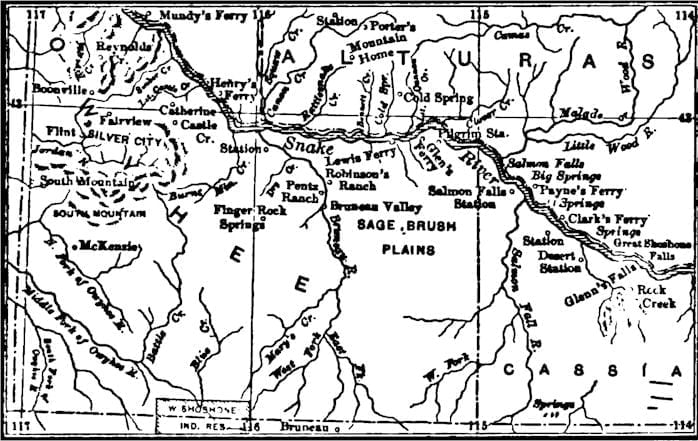
The mining districts of Owyhee were five in number. Carson district began on the summit of War Eagle Mountain, and ran west 8 miles, and north and south 15 miles. French district began on the summit of the same mountain, and ran easterly toward Snake River, and north and sooth about 12 miles. Steele district adjoined French, and was about 8 miles from Silver City. Flint district was 9 miles south of Silver City. Mammoth district was 12 miles southwest of the same place, and Wagontown district 7 miles northwest. South Mountain was 30 miles south of Silver City. The mineral characteristics of the several districts were cold and silver in the War Eagle and Florida mountains; geologically, War Eagle was granite and Florida porphyritic. In the Flint district were found refractory ores and tin; geologically, it was granitic and porphyritic, as was also Wagontown, which produced silver and milling ores. South Mountain produced argentiferous galena, its rocks being limestone, porphyry, and granite with some metamorphosed slates. Lithologically, the two extremes of the Owyhee region, War Eagle and South Mountain, were separated by a mass of basalt and lava. The gold veins ran almost due north and south; the silver veins, northwest and southeast. At the centennial exposition, 1876, medals were awarded to the gold ores from Golden Chariot and South Chariot, and silver ores from Home Resort and Leviathan; for silver-gold ores from Oro Fino; for lead bullion from South Mountain; and silver-lead ores from the Silver Chord mine.

Southwestern Idaho Map
In 1881 the depth to which Owyhee mines had been worked varied from l50 to l,500 feet. I am indebted to a series of articles by Gilbert Butler which appeared in the Silver City Avalanche, in 1881, for much knowledge of the condition and history of Idaho mines down to that period.
The Owyhee Treasury on Florida Mountain furnished ore, one hundred feet down, that yielded seventy-five cents a pound. A 'stringer' in the mine yielded nearly $46 to a pound of ore, worked in a common mortar. From 120 pounds was taken $2,344.80; but the ordinary milling ore was rated at $50 per ton. Several mines in the vicinity promised nearly equal riches. The bullion output for Owyhee County in 1881 was nearly $300,000. Silver State, June 24, 1881. Sold to the Varkoff Mining, Smelting and Milling Company were the mines Catlow, Graham Tuscarora, Venice, New York, Gazelle, Belcher, Mono, Black Warrior, New Dollar and Red Fox, aggregating 14,200 linear feet. Silver City Avalanche, May 7, 1881.
For many years it was known to prospectors that tho Wood River country contained large ledges of galena ores. The first lode was discovered by W. P. Callahan, while on his way to Montana, in 1864. Nothing was done until 1872, when Callahan returned and relocated it, naming it after himself. It was on tho main Wood River, 11 miles above the crossing of the Boise and Salmon City road. A little work was done on the vein annually, the ore being shipped to Salt Lake for smelting, at a great expense, where it sold in 1860 for $200 a ton. The second camp was 5 miles north of the road, and named after the discoverer, Frank Jacobs. Silver City Avalanche, March 13, 1880. The belligerent attitude of the Indians of southern Idaho, who knew that settlement followed mining, prevented the occupation of that region until after the subjugation of the Bannacks in 1878. During the summer of 1879-80 in an area of 60 miles square as many as 2,000 claims were taken up, the ore from which, shipped to Salt Lake, yielded on reduction from $100 to $500 per ton in silver. Several towns immediately sprang up. Bellevue had 250 houses at the end of the first seven months, and the Elkhorn mine had shipped $16,000 worth of ore, besides having left 150 tons. Rock from the Bullion mine assayed $11,000 per ton, and although not all showed equally rich, the yield of from $100 to $500 was common, making the belt in which the Bullion mine was situated, and which gave it its name, one of the richest as well as one of the most extensive in the world, being eighteen miles long, extending from Bellevue to Ketchum, and a part only of the silver-bearing region, which comprised between 4,000 and 5,000 square miles. The gross product of the Bullion mine in 1883 was $250,000.
The Bullion belt and district was the richest yet discovered. The geological formation was quartzite, slate, and porphyry. The ores were galena and carbonates, with antimony and copper, yielding sixty to eighty per cent of lead. On the east side of the river the best mineral was found in limestone, or limestone and granite. The ores were cube, leaf, and tine-grained galena and carbonates, yielding lead in about the same proportion as the Bullion belt, and silver at the rate of $100 to $300 per ton. Southwest from the Bullion belt was the Ornament Hill and Willow Creek district. The ledges in this district were immense in size, and in a granite belt, containing, besides lead and silver, antimony and gold. Again, on the Wood River Mountains, on the east side, was another belt of mines in calcareous shale, limestone, and quartzite, yielding from $50 to $100 per ton. The Ornament Hill mines, very rich in silver and bearing traces of gold, were the only free-milling ores in the whole silver region. The Mayflower mine, discovered in 1880, was sold to a Chicago company and consolidated with two others. It had shipped in 1883 three thousand tons of ore; the first thousand tons yielding $152,000, the second $144,000, and the third $276,000. This mine adjoined the Bullion. On the same lode were the Jay Gould, Saturn Group of four mines, Ophir-Durango group, and Highland Chief. This was the middle one of three lodes running northwest and southeast. On the western lode were the Mountain View, Red Elephant, O. K., and Point Lookout. On the eastern lode were the Coloradan, Fraction, Chicago, Bay State, Iris, Eureka, Idahoan, Parnell, and Pass. There were in 1883 four smelters at work on Wood River between Bellevue and Galena, two of forty tons capacity per day and two of sixty tons, producing together an average of fifty tons of bullion daily. Tho names of other mines favorably known in the early days of Wood River were the Star, Minnie Moore, Gladiator, Concordia, Idaho Democrat, Solid Muldoon, Overland, Homestake, Guy, and Mountain Belle, in the lower Wood River or Mineral Hill district.
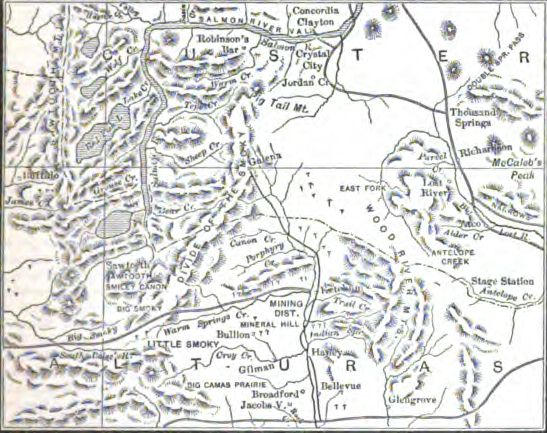
North of Mineral Hill district, which contained the above mentioned mines, was the Warm Springs district, containing many locations considered of great value; northwest of this, the Saw Tooth district; and west of it, the Little Smoky district - each rivaling the other in promising ledges. There were the Imperial, Oriental, Greenhorn, Perry, and Maud May; the Kelly group, comprising the West Fork, West Fork 2, Yellow Jacket, Black Hawk, and Big Beaver; the Moffit and Irvin group, comprising 18 locations, among which were the Ontario, Niagara, North Star, Sunday, and Black Horse. The Mountain Lily, owned by Lewis, produced copper-silver glance assaying 900 ounces to the ton. Wood River Miner, Aug. 12. 1681. The Elkhorn mine, 4 miles from Ketchum, also belonged to Lewis, and produced very valuable ores. On the east fork of Wood River were the North Star, American Eagle, Silver Fortune, Champion, Boss, Paymaster, Summit, Silver King. The Elkhorn was discovered by John Rasmussian, the North Star by William Jaikovski. In the same district were the Star Mountain group, consisting of the Ohio, Lulu, Hawkeye, Commodore, Bellevue, Star Mountain, Garfield, Amazon, Empire and Hancock. On Deer Creek were the Narrow Gauge N.G. No. 2, Banner, Kit Carson, Saturday Night and Monumental. The Little Smoky mines were at the head of Warm Springs Creek and assayed from 100 to 3,000 ounces smelting ore to the ton. Among them were the Climax and Carric Leonard

Wood River Mineral District Map
In the Upper Wood River or Galena district, in a formation of slate and lime with some porphyry, was another group of mines averaging from $175 to $200 to the ton of smelting ore. Among the locations in the Galena district were the Shamrock, Signal, Western Home, Adelaide, White Cloud, Gladiator, Accident, Little Chief, Big Chief, Eunice, Wood River, J. Marion Sims, Baltimore, Dinero, Grand View, Lawrence, Senate, Red Cloud, Independence, Wellington, Lefiathan, Highland Chief, Monarch, Our Girl, Clara Garfield and Serpent, the latter three being consolidated. These mines lay at an altitude of from 8,500 to 10,000 feet above sea level. In the Saw Tooth district, which was divided from Wood and Salmon Rivers by a high ridge called the Saw Tooth Mountains, in a granite formation, was a group of ledges bearing milling ores of high grade, but sufficiently refactory to require roasting, the yield of bullion being from 250 to 500 ounces to the ton. The most noted of the early Saw Tooth mines were the Pilgrim, Vienna, Columbia, Smiley's, Beaver, Beaver Extension, Lucky Boy, Scotia, Atlanta, Nellie, Sunbeam, and Naples. This district was discovered in July 1879, by L. Smiley, a Montana pioneer and former superintendent of Utah mines, with a party of half a dozen men from Challis. An assay of the ore led to the return of Smiley in 1879, with E. M. Wilson, J. F. Kinsley, J. B. Richy, O'Leary, and others. Smiley located the Emma, Wilson the Vienna, Kinsley the Alturas, and many others were prospected during the season. Silver City Avalanche, March 20, 1880.
Lying north of Salmon River, and directly north of the Galena distinct of Wood River, was the Yankee Fork district, discovered in 1870, but little worked before 1875, when the Charles Dickens gold-quartz lode was located by W. A. Norton, which paid $2,000 a ton. This renowned discovery was followed by the location of the Charles Wayne ledge by Curtis Estes, on Mount Estes, and a few months later by the location of the General Custer and Unknown on Mount Custer, by E. G. Dodge, J. R. Baxter, W. McKeen, and James Dodge. The Custer mine was in every respect a wonderful one. It was an immense ledge projected above the surface, requiring only quarrying instead of mining, and was as rich as it was large, and conveniently situated. It involved no outlay of capital; its face was good for a vast amount, which was easily extracted. The walls of this treasury had been nibble away for several hundred feet by the tooth of time, exposing the solid mass of wealth to whoever would come and take it. A tunnel was run into this ore body and a tramway constructed, which served to convey the ore to the mill, 1,300 feet down the mountain. All the works were so nearly automatic in arrangement as to require at the mine and mill only fifty-two men to perform every part of the labor. The average value of the ore per ton was $135. From Feb. to Nov. 1881, the owner sent to market $800,000 worth of bullion, half of which was profit. Other well-known mines of this district, which is high and well wooded, were the Montana, Bay Horse, Rams Horn, Skylark, Silver Wing, Utah Boy, Bull-of- the-Woods, Cuba, Juliet, River View, Post Boy, Hood, and Beardsley. The Montana produced from 700 to 1,000 ounces of bullion to the ton. Wood River Miner, July 20, 1881. The total value of 130,008 pounds of Montana ore, in 23 different lots, was $73,170.46. Yankee Fork Herald, Sept. 15, 1881. They shipped and sold 40 tons of ore which netted them $53,000. They are down 145 feet, and have a 165-foot level in $500 ore, 12 feet thick. Shoup's Idaho Ter. MS., 9. The Montana mine was discovered by James Hooper, A. W. Faulkner, Duncan Cameron, Amos Franklin, and D. B. Varney. Bonanza City Yankee Fork Herald, July 24, 1879. The Ram's Horn was the longest vein known in the history of modem mining. There were 24 claims 1,500 feet long located on it. It assayed 800 ounces in silver per ton. Other mines on Mount Estes were the Tonto, Pioneer, Cynosure. Snow Bird, Hidden Treasure, General Miles, Colorado, Indiana, Manhattan, Golden Gate, North Star, Ophir, Polar Star, Last Chance, Lake, Snowshoe, King Idaho, Goldstone, and Bobtail. A rival to the Custer was the Montana, & gold mine on Mount Estes, near which Bonanza City was laid out in 1877. The vein was six and a half feet wide, and the rock fairly welded together with gold.
Northwest of Yankee Fork district was the mining region of the middle fork of the Salmon, in which were a number of large ledges, on which locations were made in 1881. One mine, the Galena, assayed 190 ounces in silver to the ton; and the Northern Pacific, discovered by E. Miller and Harry Smith, assayed even richer. The Greyhound, 13 miles northwest of Cape Horn, on a high mountain, was on a 6-foot vein containing antimonial silver and chloride. Parallel to it, 60 feet north, was the White Dog and 60 feet north of that the Lake View, 4 and 6 feet in width, and containing ore similar to the Greyhound. The Patrick Henry vein was 10 feet wide at the surface. The Colonel Bernard, Rufus, and Blue Grouse were of this group.
The Blue Wing silver district, 25 miles east of the Yankee Fork district; Texas Creek silver district, 75 miles northwest of the town of Camas in the northern part of Oneida County; Cariboo gold district in the eastern part of the same county; Squaw Creek silver district, 40 miles northwest of Boise; Weiser gold, silver, and copper district on Weiser River; Lava Creek silver district, 70 miles west of Blackfoot in Oneida County, and Cariboo gold district, 75 miles northeast of Blackfoot - all contained mines of a high grade of ores.
The Cariboo district, when first discovered in 1870 by F. S. Babcock and S. McCoy, was mined as a placer district, and yielded fur ten years $250,000 annually. The auriferous gravels were accumulated in what was known as Bilk gulch, which lies immediately under the summit of Cariboo Mountain, and consisted of abraded volcanic and sedimentary materials largely mixed with the red earth derived from the softer shales. The placers were distributed along Bilk and Iowa gulches, to the confluence with McCoy Creek, a distance of three miles, and on several small creeks and gulches in the neighborhood. Quartz was discovered in this district in 1874 by Daniel Griffiths and J. Thompson, who located the Oneida, a mine very rich in spots, and of good average yield; $35,000 was refused for the mine in 1880. In 1877 John Robinson discovered a porphyry belt on the north slope of the mountain, in which he located the Robinson mine at the head of Bilk gulch. The Austin, on the same belt, was developed along with the Robinson. These mines had a very large outcrop, extending more than 1,000 feet without a break, and having a width of 25 feet. Within 20 feet of this ledge was another parallel vein of great richness, and the intermediate porphyry gold bearing.
On the southern slope of the mountain is another belt of porphyry, on which were the Northern Light, Virginia, Orphan Boy, Paymaster, and other mines. In the district were about eighty locations, carrying free gold from $10 to $1,200 per ton. Timber was plentiful in the district, and the ledges pronounced by experts to be true fissure veins. Other mines in Cariboo district were the Peterson, Nabob, Mountain Chief, Nealson, Oneida South, Northern Light Extension, N. S. Davenport, and Silver Star, more or less developed. Altitude over nine thousand feet. These discoveries conclusively proved Idaho a mining country. From the eastern to the western boundary, taking a wide swath through the central portion of the territory, the billowy swells and rugged heights were found full of minerals. Add to this central territory the country on the Clearwater, the lately discovered Coeur d'Alene district, and the Owyhee region, there is but little left which is not metalliferous. It has long been known that gold existed in the Coeur d'Alene region. A rediscovery was made in 1883, when the usual rush took place. The first eager fold-seekers pushed into the mines, dragging their outfits on toboggans (a kind of hand-sled, sometimes drawn by dogs), over several feet of snow. Kagle City started up with plenty of business; a sawmill was erected at an enormous expense by Hood & Co. and a newspaper was started, called the Nugget by C. F. McGlashan and W. E. Edwards. Considerable coarse gold was found and some valuable nuggets, but so far there seems nothing to justify any excitement. S. F. Call, March 31, 1884.
The placer mines of Idaho, as first discovered, were once supposed to be worked out to a degree to warrant only Chinese laborers on the ground. But the newer methods of bed-rock flumes and hydraulic apparatus have compelled the placers of Boise Basin to yield a new harvest, which, if not equal to tho first, is richly remunerative. Ben. Willson, the 'placer king,' had 50 miles of ditches on Grimes Creek, costing $150,000. Elliot's Hist, Idaho, 175. The Salmon River placers, in Lemhi County, which gave rise to Salmon City in 1866, paid from have to seventeen dollars a day to the hand. Working them by the old methods they were practically exhausted in five years, but by the new method the same yield was obtained as at first. Shoup's Idaho Terr., MS., 4. Ward and Napius discovered these mines. Loon Creek was discovered by Nathan Smith, a Cal. pioneer. In 1862 he came to Idaho, and was one of the discoverers of the Florence diggings. In 1869 he prospected Loon Creek, which ho named from a bird of that species found on the stream. A thousand men were mining there at one time, and the town of Ore Grande was built up as a centre of trade. When the white men had taken off the richest deposits, the Chinese purchased the ground, and were working it, when in the winter of 1878-9 the Sheep Eater Indians made a descent upon them and swept away the whole camp, carrying off the property of the slaughtered Mongolians to their hiding-places in the mountains, from which Capt. Bernard had so much trouble to dislodge them the following summer. Bonanza City Yankee Fork Herald, Oct. 18, 1884.
2. Mudbarville, Spring Town, Waterburg, and Dry Town were their euphonious appellations.
3. The deposits were of various depths, the upper bed being from 25 to 50 feet deep, and lying on a hard-pan of pscudo-morphous rock from a few inches to throe feet in thickness, beneath which is another deposit generally richer than the first. Or, in some places, the hardpan is represented by a soft cement, found at a depth of from three to nine feet. The cost of opening a claim, and putting it in good order for working is about $5,000; and the receipts from it from $10 to $.30 a day. Careful estimates, based on actual yields and measurements of ground, give the amount of gold obtained from an acre of ground as being from $5,000 to $10,000, at the rate of from $20 to $100 a day, with the gold-saving machines, which are furnished with an amalgamator.
The greatest hindrance to be overcome was the hoisting of water for mining purposes from the bed of the river, where there are no streams entering. The most feasible solution of this difficulty would be the construction of a canal taking water out of the river above, and carrying it to all the mines below. This device, besides making mining a permanent business on Snake River, would redeem extensive tracts of land which only need water for irrigation to change them from sagebrush wildernesses to gardens of delicious fruits and vegetables, or fields of golden grain. The principal claims were on tho upper Snake River, at Cariboo, and above in Wyoming, and also at Black Canon, where the Idaho Snake River Gold Mining Company had some rich ground, $100 a day to the man having been taken out with a rocker, a copper plate, and a bottle of cyanide of potassium. The average yield was $25 a day over 80 acres of auriferous gravel. The Lawrence and Holmes Company had a claim near Blackfoot paying from $19 to $50 a day to the man. Lane & Co., near the mouth of Raft River, obtained $25 a day to the man; and Argyle & Co., near Fall Creek, owned placers that paid $100 a day to the man. Other rich placers were mined in the vicinity of Salmon Falls. The best seasons for working, in reference to the stage of water in the river and the state of the weather, was from the 1st of March to the middle of May, and from the 1st of September to the 1st of November.
4. That every county but four should be quoted as gold-producing shows a very general diffusion of precious metals. The proportion was as follows: Alturas $945,000; Boise $310,000; Cassia $25,000; Cutter $1,250,000; Idaho $240,000; Lemhi $210,000; Nez Perce $5,000; Oneida $35,000; Owyhee $430,000; Shoshone $50,000.
5. Sec Strahorn's Idaho Ter. 61. The Virginia and Helena Post of Jan. 15, 1867, makes the output of the Idaho mines in 1866 $11,000,000. When Ross Browne made his report to the government on the gold yield of the Pacific states and territories he omitted Idaho, which had produced from $10,000,000 to $20,000,000 annually for 4 years. Silver City Avalanche, Feb. 9, 1867.
6. This salt analyzed yields, chloride of sodium, 97.79; sulphate of soda, 1.54; chloride of calcium, .67; sulphate magnesia, a trace. Strahorn's Idaho Ter., 63.
7. No great accuracy can be attained. Gilbert Butler divides the area of Idaho as follows: Rich agricultural lands 5,000,000 acres; that may be reclaimed by irrigation 10,000,000; grazing lands 20,000,000; timber lands 10,000,000; mineral lands 10,000,000; lakes and volcanic overflow 3,328,100. Silver City Idaho Avalanche, June 29, 1681.
Source: Bancroft Works, Volume 31, History Of Washington, Idaho, and Montana, 1845-1889, Hubert H. Bancroft, 1890. The History Company, Publishers, San Francisco