
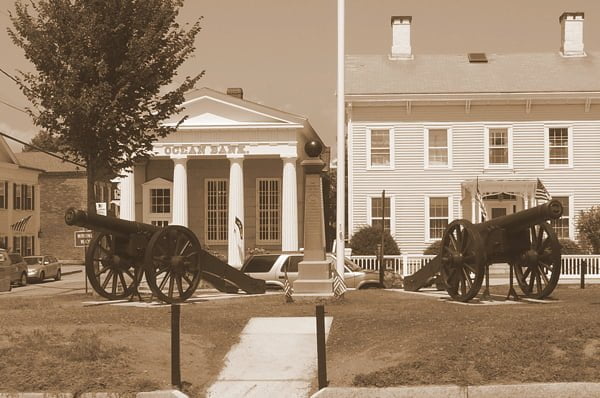
The repulse of a British squadron, at Stonington, by a few undisciplined volunteers, having only two effective guns, imperfectly protected by a low earth-work,–and this repulse accomplished without the loss of a single life,–was not the least glorious achievement of the War of 1812-14. The fiftieth anniversary of the action is close at hand. Few who witnessed,–only three or four who participated in it, survive. In this day of great events, when armies and navies are gathered on a scale of magnitude of which our fathers never dreamed,–when from the heights of modern science, we look back to the guns and the ships of war of the last generation, as to the toys of childhood,–when we are in the very crisis of a war greater in itself, and waged for a grander issue, than the world has hitherto witnessed,–it is not surprising that so few find leisure or inclination to look from the present to the past, or to recall to memory the heroism of their fathers.
Yet there are some for whom the story of “The Attack” has not yet lost its interest. They learned it in childhood, from the lips of those who shared the perils and the glory of the action. They grew up, amid associations which could hardly fail to kindle an honest pride in their birth-place. To them, the “Tenth of August” was not merely a school-holiday, but an anniversary entitled to equal honors with Independence Day itself. They have helped draw the “old Eighteens,” through the streets of the Borough, in solemn procession to the site of the demolished Battery. They have seen the cherished Flag–pierced and torn in a dozen places by the enemy’s shot,–float again from the flag-staff, in honor of the day: and some of them were standing by when “Old Hickory” bared his head to salute it, and bade the citizens preserve, with all care, this precious memorial of the courage and patriotism of their townsmen.
It is for these–the companions of my own school-days,–and in honor of the volunteers of 1814, that I have reproduced some of the contemporary accounts of the attack and defense of Stonington. The first (pp. 9-20) was written by Col. Samuel Green, the publisher of the “Connecticut Gazette”, who visited the Borough during the action, and obtained his knowledge of facts of which he was not an eye-witness, from the actors themselves and from official sources. This account, printed in the “Gazette”, of August 17th, was copied into many of the newspapers in the northern states, and appeared in Niles’s “Weekly Register”, November 5th, with some additional particulars.
Following this, are copies of the muster-roll of the Borough company of militia; the official account furnished for publication by the magistrates, warden and burgesses (pp. 24-32); and a letter from Capt. Amos Palmer, chairman of the citizens’ committee of defense, to Mr. Crawford, secretary of war, containing a concise narrative of the action. Philip Freneau’s “Battle of Stonington”,–though not of the highest order of lyric excellence,–challenges favorable comparison with many of the loyal effusions which have found their way to the public, during the present war; and will be welcomed as an old friend by some who value patriotism more than poetry.
- Record Of The Extraordinary Attack On Stonington
- Names Of Volunteers, From The Connecticut Gazette
- Muster-Roll Of Capt. Wm. Potter’s Company
- Account Of The Attack, Published By The Borough Authorities
- Letter From Capt. Amos Palmer To The Secretary Of War
- Extract From Gen. Root’s Speech In Congress, 1817
- The Battle Of Stonington, By Philip Freneau
- Celebrations Of The Battle of Stonington
- Defense of Stonington Notes
- Letters Of Commodore Hardy
